Welcome back. In our previous lesson, we established a mental model for C++ memory, distinguishing between the fast, automatic stack and the flexible, manual heap. Now, we'll build directly on that foundation by examining what happens when an object is brought to life within that memory.
This lesson focuses on the complete lifecycle of a C++ object: its birth (construction), its ability to be cloned (copying), and its eventual demise (destruction). For a senior engineer, a deep understanding of this lifecycle is non-negotiable. It's the key to writing correct, efficient, and resource-safe C++, and it's a topic that interviewers frequently probe to differentiate experienced candidates from junior ones. Our goal is to describe the precise sequence of events at each stage of an object's life.
The Four Stages of Object Construction
When you declare an object like MyClass obj;, you kick off a well-defined, four-stage process. This isn't just about the code inside your constructor's curly braces; several critical steps happen before your constructor body even begins to execute.

Let's break down these stages:
-
Memory Allocation: As we discussed, memory is first reserved for the object, either on the stack or on the heap. At this point, it's just a raw, uninitialized block of memory.
-
Member Variable Construction: This is a crucial and often misunderstood step. Before the constructor body runs, C++ initializes all of the class's member variables. If the class inherits from a base class, the base class's constructor is also called at this stage.
-
Constructor Body Execution: Only after all base classes and member variables have been constructed does the code inside your constructor's body
{...}execute. -
Object Is Ready: The object is now fully formed and ready to be used.
The most important takeaway here is the distinction between stages 2 and 3. Failing to appreciate this can lead to inefficient and sometimes incorrect code.
Initialization vs. Assignment
Let's focus on the difference between initializing a member in a member initializer list versus assigning it a value inside the constructor body.
- Member Initializer List: This syntax allows you to directly control stage 2 (Member Variable Construction). It happens after the constructor's parameters but before its body.
- Assignment in Constructor Body: This happens during stage 3 (Constructor Body Execution).
Consider this class:
class Entity {
    std::string m_Name;
public:
    // Option 1: Using a member initializer list
    Entity() : m_Name("Unknown") {}

    // Option 2: Using assignment in the body
    Entity() {
        m_Name = "Unknown";
    }
};
These two constructors might look functionally identical, but they are not.
- Option 1 is initialization.
m_Nameis constructed once, directly with the value "Unknown". - Option 2 is default construction followed by assignment.
m_Nameis first default-constructed (creating an empty string), and then the assignment operator=is called to give it the value "Unknown". This is less efficient.
For primitive types like int or double, the performance difference is negligible. But for class types, especially complex ones, the cost of constructing an object only to immediately overwrite it can be significant. Furthermore, const members, reference members, and members of a class type that have no default constructor must be initialized in the member initializer list.
The following video from The Cherno provides an excellent demonstration of this exact point, showing why initializer lists are not just a stylistic choice but a critical tool for performance and correctness.
Member Initializer Lists in C++ (Constructor Initializer List)
This video visually contrasts member initializer lists with assignment in the constructor body, clearly demonstrating the performance implications.
First, watch the demonstration of the initializer list syntax. Then, pay close attention to the section from explaining the difference. The example with the Example class clearly shows two separate object creations when using assignment, which is the core takeaway.
For a more detailed written explanation, the C++ Core Guidelines FAQ is an authoritative source.
This section of the C++ FAQ provides a definitive guide on why and how to use member initializer lists.
Please read the sections titled "Should my constructors use 'initialization lists' or 'assignment'?" and "How should initializers be ordered...?". The first part reinforces the efficiency argument, while the second explains a critical rule: members are initialized in the order they are declared in the class, not the order they appear in the initializer list.
The Full Order: Inheritance, Members, and Body
When inheritance is involved, the construction order is precise and hierarchical:
- Base class constructors are called. If there are multiple base classes, they are constructed in the order they are listed in the class declaration.
- Member variables are initialized. They are initialized in the order they are declared within the class.
- The derived class's constructor body is executed.
The following video clearly visualizes this sequence.
C++ Inheritance: constructors and destructors in base and derived classes [3]
This tutorial from Professor Hank Stalica shows the exact sequence of constructor and destructor calls in an inheritance hierarchy.
Watch the first segment from the beginning to see the default construction and destruction order. Then, watch the next part from how to explicitly call a specific base class constructor from the derived class's initializer list.
Object Copying and The Rule of Three
An object's life isn't just about creation and destruction; it also involves being copied. What happens when you write MyClass obj2 = obj1;? The compiler invokes a special function called the copy constructor. Similarly, obj2 = obj1; on pre-existing objects invokes the copy assignment operator.
By default, the compiler generates these for you. They perform a shallow copy, which means they copy each member variable bit for bit. This is fine for simple data, but it's disastrous for classes that manage resources, like a raw pointer to heap memory.
This resource contains a classic example of a Handle class that demonstrates the "double free" problem caused by a shallow copy.
Read the section titled "Why doesn’t my constructor work right?" down to the comment // leads to disaster!. This shows exactly what goes wrong when two objects end up with pointers to the same memory, which is then deleted twice.
This problem leads to one of the most fundamental principles of C++ class design: The Rule of Three.
The Rule of Three states: If a class requires a user-defined destructor, copy constructor, or copy assignment operator, it almost certainly requires all three.
The logic is simple: if you need to write a custom destructor, it's because you're managing a resource (like the memory pointed to by p in the Handle class). If you're managing a resource, the default shallow-copy behavior is wrong, so you must also provide a custom copy constructor and copy assignment operator to perform a deep copy (allocating new memory for the copy).
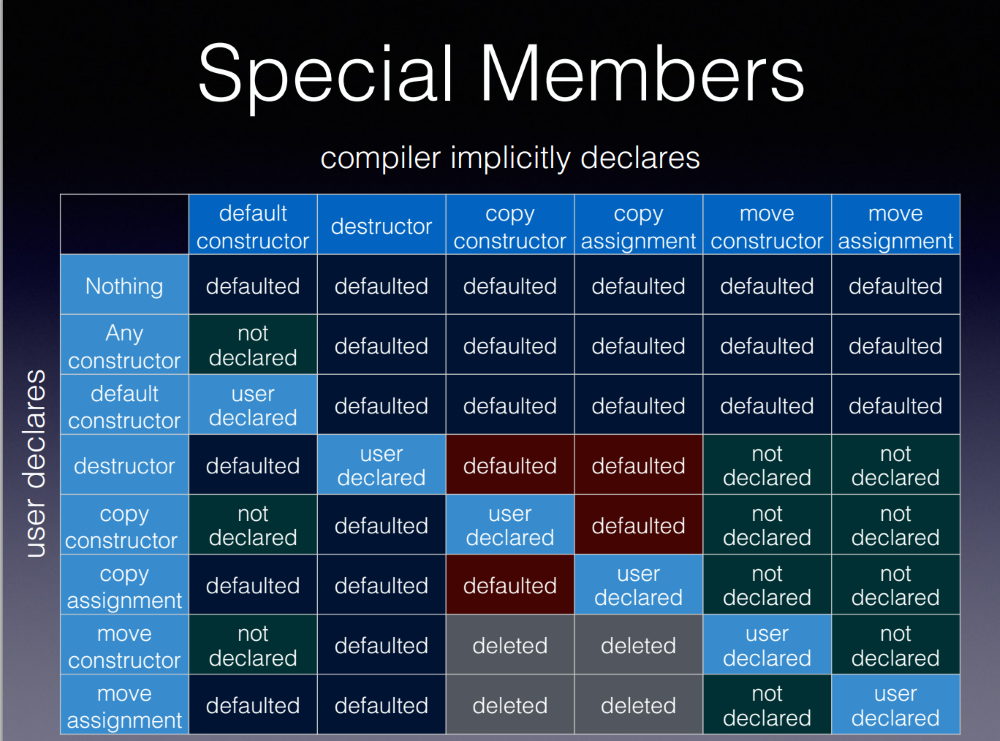
This table is an incredibly useful summary for interviews. It shows how the compiler's implicit generation of special member functions changes based on what you, the user, declare.
Destruction: The Reverse of Construction
Destruction is the final phase of the object's lifecycle. It is, quite simply, the exact reverse of construction:
- The destructor body is executed.
- Member variables are destroyed in the reverse order of their declaration.
- Base class destructors are called in the reverse order of inheritance.
The video by Professor Stalica you watched earlier also demonstrates this reverse-order destruction. The LIFO (Last-In, First-Out) nature of construction and destruction is a reliable pattern you can count on.
Conclusion
We've now traced the entire lifecycle of a C++ object. Let's consolidate the key takeaways for your interview preparation:
- Construction Order: The sequence is always: Base classes first, then member variables in declaration order, and finally the constructor body.
- Initializer Lists: Always prefer member initializer lists over assignment in the constructor body. It is more efficient and sometimes required for
constor reference members. - Shallow vs. Deep Copy: The default copy behavior is shallow. For classes that manage resources (like raw pointers, file handles, etc.), you must implement deep copy semantics to avoid errors like double-free.
- The Rule of Three: This is your guiding principle for resource-managing classes. If you write a destructor, you almost certainly need to write a copy constructor and copy assignment operator as well.
- Destruction Order: Destruction happens in the precise reverse order of construction.
In our next lesson, we'll make this concrete by fully implementing the Rule of Three for a sample class, turning today's theory into practical, compilable code.