Introduction
In our last lesson, we established a clear correspondence between the distance in semitones on a piano roll and a specific interval name. For example, you learned that 7 semitones is a "Perfect Fifth" and 4 semitones is a "Major Third". However, this system has a crucial ambiguity. An interval of 6 semitones, for instance, is sometimes called a "Tritone," but can also be labeled an "Augmented Fourth" or a "Diminished Fifth." Why do these different names exist for intervals that sound identical on a piano?
This lesson will resolve that ambiguity by introducing the complete, two-part classification system for intervals. You will learn that every interval is defined by both its Number (its size on the musical staff) and its Quality (its precise size in semitones, described by terms like perfect, major, minor, augmented, and diminished). Our goal is to master this system, enabling you to precisely name any interval and understand why its spelling matters.
The Two-Part Naming Convention: Number and Quality
The full name of an interval, such as "Major Third," consists of two components:
- The Number: This indicates the generic size of the interval, determined by counting the number of letter names from the lower note to the upper note, inclusively. This is also called the diatonic number.
- The Quality: This is a modifier that specifies the precise size of the interval. The main qualities are perfect, major, minor, augmented, and diminished.
Let's start by focusing on the first, and most fundamental, part: the interval number.
How to Identify Musical Intervals (Music Theory)
The video "How to Identify Musical Intervals" by Saher Galt provides a very clear, step-by-step procedure. We'll use it to break down the naming process.
Watch the segment on identifying the interval number. The key concept here is that the number is based on "pure alphabetical distance," ignoring any sharps or flats. For example, from G to E, you count G-A-B-C-D-E, making it a sixth, regardless of whether the notes are G-sharp or E-flat.
This concept of counting letter names is the reason why C to F# and C to G♭, despite spanning the same 6 semitones, have different names.
- C to F#: Counting letters gives C-D-E-F. This is a fourth.
- C to G♭: Counting letters gives C-D-E-F-G. This is a fifth.
The quality (Augmented vs. Diminished) then specifies the precise semitone count, which we will explore next.
The Origin of Interval Qualities
Before learning the rules for assigning qualities, it's valuable to understand where these terms come from. Given your background in physics, you'll appreciate that these names are not arbitrary; they have roots in the physics of sound and the history of tuning systems.
Historically, intervals were categorized by their perceived purity or consonance.
- Perfect Intervals: The unison, fourth, fifth, and octave were considered "perfect" because their frequency ratios are based on the simplest of integers (1:1, 4:3, 3:2, 2:1), leading to maximum overlap in their harmonic series and a pure, stable sound.
- Imperfect Intervals: The seconds, thirds, sixths, and sevenths were considered "imperfect." They have more complex frequency ratios, giving them more harmonic "character" or "bite."
Interval Terminology FINALLY EXPLAINED -- Minor, Major, Perfect, Imperfect, Augmented, Diminished
The video "Interval Terminology FINALLY EXPLAINED" by Zero To Piano gives an excellent historical overview of this distinction.
Watch the opening segment explaining the historical separation of intervals into "perfect" and "imperfect" categories based on their perceived purity and harmonic impact.
The terms augmented (widened) and diminished (narrowed) arose from the imperfections of early tuning systems. In a system like Pythagorean tuning, which is built by stacking pure 3:2 fifths, you find that stacking twelve fifths doesn't perfectly align with seven octaves. This discrepancy (the Pythagorean comma) means that a note like F♯ (reached by stacking fifths upwards from C) and G♭ (reached by stacking fifths downwards from C) are not the same pitch.
The interval from C to F♯ in this system is an augmented fourth, while the interval from C to G♭ is a diminished fifth. They are two distinct intervals with slightly different frequency ratios. In modern 12-tone equal temperament, we compromise and make these two notes enharmonically equivalent, but we retain the distinct names to reflect their different theoretical origins and musical function.
[PDF] The physics of musical scales: Theory and experiment
This paper from the American Journal of Physics delves into the mathematics of tuning systems. It provides a rigorous explanation for the origin of these interval names.
Please read the section on "THE PYTHAGOREAN SCALE". Focus on the paragraph that begins "Going up an equal temperament fifth". This passage explains how the Pythagorean comma leads to a distinction between the augmented fourth and the diminished fifth, which are different intervals in this tuning system. This is the physical and mathematical origin of the naming ambiguity we are seeking to resolve.
A Systematic Framework for Qualities
Now that we understand the origins, let's establish a practical system for assigning qualities in our standard 12-TET system. We'll use two different, complementary models.
Model 1: The Two Classes of Intervals
As the historical context suggests, we handle the perfect and imperfect intervals differently. This method relies on knowing the major scale of the lower note.
How to Identify Musical Intervals (Music Theory)
We return to Saher Galt's video for a methodical walkthrough of assigning qualities.
First, watch the section on perfect intervals (unisons, fourths, fifths, octaves). The rule is: if the upper note is in the major scale of the lower note, the interval is perfect. If it's a semitone higher, it's augmented; a semitone lower, it's diminished. Next, watch the explanation for major and minor intervals (seconds, thirds, sixths, sevenths). The rule is similar: if the upper note is in the major scale of the lower note, the interval is major. If it's a semitone lower, it's minor. If it's a semitone higher than major, it's augmented. Finally, watch the full recap to see the entire two-step process (Number then Quality) put into practice.
Model 2: The Interval "Ladder"
A more abstract way to conceptualize this is to think of interval qualities as rungs on a ladder, where each step is one semitone.

This model helps clarify the relationships:
- For imperfect intervals (2, 3, 6, 7), there are four main states: Diminished, Minor, Major, and Augmented.
- For perfect intervals (1, 4, 5, 8), the natural state is in the middle. They can only be Diminished (one semitone smaller) or Augmented (one semitone larger). They are never called "major" or "minor."
Interval Terminology FINALLY EXPLAINED -- Minor, Major, Perfect, Imperfect, Augmented, Diminished
The Zero To Piano video explains this modification process very clearly.
Watch the segments on how to augment and diminish perfect intervals and then how this system is expanded for imperfect intervals to include minor and major, creating the four-step "ladder".
Synthesis: Putting It All Together
We can now combine these concepts into a definitive procedure. To name any interval:
- Determine the Number: Count the letter names from the lower to the upper note, inclusively (e.g., A → C is A-B-C, a third).
- Determine the Quality: Count the semitones and compare this to the "default" interval (perfect or major).
Let's revisit our tritone example: an interval of 6 semitones.
-
Case 1: C to F♯
- Number: C-D-E-F → A fourth.
- Quality: The default perfect fourth (C-F) is 5 semitones. C-F♯ is 6 semitones, which is one semitone wider. Therefore, the quality is Augmented.
- Full Name: Augmented Fourth (A4).
-
Case 2: C to G♭
- Number: C-D-E-F-G → A fifth.
- Quality: The default perfect fifth (C-G) is 7 semitones. C-G♭ is 6 semitones, which is one semitone narrower. Therefore, the quality is Diminished.
- Full Name: Diminished Fifth (d5).
This demonstrates that the spelling of the notes is not merely a typographical choice; it is essential for defining the interval's identity.
The Wikipedia article on musical intervals provides a comprehensive textual reference for these concepts.
Read the sections titled "Number" and "Quality", which cover the definitions of Perfect, Major, Minor, Augmented, and Diminished intervals. Then, study the "Example" section carefully, as it provides a clear, tabulated breakdown of how intervals spanning 6 semitones can have different names based on their spelling.
Reference Chart
The following chart summarizes all the standard intervals within an octave, showing their semitone distance (Δ) from the root note. This serves as a complete reference for the system you've just learned.
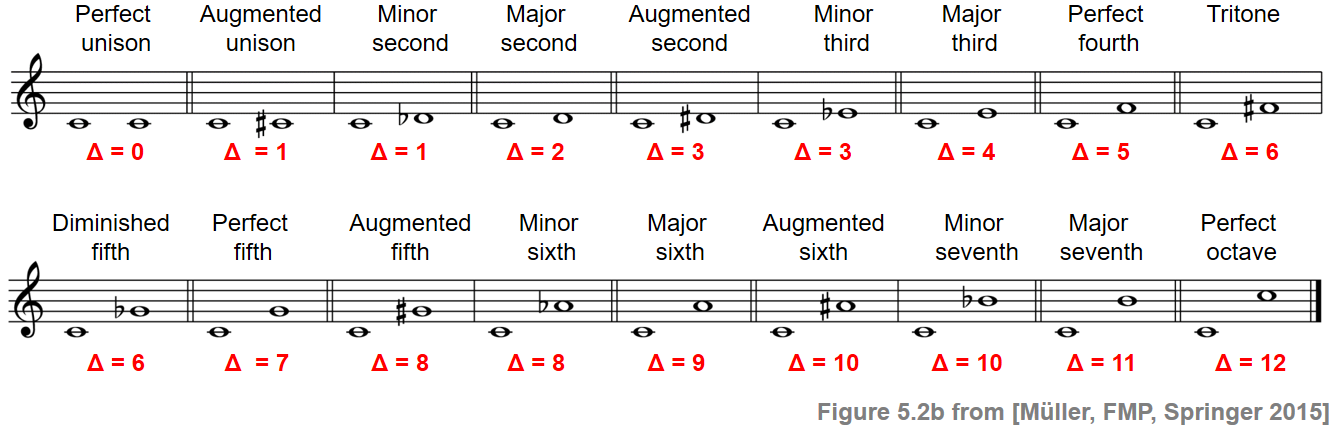
This chart visualizes the concepts we've discussed. For instance, you can see that the augmented fourth (C-F♯) and the diminished fifth (C-G♭) both have Δ=6, but occupy a different number of staff positions, confirming their different interval numbers.
Conclusion
In this lesson, you have deconstructed the naming system of musical intervals, moving beyond simple semitone counting to a more precise and descriptive framework.
Key takeaways:
- An interval's name has two parts: its Number (diatonic distance, from counting letters) and its Quality (its precise size, e.g., major, minor, perfect).
- The terms perfect, major, minor, augmented, and diminished describe the interval's quality relative to a default state, which is rooted in the physics of tuning and consonance.
- Intervals are grouped into two classes: Perfect (1, 4, 5, 8) and Major/Minor (2, 3, 6, 7).
- The spelling of a note (e.g., F♯ vs. G♭) is critical as it determines the interval's number, and therefore its correct name. An augmented fourth and a diminished fifth sound the same in isolation but have different theoretical identities.
You are now equipped to analyze and label the building blocks of melody and harmony with precision. In the next lesson, we will revisit the concept of consonance and dissonance, using your new classification skills to rank intervals by their perceived tension and explore how this is used to create emotional impact in music.