Introduction
In our last session, you began training your ear to recognize the distinct sonic character of key intervals. We connected the "happy" sound of a major third and the "powerful" sound of a perfect fifth to their simple frequency ratios. Today, we'll delve into a concept that reveals the elegant symmetry hidden within the interval system: inversion.
This lesson will demonstrate how intervals are not isolated entities but exist in complementary pairs. Understanding inversion is like learning a fundamental operation in a mathematical system; it simplifies complexity and reveals underlying structure. For you as a producer, it is a powerful tool for generating new melodic and harmonic ideas, such as creating compelling basslines that move in contrary motion to a lead melody. We will explore inversion from three perspectives: the simple procedural rules, the physical basis in frequency ratios, and the mathematical framework of modular arithmetic.
What is Interval Inversion?
At its most basic, inverting an interval means flipping its notes. If you have an interval from a lower note to a higher note, the inversion is created by moving the lower note up an octave, placing it above the original higher note.
For example, take the interval C up to G. This is a perfect fifth. If we move the C up an octave, we now have the interval G up to C. This new interval is a perfect fourth. The perfect fifth and perfect fourth are inversions of each other.
This concept is especially useful for understanding and calculating descending intervals, which are crucial for writing basslines and melodies that move downwards.
Descending Intervals and Interval Inversions - Intervals Made Easy (Part 5)
The video "Descending Intervals and Interval Inversions" by Gracie Terzian provides an excellent visual and aural introduction to this idea.
First, watch the section from the beginning to understand why we need a system for handling descending intervals. Then, watch the next segment from the introduction to inversions, where she introduces the visual concept of "opposite" intervals and the "rule of nine."
The Rules of Inversion
As you just saw, there are clear and simple rules for determining an interval's inversion. The process involves transforming both the interval's size (the number) and its quality (the descriptive term).
1. Inverting the Size: The "Rule of Nine"
When an interval is inverted, the sum of the original and inverted interval numbers is always nine.
- A 2nd inverts to a 7th (2 + 7 = 9)
- A 3rd inverts to a 6th (3 + 6 = 9)
- A 4th inverts to a 5th (4 + 5 = 9)
Unisons (1) and octaves (8) are also inversions of each other (1 + 8 = 9).
2. Inverting the Quality
The quality of the interval also transforms according to a predictable pattern:
- Perfect intervals invert to Perfect intervals.
- Major intervals invert to Minor intervals (and vice versa).
- Augmented intervals invert to Diminished intervals (and vice versa).
Let's combine these rules. If we have a Major 3rd, its inversion will be a Minor 6th. (Major -> Minor, 3rd -> 6th).
For a concise, formal summary of these rules, watch this section from Dr. Kati Meyer's video, "Intervals and Inversions."
Watch the segment from the definition of inversion. Pay close attention to her summary of how both size and quality change.
The Scientific "Why": Physics and Mathematics of Inversion
These rules are convenient, but your background in physics and mathematics equips you to understand them at a much deeper level.
The Physics: Division of Ratios
In our first module, we defined intervals as frequency ratios. An octave has a ratio of 2/1. Inversion can be understood physically as "subtracting" an interval from the octave. Because our perception of pitch is logarithmic, this "subtraction" is performed by dividing the frequency ratios.
Let's invert a Perfect Fifth (P5), which has a just ratio of 3/2:
The resulting ratio, 4/3, is the just ratio for a Perfect Fourth (P4). This physical principle perfectly explains why a fifth inverts to a fourth and why both remain "perfect."
Now consider a Major Third (M3), with a just ratio of 5/4:
The ratio 8/5 corresponds to a Minor Sixth (m6). This demonstrates the physical basis for the Major-to-Minor quality transformation.
1 physical acoustics of tuning systems - Peter Frazer
This article by Peter Frazer formalizes the concept of inversion as a division of ratios.
Read section 1.8, "Inversion of an Interval". This section directly explains the process of dividing the octave by the fifth to yield the fourth.
The Mathematics: Modular Arithmetic
We can also model the 12-tone system with modular arithmetic, which provides an elegant and rigorous way to describe inversion. Let's map the 12 pitches to the integers from 0 to 11 (the set ), where C=0, C#=1, D=2, and so on.
An interval is simply the number of semitones between two pitches. A Major 3rd (like C to E) is an interval of 4 semitones. A Perfect 5th (C to G) is 7 semitones.
In this system, inversion of an interval is simply its additive inverse, calculated as:
Let's apply this:
- Inverting a Perfect Fifth (7 semitones): semitones. An interval of 5 semitones is a Perfect Fourth.
- Inverting a Major Third (4 semitones): semitones. An interval of 8 semitones is a Minor Sixth.
This mathematical model confirms the "Rule of Nine" is a musical interpretation of the fact that the semitone counts of an interval and its inversion sum to 12 (the octave). For example, a 3rd is either 3 or 4 semitones, and a 6th is 8 or 9. In the case of a M3 (4 semitones) and m6 (8 semitones), 4 + 8 = 12.
For a deeper look at this mathematical approach, you can explore its application in twelve-tone serialism, a compositional technique developed by Arnold Schoenberg.
[PDF] The Mathematics of Twelve Tone Music
This paper applies these mathematical concepts to atonal music. While the broader topic is advanced, the definition of the inversion operation is highly relevant.
Focus on the section that begins with the description of Inversion. The formula provided, [12 - (Pi - P1) + P1] (mod12), is a formal way of stating that each interval from the starting note (P1) is inverted. For our purposes, if we set the starting note P1 to 0, the formula for inverting a pitch Pi simplifies to (12 - Pi) mod 12, exactly the operation we discussed.
As a brief aside, the paper goes on to show that the operations of Prime (Identity), Retrograde (reversing order), Inversion, and Retrograde-Inversion form a mathematical group known as the Klein four-group. This is a beautiful example of the deep structural symmetries in music that can be described with formal mathematics.
Practical Exercise: Inversion in the DAW
Let's apply this theory. A common use of inversion is to create contrary motion, where two melodic lines move in opposite directions. This adds interest and independence to the parts.
The image below shows a simple melodic line programmed in Ableton Live's piano roll.
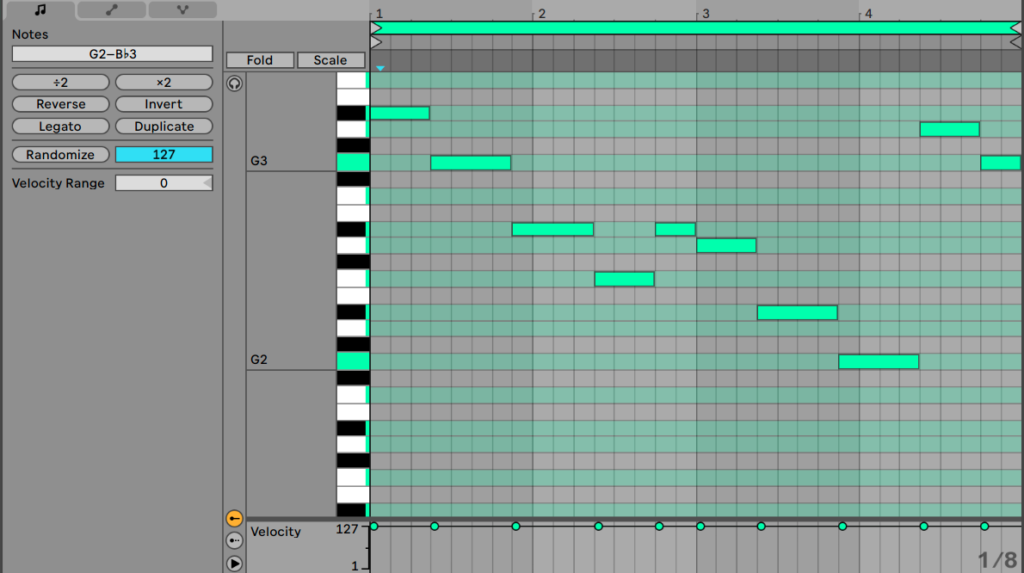
Your task is to create a second melodic line that is the inversion of this one.
- Analyze the original melody: Program the notes from the image into your DAW. Starting on G3, the sequence of notes is: G3, A#3, F3, G3, D3, C#3, A#2, C3, G2.
- Determine the melodic intervals: Identify the interval between each successive note.
- G3 to A#3 is an upward Major 3rd (+3 semitones).
- A#3 to F3 is a downward Perfect 4th (-5 semitones).
- ...and so on for the rest of the phrase.
- Calculate the inverted intervals: For each interval in the original melody, find its inversion.
- The inversion of an upward Major 3rd is a downward Minor 6th (-8 semitones).
- The inversion of a downward Perfect 4th is an upward Perfect 5th (+7 semitones).
- ...and so on.
- Program the inverted melody: Create a new MIDI track. Start on the same note, G3. Now, program a new melody using the sequence of inverted intervals you just calculated.
- Listen to the result: Play both MIDI tracks together. You should hear two distinct lines moving in contrary motion, creating a harmonically rich texture from a single melodic idea.
This exercise directly simulates a compositional process where you leverage a theoretical concept to generate new musical material efficiently.
Conclusion
Today you've seen that interval inversion is far more than a music theory curiosity. It is a fundamental symmetry that can be understood through simple rules, the physics of frequency ratios, and the elegance of modular arithmetic.
Key Takeaways:
- Definition: Inversion flips an interval's notes, creating a complementary interval.
- The Rules:
- Size: The numbers add to 9 (e.g., 3rd inverts to 6th).
- Quality: Perfect stays Perfect, Major swaps with Minor, and Augmented swaps with Diminished.
- The Physics: Inversion is the division of the octave's ratio (2/1) by the interval's ratio.
- The Math: In a system of 12 semitones, inversion is calculating the additive inverse: .
- Application: Inversion is a powerful tool for creating contrary motion and generating new melodic material.
In our next lesson, we will briefly touch upon the distinction between simple and compound intervals—those smaller than an octave versus those larger than an octave—and see how compound intervals are just simple intervals displaced by one or more octaves.