Introduction
In our previous lesson, we completed our survey of musical intervals by distinguishing between simple and compound forms. You now possess a complete theoretical framework for identifying and naming any interval based on its semitone count and its relationship to the octave. However, music theory is inert without application. Today, we will bridge this gap between abstract knowledge and creative practice.
This lesson focuses on bringing intervals to life within your Digital Audio Workstation (DAW). Our goal is to program simple two-voice melodic and harmonic phrases, allowing you to directly connect the name of an interval—like a "perfect fourth" or "minor seventh"—to its distinct sonic character. This is the foundational skill for writing basslines, creating counter-melodies, and building the harmonic textures central to the electronic music genres you wish to explore.
The Piano Roll: Your Musical Canvas
The primary interface for composing with pitch and rhythm in a DAW is the piano roll. It's a grid where the vertical axis represents pitch (like a piano keyboard turned on its side) and the horizontal axis represents time. Each block you place on this grid is a MIDI note, with its vertical position determining its pitch and its horizontal length determining its duration. For anyone accustomed to plotting data on a Cartesian plane, the piano roll is an immediately intuitive environment.
To begin, you'll need to know how to access and use the piano roll in your specific DAW. The following resource is an excellent guide covering the most popular DAWs.
The Ultimate Guide to MIDI Piano Rolls (All Major DAWs) - Hooktheory
This article from Hooktheory provides a concise overview of the piano roll's function and offers specific instructions for several major DAWs.
First, read the brief introductory section, "The piano roll is...". Then, navigate to the section that corresponds to your DAW of choice—Ableton Live, FL Studio, or Logic Pro—and familiarize yourself with how to create a MIDI clip and access its piano roll editor.
Programming and Auditioning Intervals
With the piano roll open, our first step is to systematically program and listen to the intervals we've studied. This exercise is designed to train your ear to recognize their unique qualities, moving beyond mere semitone counts to an intuitive understanding of their emotional and structural feel.
The following video provides an excellent demonstration of this process. The presenter walks through each interval, starting from a common root note, and discusses its characteristic sound.
THEORY in the DAW 4 - Musical Harmony 101 Which Notes go Together?
The video "THEORY in the DAW 4 - Musical Harmony 101" from the GARDNSOUND channel provides a perfect walkthrough of building and listening to intervals in a DAW.
Watch the segment from the beginning, where the presenter demonstrates each interval from the minor second up to the octave. As you watch, I encourage you to replicate his actions in your own DAW. Create a MIDI track with a simple instrument sound (like a piano or a basic sine wave) and program each interval yourself. Pay close attention to his descriptions of each interval's sound—"uncomfortable," "hollow," "melancholy," "Jazzy."
As you perform this exercise, actively listen for the qualities of consonance and dissonance.
- Notice the stark, clashing nature of the minor second (1 semitone) and the major seventh (11 semitones).
- Contrast this with the stable, open sound of the perfect fifth (7 semitones) and perfect fourth (5 semitones). The presenter notes these sound "hollow," which relates to the physics we discussed earlier. Their frequency ratios are very close to simple integers (3:2 and 4:3, respectively), meaning their waveforms align with minimal interference or "beating."
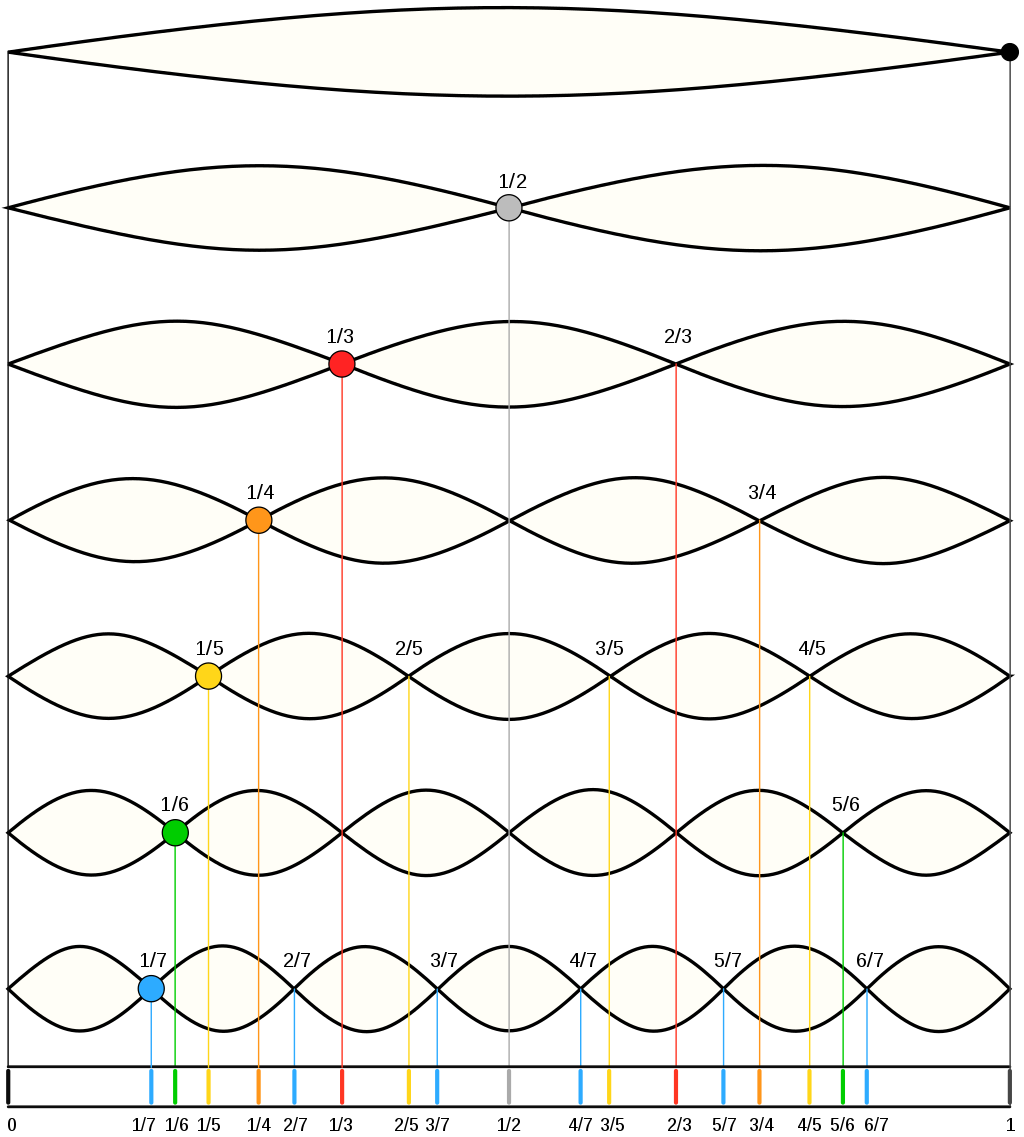
The minor third (3 semitones) and major third (4 semitones) occupy a middle ground, offering harmonic color without the stability of perfect intervals or the harshness of dissonant ones. Internalizing these distinct flavors is crucial for making deliberate harmonic choices in your music.
From Static Intervals to Dynamic Phrases
So far, we have focused on harmonic intervals, where two notes are played simultaneously. Music, however, unfolds over time. We can use the same intervals to create two-voice musical lines. This can be done in two primary ways:
- Harmony in Motion: A sequence of harmonic intervals (dyads) moving together.
- Counterpoint: Two independent melodic lines interacting with each other. The intervals are formed by the notes that sound at the same moment in time.
The image below shows a simple example of two-part counterpoint in a piano roll. Notice how the vertical distance between notes changes over time, creating a sequence of different harmonic intervals.

Now, let's put this into practice with a creative exercise. The goal is to create a short, looping musical idea using a single interval as the foundation.
How to Make Interval Ear Training Exercises with Garageband
While this guide is for Garageband, the creative process it describes is universal and perfectly suited to our current goal.
Read the section Making a Catchy Mix. The key steps are: Record a few measures of a single harmonic interval (e.g., a perfect fourth). On a second track, improvise a short melody using only the two notes from that interval. Experiment with different instrument sounds, effects, and adding a simple drum beat. This exercise transforms a static interval into a dynamic musical phrase.
Your Task:
Choose an interval you find interesting (e.g., a minor third, a perfect fifth, or even a dissonant tritone) and follow the process described above to create a 2-4 bar loop in your DAW. This is your first step in active composition, using intervals as your primary building blocks.
Intervals in Context: Application to Electronic Music
This focus on intervals and simple two-voice phrases is not merely an academic exercise; it is a fundamental technique in many electronic genres, especially techno and industrial. In these styles, full, complex chords are often less common than sparse, repetitive melodic fragments or ostinatos. Thinking in intervals is key.
The video "Music Theory for Techno" by Underdog Electronic Music School provides excellent insight into how these concepts are applied in a real-world context.
First, watch the segment on thinking in intervals. The presenter explicitly advises to "think in intervals, not so much in chords," highlighting the perfect fifth, minor third, and flat second as powerful choices. Next, watch the section on dissonance and ostinato. This connects directly to our exercise. The concept of ostinato—that any pattern repeated over and over will eventually sound correct—is central to techno. Your two-voice loop is an ostinato. This is where dissonance can become a powerful tool; a repetitive, dissonant phrase can create the tension and hypnotic energy characteristic of industrial and darker techno styles.
By focusing on the relationship between just two notes, repeated and modulated over time, you can generate the core melodic and harmonic identity of a track.
Conclusion
In this lesson, you have taken the crucial step from theory to practice. You have moved from identifying intervals on paper to programming, hearing, and manipulating them in a DAW. This hands-on experience is essential for developing an intuitive sense of their musical function.
Key Takeaways:
- The piano roll is your primary tool for programming melodies and harmonies in a DAW.
- Each interval has a distinct sonic character, ranging from the harshness of dissonance (e.g., minor second) to the stability of consonance (e.g., perfect fifth).
- Simple two-voice phrases, or ostinatos, built from a limited set of intervals are a foundational technique in techno and industrial music.
- By programming and experimenting with these phrases, you begin to compose, transforming theoretical knowledge into creative output.
We have now established our fundamental building blocks: pitches and the intervals between them. In our next lesson, we will begin assembling these blocks into larger, ordered structures. We will explore scales, starting with the construction of the major scale, which serves as the primary tonal framework for much of Western music.