In our last session, we established the fundamental building blocks of rhythm by defining the relative durations of notes and rests, and saw how these are represented in a piano roll. We programmed patterns using quarter and eighth notes, but we left a crucial question unanswered: how fast are those notes actually played? A quarter note is simply a duration relative to the measure; its absolute duration in seconds is undefined until we set the overall speed.
This lesson tackles that question head-on. We will define tempo, the absolute speed of music, and its standard unit of measurement, Beats Per Minute (BPM). Our goal is to understand not just what tempo is, but why it's a cornerstone of electronic music production. By the end of this session, you will be able to explain the crucial role tempo plays in defining the genre, energy, and overall character of an electronic track.
The Pulse of the Machine: Defining Tempo and BPM
At the heart of every piece of music is a steady pulse, an underlying grid of evenly spaced moments in time. Tempo is simply the speed or rate of this pulse. In modern music production, and especially in electronic music, this is measured with precision using Beats Per Minute (BPM).
The concept is straightforward: a tempo of 120 BPM means there are 120 beats every minute. Given your background, you can think of this as a frequency.
- 60 BPM = 60 beats / 60 seconds = 1 beat per second = 1 Hz
- 120 BPM = 120 beats / 60 seconds = 2 beats per second = 2 Hz
Each beat in a 120 BPM track therefore has a duration of 0.5 seconds. This simple conversion is the bridge between the musical grid and absolute, physical time.
To begin, let's watch a very brief segment that introduces this concept.
Fundamentals of Rhythm for Electronic Music
This clip from the video "Fundamentals of Rhythm for Electronic Music," which we saw in our last lesson, provides a concise definition of tempo.
Please watch from the start of this section. Pay attention to how tempo is introduced as the speed of the underlying pulse within a time signature.
Now, let's build a more formal understanding. The following resource provides a thorough definition of pulse and tempo, its measurement, and its historical context.
Pulse, beat and tempo | Chromatone.center
This article from Chromatone.center provides an excellent foundation for understanding tempo.
Please read the following three sections: The "Pulse" section defines the core concept of the underlying beat and introduces tempo as its speed. Note the mention of the perceptual limits of pulse, which touches on the psychoacoustics of rhythm. The "Tempo" section provides the formal definition and its origin. The "Measurement of the tempo" section is the most critical part. It focuses on BPM as the modern standard, the historical role of the metronome, and how sequencers (the basis of your DAW) use the BPM system.
As the article mentions, while traditional music used Italian terms like Allegro (fast) or Adagio (slow), the precision of BPM is essential for electronic music, where machines need to communicate and synchronize perfectly.
Why Tempo is a Defining Force in Electronic Music
In electronic music, tempo is far more than just a speed setting; it's a primary driver of a track's identity and function. A track's BPM is arguably its most immediate and recognizable characteristic, fundamentally shaping its energy and emotional impact. The article "EDM BPM: The Ultimate Guide For DJs" explains this well.
EDM BPM: The Ultimate Guide For DJs (2026) | ZIPDJ
This section from a ZIPDJ blog post articulates why BPM is so crucial in the context of DJing and production.
Please read the section titled The Importance Of BPM In EDM. Focus on the four bullet points that explain its role in modulating emotion, establishing energy, organizing tracks, and informing production.
One of the key points raised is beatmatching, the technique DJs use to mix tracks together seamlessly. This relies on synchronizing the BPM of two or more tracks. This practical need for synchronization is a major reason why BPM is such a rigid and important parameter in dance music. The article on Chromatone.center elaborates on this process.
Pulse, beat and tempo | Chromatone.center
Let's return to the Chromatone.center article to look specifically at the practical application of beatmatching.
Read the section on Beatmatching. The concepts of pitch-shifting and time-stretching are interesting from a signal processing perspective. Modern DAWs use sophisticated time-stretching algorithms (like phase vocoders or granular synthesis techniques) to change a track's tempo without altering its pitch, a process that was impossible with vinyl records alone.
A Map of Genres by Tempo
The most powerful role of tempo in electronic music is as a genre signifier. The distinction between house, techno, and drum and bass is, to a large extent, a distinction in tempo.

Let's dive into the specifics for the genres you're interested in. The following resources provide detailed breakdowns of BPM ranges for a wide variety of electronic music styles.
EDM BPM: The Ultimate Guide For DJs (2026) | ZIPDJ
This article provides a clear, genre-by-genre list with descriptions, followed by a helpful summary chart.
Read the main section EDM Genres By BPM, paying close attention to the descriptions for House, Techno, Breakbeat, and Dubstep. Then, review the EDM BPM Chart that follows for a quick reference of subgenres.
To complement this, the Chromatone.center article offers a similar list, which will help reinforce these ranges.
Pulse, beat and tempo | Chromatone.center
This section provides another list of genre-specific tempo ranges.
Please read the list under the heading Electronic music.
From these readings, we can extract a clear taxonomy:
- House and Techno: These genres form the backbone of modern club music and typically occupy the 120-150 BPM range. This tempo is fast enough to be energetic for dancing but slow enough to allow for hypnotic grooves. Your interest in these genres places you squarely in this foundational tempo territory.
- Breakbeat and Drum and Bass: These genres are defined by their speed, pushing tempos into the 160-180 BPM range. The frantic energy of breakbeat and the rolling momentum of drum and bass are direct consequences of their high tempo.
- Industrial: This is a more complex case. Industrial music often uses tempo for shock value. It can be oppressively slow and grinding, or it can push into the extremely fast territory of genres like Hardcore/Gabber (165-220 BPM) and even faster, more abstract subgenres mentioned in the resources. The choice of tempo is a deliberate aesthetic statement.
Tempo in Your DAW: The Master Clock
Finally, it's crucial to understand that in your DAW, the BPM setting is the master clock for the entire project. It doesn't just dictate the speed of your drum patterns; it synchronizes everything.
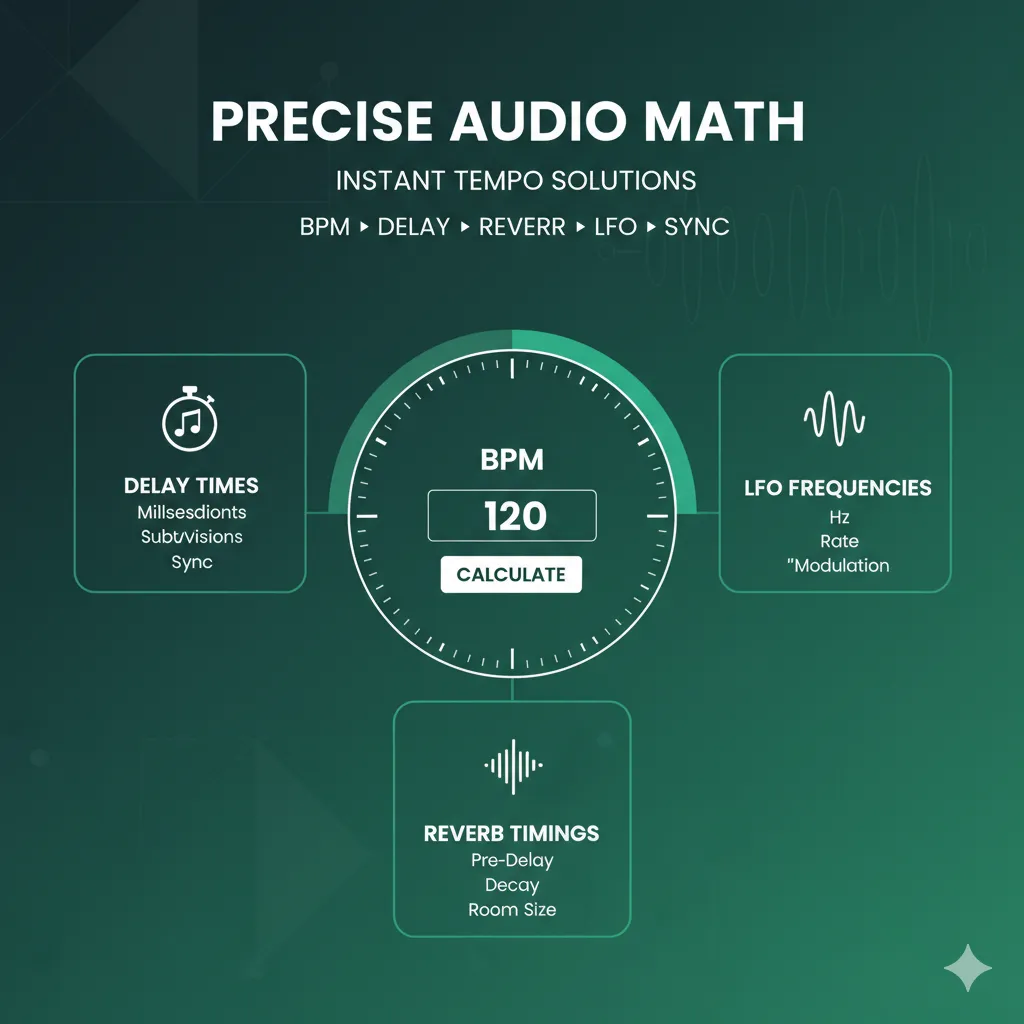
When you add a delay effect to a track, you can often set the delay time not in milliseconds, but in rhythmic values like "1/4" or "1/8 dotted". The DAW calculates the exact millisecond value based on the project's BPM. For a quarter-note delay in a 130 BPM project, the calculation is:
Similarly, Low-Frequency Oscillators (LFOs), which are used to create movement and modulation (like a filter sweep or a synth "wobble"), can be synchronized to the project tempo. This ensures that all rhythmic and textural elements are locked into a coherent grid, a defining feature of electronically produced music.
Conclusion
In this lesson, we have moved from the relative time of note durations to the absolute time defined by tempo. We've established that tempo, measured in Beats Per Minute (BPM), is the master clock of an electronic music project. It's not just a number, but a fundamental creative choice that dictates a track's energy, influences its emotional trajectory, and, most critically, helps define its genre.
Key Takeaways:
- Tempo is the speed of the underlying pulse in music, measured in Beats Per Minute (BPM).
- BPM can be directly related to frequency (60 BPM = 1 Hz).
- In electronic music, tempo is a primary characteristic used to classify genres like House (115-130 BPM), Techno (120-150 BPM), and Drum and Bass (160-180 BPM).
- The BPM setting in a DAW acts as a master clock, used to synchronize not only notes on the grid but also time-based effects like delay and modulators like LFOs.
We now understand how to define the length of a note and how fast to play it. The next logical step is to explore how these notes are grouped together. In our next lesson, we will investigate meter, the organizational framework that groups beats into repeating patterns called measures. We will start by distinguishing between simple meter, where each beat divides into two, and compound meter, where each beat divides into three—a distinction that opens up new rhythmic possibilities.