Introduction
In our last lesson, we delved into the world of loop-based harmony, focusing on progressions like i-VI-III-VII that create a sense of hypnotic, cyclical motion by deliberately weakening the pull back to the tonic. We explored formal concepts like "plateau loops" and "rhetorical function" to understand how harmony can sustain a state rather than drive toward a conclusion.
This lesson pivots from that cyclical model to analyze two of the most powerful and goal-oriented progressions in all of Western music: I–V–vi–IV and ii–V–I. These sequences are the harmonic bedrock of countless songs across genres, from baroque canons to modern pop and, of course, melodic electronic music. Our goal is to deconstruct their internal logic to understand why they are so effective at creating emotional narratives of tension and release. This will provide you with a foundational toolkit for building more structured and melodic harmonic ideas, bridging the gap between simple loops and complete song arrangements.
The Syntax of Harmony: Tonic, Subdominant, and Dominant
Before analyzing specific progressions, we must first establish a formal framework for understanding how chords relate to one another. Much like words in a sentence, chords have functions that give a progression its meaning and direction. The three primary harmonic functions are:
- Tonic (T): The point of rest and resolution; the "home" chord. It feels stable and complete. The primary tonic chord is
I(and its relativevi, which shares two notes and provides a softer landing). - Subdominant (S or SD): A point of moderate tension that moves away from the tonic, creating a sense of "going somewhere." It often serves as a preparation for the dominant. The primary subdominant chords are
IVandii. - Dominant (D): The point of maximum tension. It has a strong gravitational pull back to the tonic, creating a powerful desire for resolution. The primary dominant chords are
Vandvii°.
A typical harmonic "sentence" follows the path T → S → D → T, moving from rest, to departure, to high tension, and finally back to rest.
The following video provides an excellent, structured explanation of this concept, drawing an analogy to linguistic syntax that should resonate with your analytical background.
Functional Harmony - Creating Musical Syntax with Chords!
The video "Functional Harmony - Creating Musical Syntax with Chords!" by Scott Ross-Molyneux lays out this theoretical foundation.
Watch from the beginning through the first three sections. Pay close attention to: The discussion of primary pitches (tonic, dominant, subdominant) and how they form the basis of these functions. The method for categorizing all diatonic chords into one of the three functional groups based on which primary pitches they contain. The introduction of the "function circle," a visual model for the standard T → S → D → T flow.
To visualize this flow, music theorists often use diagrams. These charts show the standard paths a progression can take.

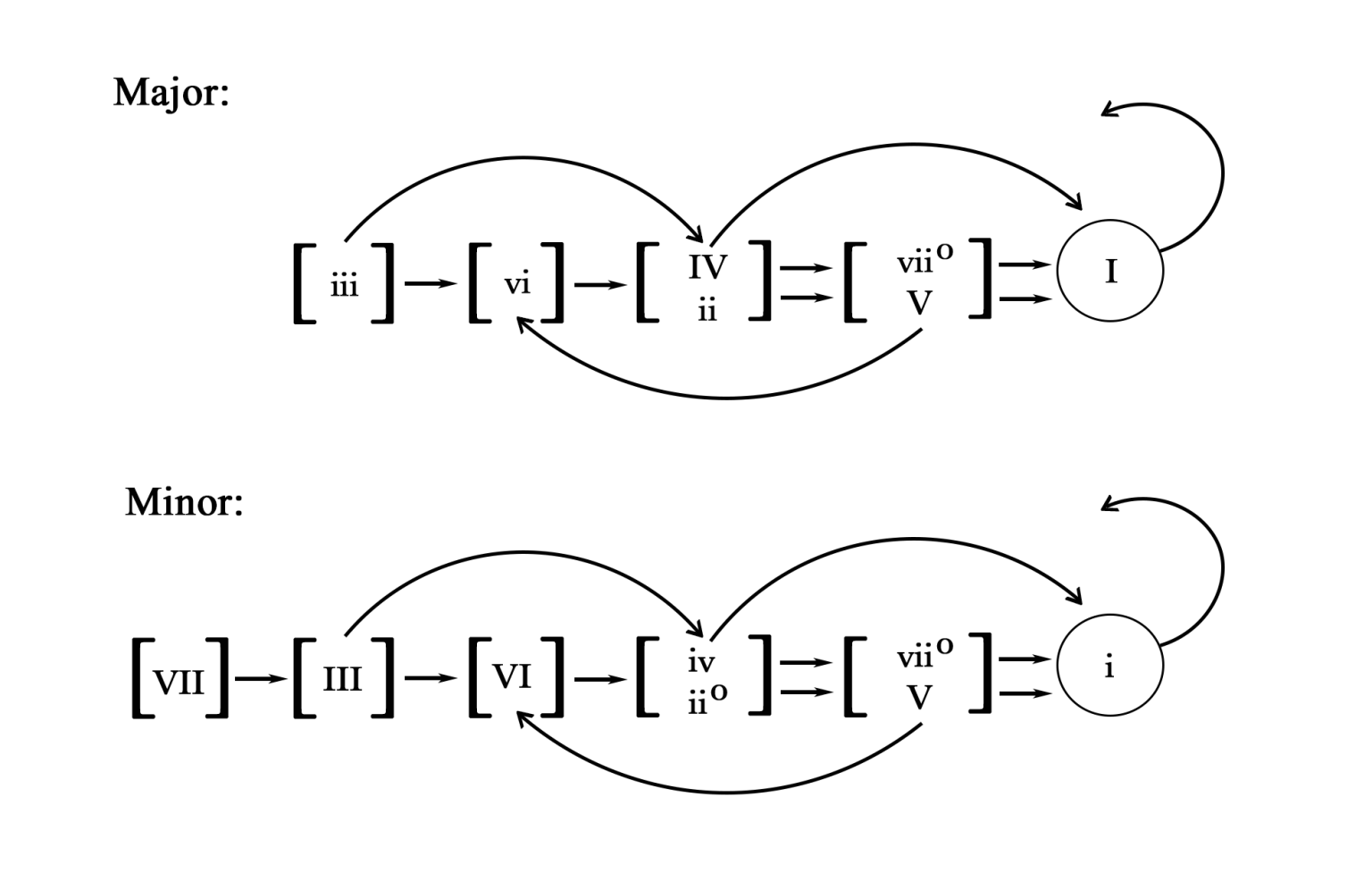
With this framework, we can now analyze our target progressions with greater precision.
The I–V–vi–IV Progression: The Narrative Loop
This progression, often called the "four chords of pop," is ubiquitous for its ability to create a sense of emotional, forward-moving narrative that also loops seamlessly. In C major, the chords are: C (I) – G (V) – Am (vi) – F (IV).
Let's analyze its functional path: I (T) → V (D) → vi (T) → IV (S).
Notice something interesting? It doesn't follow the clean T → S → D → T path. The progression introduces a crucial twist: the move from V to vi.
I → V: We move from home (Tonic) directly to high tension (Dominant).V → vi: Here is the critical moment. TheVchord creates a strong expectation for a resolution toI. Instead, it resolves tovi. This is called a deceptive cadence. Because thevichord shares two notes with theIchord (in C major, Am and C both contain C and E), it feels like a resolution, but a more somber, "deceptive" one. It provides release from theVchord's tension without bringing the progression to a full stop.vi → IV: We move from the minor tonic feel ofvito the subdominantIV, which pulls the harmony away from the tonic center again.IV → I: The subdominant moves back to the tonic, restarting the cycle. ThisIV → Imovement is known as a plagal cadence, which has a softer, less final feel than theV → Iauthentic cadence.
The combination of the deceptive cadence and the plagal cadence is what makes this progression so effective as a loop. It constantly creates and resolves tension in a way that avoids finality, inviting endless repetition.
The Advanced Guide to Tension and Energy in Electronic ...
This article provides a practical look at cadences.
Focus on the short section titled The deceptive cadence. It explains precisely the V → vi move we just discussed, framing it as a tool to extend a progression and subvert listener expectation.
The ii–V–I Progression: The Engine of Resolution
If I–V–vi–IV is a narrative loop, ii–V–I is a powerful engine of resolution. It is the absolute cornerstone of jazz harmony and appears frequently in more harmonically complex electronic music like jazz-infused house or liquid drum-and-bass. In C major, this is: Dm (ii) – G (V) – C (I).
Its functional path is ii (S) → V (D) → I (T). This is the purest possible demonstration of the S → D → T pattern.
ii (Subdominant): It moves the harmony away from the tonicI.V (Dominant): It builds maximum tension, pulling strongly towardsI.I (Tonic): It provides a powerful and satisfying resolution.
The strength of this progression comes from two main sources, which your physics and math background will appreciate:
- Root Motion in Fifths: The root notes of the chords (D → G → C) move by intervals of a perfect fifth (or its inversion, a perfect fourth). This movement around the circle of fifths is perceived as one of the strongest and most logical harmonic motions.
- Voice Leading Efficiency: The notes of the chords resolve to the next with maximum efficiency. For example, in the
G7 → Cresolution, the G7 chord contains the notes G-B-D-F. The 'B' (the leading tone) resolves up by a semitone to 'C', and the 'F' (the chordal seventh) resolves down by a semitone to 'E'. This contrary motion of two voices resolving by the smallest possible step creates an incredibly smooth yet powerful sense of arrival.
For a deeper, more formal look at why the ii-V-I is so fundamental, we can turn to academic analysis.
[PDF] Why is the ii-V-I chord progression used so frequently? With ...
This dissertation provides a rigorous justification for the progression's power.
First, read the section that explains the relationship between the ii and IV chords, a concept called plurality. This clarifies why ii serves the subdominant function so well. Next, focus on the most compelling part for your background: the section outlining Daniel Schnell's five mathematical rules for forming a good chord sequence. Read from these rules. The paper explains how the ii-V-I progression satisfies these principles of 'Covering', 'Surprise', 'Connection', 'Structure', and 'Voice pattern', providing a quantitative basis for its perceived stability and agreeableness.
Application and Experimentation
In electronic music, these progressions serve as frameworks for more melodic and harmonically rich tracks.
- The
I–V–vi–IVprogression is a staple in trance, progressive house, and synth-pop. Its emotional, slightly melancholic feel is perfect for creating epic pads and memorable lead lines. - The
ii–V–Iprogression, especially with seventh chords (ii7–V7–Imaj7), brings a level of sophistication found in deep house, future garage, and other jazz-influenced styles.
Of course, knowing the rules is the first step to breaking them tastefully. The following video demonstrates many common substitutions and "rule breaks" that can add complexity to these standard progressions, which directly relates to your interest in experimental structures.
Music Theory For Producers (This Is All You Need)
This video from Ethan Davis, "Music Theory For Producers," demonstrates these progressions and how to alter them.
First, watch the demonstration of common progressions from this section. It covers 1-5-6-4 (a permutation of our first progression) and 2-5-1, showing their application in famous songs. Then, jump to the section on breaking the rules. This is where the fun starts. The presenter shows how to introduce non-diatonic chords to create surprising and emotional effects, such as using a minor iv chord or a major II or III chord. These are examples of modal interchange, a topic we will formalize in the next module, but which you can begin exploring now as a creative tool.
Conclusion
Today we've moved from the static, cyclical world of non-functional loops to the dynamic, goal-oriented world of functional harmony. We've seen how chords can be grouped by function—Tonic, Subdominant, and Dominant—to create a syntax of tension and release.
Key Takeaways:
- Functional Harmony: Chords can be categorized by their function: Tonic (home/rest), Subdominant (departure/variety), and Dominant (tension/return). The standard flow is
T → S → D → T. - The
ii–V–IProgression: This is the archetypal functional progression (S → D → T). Its strength comes from efficient voice leading and root motion in fifths, a structure so robust it can be justified with mathematical principles. - The
I–V–vi–IVProgression: A versatile and popular loop that creates a continuous narrative feel by using a deceptive cadence (V → vi). This subverts expectations and avoids a full resolution, making it perfect for looping. - Application: These progressions provide a more directed harmonic foundation than the loops from our previous lesson, making them ideal for melodic genres like trance, progressive house, and other song-structured electronic music.
In our next and final lesson for this module, you will put these analytical skills to the test. We will deconstruct the harmonic structure of a complete reference track, identifying these foundational progressions and their variations in a real-world musical context.