Introduction
In our last lesson, we established a systematic method for building the complete "palette" of diatonic chords for a major key. We saw how the fixed interval pattern of the major scale results in a predictable and universal sequence of major, minor, and diminished chords, which we learned to label using Roman numeral analysis.
Today, we will apply this same rigorous process to the more complex world of minor keys. You'll discover that while major key harmony is relatively uniform, minor key harmony is a flexible system drawing from multiple sources. We will harmonize both the natural and harmonic minor scales, and in doing so, we will uncover the answer to a crucial question: why do different versions of the minor scale exist? The answer lies in the concept of harmonic function, and specifically, the role of the V chord in creating the tension and resolution that drives tonal music. For someone with your background in physics, this can be likened to understanding the potential energy in a system that "wants" to move to a stable, lower-energy state.
By the end of this lesson, you will be able to derive the chords of the natural and harmonic minor scales and, most importantly, explain why the V chord from the harmonic minor is so essential to the sound of Western music.
The Natural Minor Scale and its Diatonic Chords
We begin with the natural minor scale, which you may also know as the Aeolian mode. As we saw in Module 3, it shares its key signature with its relative major (e.g., A minor and C major both have no sharps or flats). Its interval pattern is Whole-Half-Whole-Whole-Half-Whole-Whole.
Let's apply the same harmonization process from our last lesson: stacking diatonic thirds on each scale degree. We'll use A minor (A-B-C-D-E-F-G) as our example.
- i: A-C-E (A minor triad)
- ii°: B-D-F (B diminished triad)
- III: C-E-G (C major triad)
- iv: D-F-A (D minor triad)
- v: E-G-B (E minor triad)
- VI: F-A-C (F major triad)
- VII: G-B-D (G major triad)
The universal pattern for triads in any natural minor key is: i, ii°, III, iv, v, VI, VII.
When we extend these to seventh chords, we get:
- i7: A-C-E-G (A minor 7)
- iiø7: B-D-F-A (B half-diminished 7)
- IIImaj7: C-E-G-B (C major 7)
- iv7: D-F-A-C (D minor 7)
- v7: E-G-B-D (E minor 7)
- VImaj7: F-A-C-E (F major 7)
- VII7: G-B-D-F (G dominant 7)
The pattern for seventh chords is: i7, iiø7, IIImaj7, iv7, v7, VImaj7, VII7.
Music Theory - Minor Keys Explained - Chords, Scales and Function
The video "Music Theory - Minor Keys Explained" by Rick Beato offers a concise walkthrough of harmonizing the natural minor scale. He uses C minor as his example.
Watch the opening section from the start to the end of the natural minor discussion. Focus on how he builds the triads and seventh chords, and how he labels them with both Roman numerals and functional names (tonic, supertonic, etc.).
Look closely at the chords we've generated, particularly the chord built on the fifth scale degree: a minor triad (v) or a minor seventh chord (v7). While perfectly diatonic, this chord presents a functional problem.
The Harmonic "Problem" and its Solution: The V Chord
In tonal music, the progression from the dominant (V) chord to the tonic (I or i) is the most powerful and defining movement. It creates a strong sense of arrival and resolution. This power comes from the acoustic tension created by specific intervals.
The key ingredient for this tension is the tritone—an interval of six semitones (e.g., C to F#). A dominant 7th chord (like G7 in the key of C major) contains a tritone between its 3rd and 7th degrees (in G7, the notes are B and F). This unstable interval strongly "pulls" toward resolution.
Our v7 chord from the natural minor scale (e.g., E minor 7 in A minor) is built with the notes E-G-B-D. It contains no tritone. It lacks that crucial harmonic tension and its progression to the tonic feels less conclusive, more like a gentle shift.
Everything You Don't Know About Minor Harmony • Jazzadvice
This article from Jazzadvice provides a superb explanation of this very issue.
First, read from the beginning of the article to the section break, ending at "not complete". This sets up the context of minor harmony and identifies the "missing" dominant 7th chord. Next, read the section "Where the V7 chord comes from". The author explicitly discusses the role of the tritone and introduces the harmonic minor scale as the source of the V7 chord.
To solve this, composers systematically altered the natural minor scale for harmonic purposes. By raising the seventh scale degree by a semitone, a new scale is born: the harmonic minor scale.
- Natural Minor: 1, 2, ♭3, 4, 5, ♭6, ♭7
- Harmonic Minor: 1, 2, ♭3, 4, 5, ♭6, ♮7
In A minor, this changes the G to a G#. This new ♮7 is called the leading tone because it is only a semitone away from the tonic and melodically leads the ear powerfully back home. The ♭7 of the natural minor is called the subtonic.
Harmonizing the Harmonic Minor Scale
This single note change—the G to G# in our A minor example—affects every chord that contains the seventh degree: the III, the v, and the VII.
Music Theory for Producers #13 - Harmonic Minor, Dominant V & Altered Chords
The video "Harmonic Minor, Dominant V & Altered Chords" by MusicTechHelpGuy gives a very clear, step-by-step explanation of how this single note change transforms the harmony.
First, watch the introduction from the beginning to the recap of harmonic minor. This part clearly defines the leading tone and its function. Next, watch the segment from explaining the altered chords. This is the crucial part where he demonstrates how the III, V, and VII chords change quality because of the raised 7th degree.
As the video explains, the alterations are as follows:
- The v chord becomes a V chord. The minor triad becomes a major triad. In A minor, E-G-B becomes E-G#-B (E major). This is our solution! We now have a proper dominant chord.
- The III chord becomes a III+ chord. The major triad becomes an augmented triad (a stack of two major thirds). In A minor, C-E-G becomes C-E-G# (C augmented).
- The VII chord becomes a vii° chord. The major triad becomes a diminished triad. In A minor, G-B-D becomes G#-B-D (G# diminished). This diminished chord on the leading tone also has a strong dominant function, as it shares key notes with the V chord.
This "borrowing" of the raised 7th degree gives us access to a V chord with a powerful dominant function. Music in a minor key is therefore best understood as a hybrid system. It primarily uses the chords of the natural minor but borrows the V and vii° chords from the harmonic minor whenever a strong cadence or resolution to the tonic is desired.
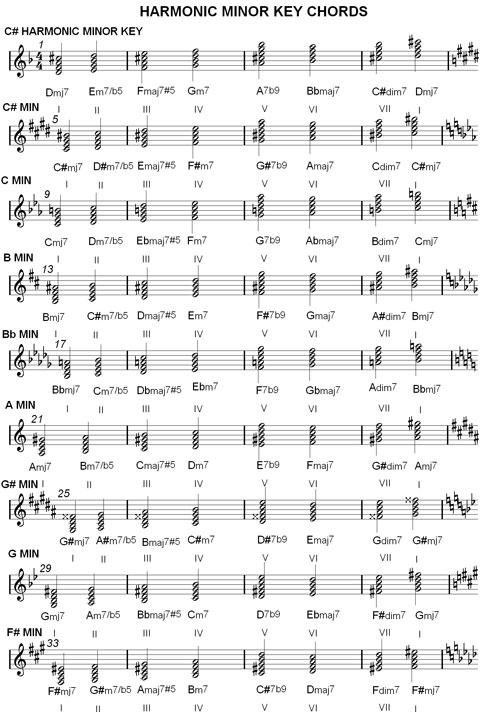
The chart below shows the full set of seventh chords available in the harmonic minor scale, which produces some of the more "experimental" sounds you're interested in, such as the i(maj7) and IIImaj7(#5).
The Dominant Function in Practice
The V-i progression is arguably the most common and powerful harmonic device in minor-key music. The pull from the major V chord back to the minor i tonic is dramatic and satisfying.
Music Theory for Producers #13 - Harmonic Minor, Dominant V & Altered Chords
Let's return to the MusicTechHelpGuy video for a practical demonstration.
Watch the section from discussing the dominant V. The presenter does an excellent job of demonstrating the sonic difference between a v-i progression and a V-i progression. He rightly points out that the vast majority of popular music uses the major V chord in minor keys.
This idea of a flexible "pool" of chords is fundamental to understanding minor harmony. You are not confined to the seven chords of a single scale. You can fluidly move between the chords of the natural minor (for a softer, more modal feel) and the dominant-function chords of the harmonic minor (for strong, directional harmony).
This flowchart provides a great visualization of this functional concept. The Dominant (D) chords, including our V and vii°, have a primary function of leading back to the Tonic (T).

Conclusion
Today we've navigated the richer, more ambiguous landscape of minor harmony. Unlike the straightforward diatonicism of the major scale, minor keys operate as a hybrid system, drawing chords from different scale variations to achieve different functional goals.
Key Takeaways:
- Harmonizing the natural minor scale produces a set of seven diatonic chords, but its
vchord is minor and lacks strong dominant function. - The harmonic minor scale is created by raising the 7th degree of the natural minor scale. This creates a leading tone which pulls strongly to the tonic.
- This single note alteration transforms three chords, most importantly changing the
v(minor) into a V (major), providing the necessary tension for a strong resolution. - Minor key harmony is best understood as using the chords of the natural minor as a base, but borrowing the
Vandvii°chords from the harmonic minor to create dominant function. - This flexibility gives minor keys a wider palette of harmonic colors than major keys.
We have now established how dominant function is created in both major and minor keys. In our next lesson, we will formalize this concept by defining the three core harmonic functions—Tonic, Subdominant, and Dominant—and mapping out how all diatonic chords fit into this powerful framework of tension and release.