Introduction
In our previous lesson, we constructed the Pythagorean scale from first principles, using only the "perfect" ratios of the octave (2:1) and the fifth (3:2). We ended by uncovering a deep mathematical inconsistency: the chain of fifths never perfectly closes back on itself. An integer number of perfect fifths can never equal an integer number of octaves, a fact stemming from the impossibility of .
This lesson will explore the musical consequences of this and other similar mathematical limitations. We will precisely define and quantify the errors that arise in tuning systems built on pure integer ratios. This will address the learning outcome: Explain the limitations of Pythagorean tuning and just intonation, such as the Pythagorean comma. We will first examine the Pythagorean comma and the dissonant wolf interval it creates. Then, we will explore an alternative system, Just Intonation, which fixes the flaws of Pythagorean thirds but introduces its own set of problems, epitomized by the syntonic comma. This exploration will set the stage for understanding why modern music relies almost universally on a compromise: equal temperament.
The Problem of Stacking Pure Intervals
The issue we discovered with stacking fifths is not unique. It's a general principle that stacking any pure interval based on simple integer ratios (other than the octave itself) will fail to align perfectly with the octave framework. This means that attempting to build a closed system of notes using these "perfect" building blocks is mathematically impossible.
The following short video provides a brilliant, fast-paced demonstration of this very problem.
Why It's Impossible to Tune a Piano
The video "Why It's Impossible to Tune a Piano" from the channel minutephysics concisely illustrates why no system of simple ratios can create a consistent, closed musical scale.
Watch the segment from the problem. Notice how stacking different intervals—whole steps (9/8), major thirds (5/4), fourths (4/3), and fifths (3/2)—all result in a final value that misses the target octave ratio of 2.
The Pythagorean Comma and the Wolf Interval
Let's now formally quantify the error in the Pythagorean system. The circle of fifths in Western music contains 12 notes. What happens if we generate 12 notes by stacking 12 perfect fifths?
Starting from a frequency , we get . To bring this back into a comparable range, we need to lower it by several octaves. The note 12 fifths up from C is B-sharp, which is enharmonically a C. This B-sharp should be equivalent to the C seven octaves above our starting C, which has a frequency of .
Let's compare these two values:
- The stack of 12 fifths gives a ratio of
- The stack of 7 octaves gives a ratio of
The two values are close, but not identical. The ratio between them is the Pythagorean comma:
This small but perceptible interval is the accumulated error of the Pythagorean system. In a practical instrument with a limited number of keys (like a 12-note keyboard), this error has to be "stuffed" somewhere. The result is that to keep 11 of the fifths pure (3:2), the 12th "fifth" that closes the circle becomes horribly dissonant. This interval is known as the wolf interval or "wolf fifth" because its harsh, beating sound was likened to the howl of a wolf. The presence of a wolf interval makes playing music in certain keys impossible, severely limiting musical modulation.
[PDF] The physics of musical scales: Theory and experiment
The paper "The physics of musical scales: Theory and experiment" by Durfee and Colton provides a clear, physics-oriented explanation of this phenomenon.
Please read Section III, "THE PYTHAGOREAN SCALE," starting from the paragraph that begins "Going up an equal...". This section formally calculates the comma. Then, continue to the end of the section to understand how this leads to the wolf interval and other problematic intervals like the major third. Pay close attention to Figure 3(b), which visually shows the single, large deviation of the wolf fifth compared to the other eleven consonant fifths.
Just Intonation: A Different Compromise
The Pythagorean system's most dissonant interval, apart from the wolf fifth, is its major third (). This interval sounds noticeably sharp and "rough" compared to a smoother, more consonant major third based on a simpler ratio.
This simpler ratio is the just major third, with a frequency ratio of 5/4 (or 1.25). It arises from the 5th harmonic in the harmonic series, a component the Pythagorean system (based only on powers of 2 and 3) ignores.
Just Intonation is a tuning system that prioritizes these simple integer ratios for chords. For example, a C major chord (C-E-G) in just intonation is built with the following ratios relative to the root C:
- C: 1
- E: 5/4 (Just Major Third)
- G: 3/2 (Perfect Fifth)
The frequency relationship between the notes of the chord is therefore 1 : 5/4 : 3/2, which can be expressed as the simple integer ratio 4:5:6. This alignment of simple ratios creates a perfectly smooth, consonant chord with minimal beating.
The difference in sound quality is not subtle. The following video provides an excellent aural demonstration and an explanation rooted in the physics of harmonics.
The Mathematical Problem with Music, and How to Solve It
The video "The Mathematical Problem with Music, and How to Solve It" from the channel Formant compares Pythagorean tuning with Just Intonation.
Watch from the introduction to Just Intonation. First, you'll hear a comparison of the single notes. Then, critically, listen to the comparison of the major chord in both tunings (chord comparison). The video then provides a superb explanation, tailored to a physics perspective, of how clashing harmonics in Pythagorean tuning cause roughness, while their alignment in Just Intonation creates smoothness (harmonic clash explanation).
The Limitations of Just Intonation: The Syntonic Comma
Just Intonation produces beautifully consonant chords within a single key, but this perfection comes at a steep price: the system collapses as soon as you try to change keys. The problem lies in the fact that to accommodate the pure 5/4 third, the intervals within the scale are no longer consistent.
Let's examine the whole step (the interval between C and D, or D and E) in a just C major scale:
- The interval from C (ratio 1) to D (ratio 9/8) is a major tone: .
- The interval from D (ratio 9/8) to E (ratio 5/4) is a minor tone: .
We have two different sizes of whole step! The difference between them is precisely the syntonic comma. It is the ratio between the Pythagorean major third (derived from four fifths, which creates two major tones) and the just major third.
This seemingly small difference means that a melody cannot be transposed. A tune that goes C-D-E has an intervallic structure of (major tone, minor tone). If you try to play that same tune starting on D, you would need the notes D, E, and F-sharp. However, the interval D-E is a minor tone. The interval E-F# would need to be a major tone, but the F# derived in the key of C may not produce this interval correctly. This inconsistency makes modulation and transposition a nightmare.
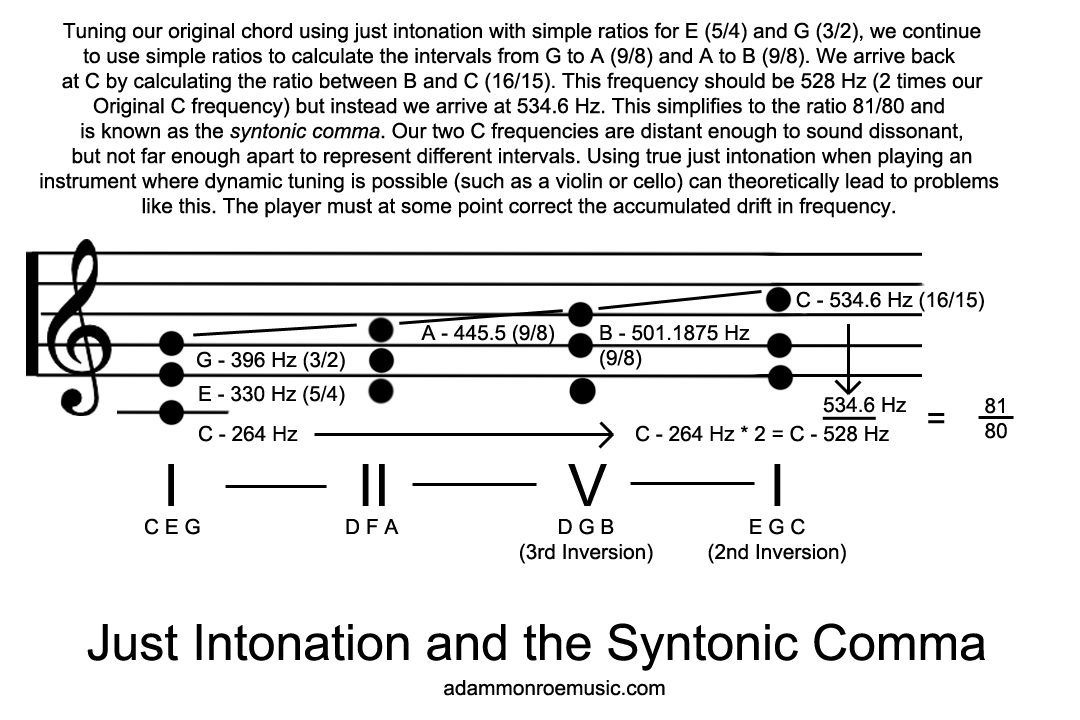
The image below illustrates this drift perfectly. By tuning chords using simple ratios, a short progression that should end on C actually arrives at a pitch that is sharp by a factor of 81/80—the syntonic comma.
[PDF] The physics of musical scales: Theory and experiment
The Durfee and Colton paper also discusses the shift towards systems that could accommodate better-sounding thirds.
Read the first paragraph of Section IV, "MEANTONE SCALES," from the beginning. This section formally defines the syntonic comma as the difference between four just fifths and a just major third, and it introduces the concept of "tempering" the fifth to resolve this discrepancy, a crucial idea we will build upon in the next lesson.
The inability to transpose is the fatal flaw of Just Intonation for most forms of music.
The Mathematical Problem with Music, and How to Solve It
The Formant video concludes its section on Just Intonation by demonstrating this exact problem.
Watch the final part of the segment, from the downside of Just Intonation, which clearly explains and demonstrates why even the simplest melody cannot be transposed correctly.
Conclusion
We have now seen that the two most historically important tuning systems based on pure, simple integer ratios each contain a fatal flaw.
Here are the key takeaways:
- Pythagorean Tuning, built from pure 3:2 fifths, creates a mathematically open system. The discrepancy, called the Pythagorean comma (), forces one of the fifths in a 12-note scale to be a dissonant wolf interval, severely limiting the ability to change keys.
- Just Intonation prioritizes pure thirds (5/4) and fifths (3/2) to create perfectly consonant chords. However, this creates inconsistently sized intervals within the scale (e.g., major and minor tones). This makes transposition impossible without retuning. The discrepancy between the Pythagorean third and the just third is called the syntonic comma ().
- Both systems represent a fundamental trade-off: you can have mostly pure fifths (Pythagorean) or pure chords in one key (Just Intonation), but you cannot have both simultaneously in a system that allows for free transposition.
This inescapable dilemma led musicians and theorists on a centuries-long search for a better compromise. The ultimate solution, which dominates virtually all modern music, is 12-Tone Equal Temperament. In our next lesson, we will see how this system "solves" the problem by abandoning pure intervals altogether, instead dividing the octave into 12 perfectly equal, but mathematically "imperfect," steps. We will derive its foundational ratio: .