Introduction
Welcome to your first lesson. We'll begin our journey into music theory by exploring the very physics of sound itself. This lesson addresses the first learning outcome of the course: describing the harmonic series and explaining its role in determining an instrument's timbre.
Your background in physics and mathematics provides an ideal foundation for this topic. We will bridge the gap between the physical properties of sound waves and their perceptual qualities in music. By the end of this lesson, you'll understand why a guitar playing a C note sounds different from a piano playing that same C note. This concept, known as timbre, is not just an acoustic curiosity; it's the basis for synthesis and sound design in electronic music. We'll lay the groundwork for future lessons on tuning, intervals, and harmony, all of which are deeply connected to the principles we establish today.
The Anatomy of a Musical Note
When we hear a musical note, our ears are not typically sensing a simple, pure sine wave. Most sounds in nature, and especially in music, are composed of complex, periodic waveforms. A crucial insight, which will be familiar to you from your studies in physics, is that any complex periodic wave can be deconstructed into a sum of simple sine waves. This mathematical tool is, of course, Fourier analysis.
In the context of music, these component sine waves are called partials. The set of partials for a given note has specific names:
- Fundamental Frequency (): This is the lowest-frequency partial in the sound. It is the strongest determinant of the note's perceived pitch. For example, the note A4 has a fundamental frequency of 440 Hz.
- Overtones: These are all the partials with frequencies higher than the fundamental.
- Harmonics: This is a special, and very common, class of partials where the frequencies are integer multiples of the fundamental frequency (i.e., for ). Note that the first harmonic () is the fundamental itself.
While the terms "overtone" and "harmonic" are often used interchangeably, it's useful to maintain the distinction. Not all instruments produce overtones that are perfectly harmonic. This distinction is a key factor in their unique sound.
To solidify these definitions, please read the first page of the following document.
[PDF] The Harmonic Series - Anneloes Wolters | composer
This document by Reginald Bain provides a precise, formal definition of the harmonic series and distinguishes it from the more general overtone series.
Please read the first page, focusing on the sections defining the terms and the explanation of frequency-multiple notation.
The Physical Origin of Harmonics
Why does the harmonic series appear so consistently in musical instruments? The reason lies in the physics of vibrating objects, like strings and columns of air. Let's use a guitar or bass string as our model, which should be intuitive given your experience with these instruments.
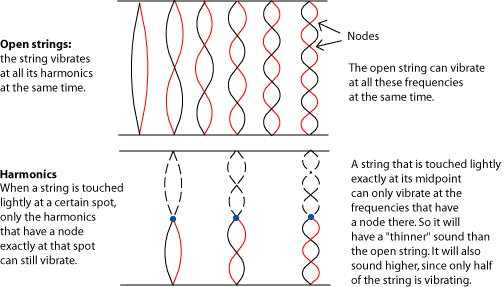
When you pluck a string fixed at both ends, it doesn't just vibrate along its entire length. It also simultaneously vibrates in fractions of its length. These different modes of vibration are quantized by the boundary conditions—the fixed ends of the string, which must be nodes of the standing wave.
- The string vibrates as a whole (one anti-node), producing the fundamental, .
- It vibrates in two halves (two anti-nodes), producing the second harmonic, .
- It vibrates in three thirds (three anti-nodes), producing the third harmonic, .
- And so on, for all integer divisions.
The following image illustrates the first six modes of vibration for a string and connects them to their musical intervals.

This next image provides a clear visual distinction between how an open string vibrates with all its harmonics at once, versus how a musician can isolate a specific harmonic by lightly touching the string at a node.
From Harmonics to Timbre
We now arrive at the central concept: timbre (pronounced TAM-ber), or tone color. Timbre is what allows us to distinguish between two instruments playing the same note at the same loudness. It is determined almost entirely by the harmonic content of the sound—specifically, the number of harmonics present and their relative amplitudes.
A sound with strong, high-frequency harmonics will be perceived as "bright" or "buzzy," while a sound with only a few low-frequency harmonics will sound "mellow" or "pure." The sine wave is the limit case: it has only one harmonic (the fundamental) and thus no overtones.
The following video from music producer Andrew Huang is an excellent demonstration of these concepts. He uses a spectrum analyzer to show the harmonic "fingerprints" of different sounds and demonstrates how timbre is constructed.
The most mind-blowing concept in music (Harmonic Series)
This video provides a practical, musically-oriented look at the harmonic series and its direct relationship to timbre and synthesis.
Please watch from the bass guitar example. Pay close attention to the spectrum analyzer when he compares the guitar and clarinet. The demonstration where he uses an EQ to isolate the fundamental is particularly revealing. Then, watch the next segment on additive synthesis, where he builds complex timbres by combining simple sine waves. This directly connects the theory of harmonics to the practice of sound design in electronic music.
As you saw, the unique timbre of any instrument is simply the result of its particular "recipe" of harmonic amplitudes. The physical construction of an instrument determines which harmonics are emphasized and which are suppressed.
Quantifying Timbre
Given your background, you'll appreciate that we can move beyond qualitative descriptions like "bright" or "mellow" and quantify timbre using objective, mathematical measures. These are often called spectral features. They are essentially statistical descriptors of the sound's power spectrum.
The following resource, from a university course on computer audition, details several of these features.
These lecture slides provide a formal, quantitative framework for describing timbre.
First, quickly review the physical vs. psychological properties of sound on slide 10. Then, focus on the sections detailing Spectral Features (slides 12-15) and Harmonic Features (slides 16-18). You don't need to memorize every formula, but understand what each feature measures. For example, see how the Spectral Centroid is analogous to a center of mass calculation for the spectrum. Finally, review the Source-Filter Model on slides 21-23.
The source-filter model is a particularly powerful concept for electronic music production. It provides the theoretical basis for subtractive synthesis, the most common synthesis method.
- Source: An oscillator generates a harmonically rich waveform (e.g., a sawtooth or square wave). This is the "harmonic comb."
- Filter: A filter module then shapes this raw sound by attenuating or boosting certain frequency regions. This creates the "spectral envelope."
The final timbre is the product of the source spectrum and the filter's frequency response. By manipulating these two components, you can create a vast universe of sounds.
The Broader Impact: From Timbre to Tuning
The influence of the harmonic series extends far beyond timbre. It is also the foundation of harmony and tuning. The consonant intervals in Western music (octaves, fifths, fourths) are not arbitrary cultural conventions; they are a direct consequence of the simple integer frequency ratios found among the lowest, most powerful harmonics.
The following video explains how the interaction between the harmonic series of two different notes creates our perception of consonance and dissonance.
This video from minutephysics masterfully connects the physics of overtones to the perceptual experience of music.
Please watch the section from "dissonance in notes with overtones". The key insight here is that the perceived consonance or dissonance between two notes is the sum of all dissonances between all their component harmonics. This explains why certain frequency ratios sound "in tune"—they minimize the dissonance between their respective harmonic series. Notice the contrast drawn between instruments with harmonic overtones (strings, pipes) and those with inharmonic overtones (bells, drums).
This idea that "tuning comes from overtones" is profound. The harmonic series of vibrating strings and pipes is the physical phenomenon upon which most of Western music theory is built. The experimental genres you're interested in, like industrial and noise, often derive their character from using sounds with complex, inharmonic overtone structures, deliberately clashing with the expectations set by the harmonic series.
Conclusion
In this lesson, we have established a bridge from the physics of vibration to the perception of musical sound.
Here are the key takeaways:
- Most musical sounds are complex periodic waveforms that can be decomposed into a series of sine waves: a fundamental and its overtones.
- In many instruments, these overtones form a harmonic series, with frequencies that are integer multiples of the fundamental.
- Timbre, the quality or "color" of a sound, is determined by the specific amplitudes of these harmonics.
- We can quantify timbre using spectral features like the spectral centroid, and understand its creation through the source-filter model.
- The harmonic series is not just about timbre; its inherent frequency ratios are the foundation for musical concepts of consonance, dissonance, and tuning.
In our next lesson, we will zoom in on the most fundamental relationship within the harmonic series: the 2:1 frequency ratio between the first and second harmonics. This relationship defines the octave, the primary building block for all musical scales and the bedrock of pitch perception.