Hello! Welcome back.
In our last lesson, we delved into the theoretical underpinnings of exciton fine structure, establishing how crystal field and spin-orbit coupling give rise to the specific band symmetries in a crystal like Cu₂O. We concluded that the electron-hole exchange interaction splits the ground-state exciton into two distinct species: the spin-triplet, optically active orthoexciton and the spin-singlet, optically forbidden paraexciton.
Today, we will connect this theory to tangible, experimental evidence. Our learning goal is to analyze experimental signatures of ortho- and para-excitons in absorption and photoluminescence spectra. We will examine how these two states, one "bright" and one "dark," leave distinct fingerprints in spectroscopic data. For you, this is a particularly crucial lesson, as these are the very techniques and signatures you will encounter and analyze in your research on excitons in Cu₂O.
1. Signatures in Absorption Spectra
An absorption spectrum measures the photons that are removed from a beam as it passes through a material, promoting electrons to excited states. Let's see how ortho- and para-excitons manifest here.
Direct and Indirect Absorption
As we established using group theory, the ground state to 1S paraexciton transition is strictly forbidden for single-photon absorption due to spin conservation. The 1S orthoexciton transition is electric-dipole forbidden but weakly electric-quadrupole allowed in Cu₂O.
The most prominent feature in the absorption spectrum of a high-quality semiconductor like Cu₂O is not the ground state exciton, but the Rydberg series of higher-energy P-states (2P, 3P, etc.). These transitions are dipole-allowed and thus much stronger.
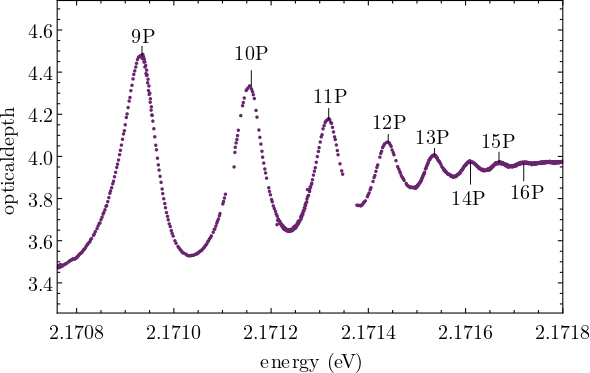
So, how can we "see" the dark paraexciton?
- Phonon-Assisted Absorption: A transition can become weakly allowed if the crystal lattice participates by creating or annihilating a phonon. This process creates broad, continuous absorption features starting at , but it's an indirect signature.
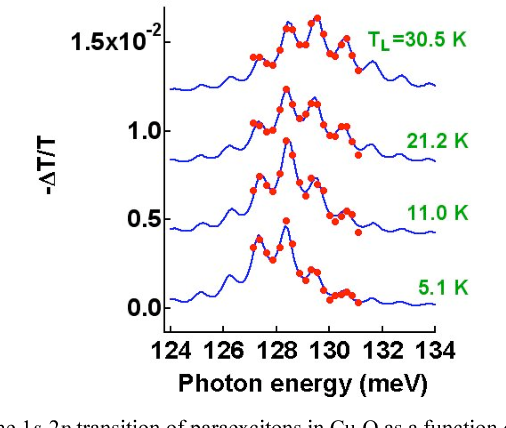
- Induced Absorption (Pump-Probe Spectroscopy): A much more powerful and direct method is to probe the absorption from an excited population. In this technique, a "pump" laser pulse first creates a population of excitons. Many of the initially-created, higher-energy excitons and orthoexcitons will quickly relax into the lower-energy, long-lived 1S paraexciton state. A second, delayed "probe" pulse then measures the sample's absorption. This probe beam can be absorbed by the existing paraexcitons, promoting them to higher excitonic states (e.g., from 1S-para to 2P-para). Since this is an s→p transition, it is dipole-allowed and produces a strong signal.
The following resource provides a good overview of the theory behind induced absorption and presents experimental data.
Lifetime of Paraexcitons in Cuprous Oxide
This Master's Thesis, 'Lifetime of Paraexcitons in Cuprous Oxide' by Marian Otter, provides a clear introduction to the experimental techniques used to study excitons. We will focus on the sections describing induced absorption and its interpretation.
Please read Section 2.7: Induced absorption (pages 29-31). Focus on the main idea: you are measuring absorption not from the ground state, but from an existing population of 1s excitons. Pay attention to how the lineshape of the induced absorption (Equation 2.21) depends on the thermal distribution of the initial 1s exciton population.
This technique results in a "differential transmission" signal (), which directly maps the population of paraexcitons. The image below shows such spectra for Cu₂O at various temperatures. You can see distinct absorption features corresponding to transitions originating from the populated paraexciton level.
2. Signatures in Photoluminescence (PL) Spectra
Photoluminescence (PL) measures the light emitted when excited states relax back down. It's the inverse process of absorption and is exceptionally sensitive to the nature of the emitting state.
Direct vs. Phonon-Assisted Recombination
- Orthoexciton PL: The 1S orthoexciton can decay radiatively via its weak, quadrupole-allowed channel. This produces a sharp, but often faint, emission line right at the orthoexciton energy, often labeled .
- Paraexciton PL: The 1S paraexciton is dark. Its direct radiative decay is forbidden. Therefore, you will not see a sharp emission line at the paraexciton energy.
The dominant PL mechanism, especially in indirect-gap materials but also crucial in Cu₂O, is phonon-assisted recombination. Here, an exciton recombines by emitting both a photon and a phonon. This process relaxes the strict -selection and spin-selection rules, allowing even dark excitons to emit light.
This gives rise to broad emission bands in the PL spectrum:
- Stokes Line: A band shifted to lower energy than the direct line by one phonon energy ().
- Anti-Stokes Line: A band shifted to higher energy (), requiring thermal energy to absorb a phonon from the lattice.
To understand how these features appear in a real spectrum, please read the following section.
Lifetime of Paraexcitons in Cuprous Oxide
Let's return to the thesis by Otter to see how these PL concepts are applied. This section explains how a typical PL spectrum of Cu₂O is deconstructed.
Please read Section 2.6.3: Linewidth of the emission spectrum (pages 25-28). Focus on Figure 2.8, which shows a typical 77 K spectrum. Identify the sharp direct-recombination line (X_o), the Stokes line, and the anti-Stokes line. Note the key insight: the shape of the phonon-assisted bands reveals the exciton temperature, while the intensity ratio of Stokes-to-anti-Stokes bands reveals the lattice temperature.
Lifetime Differences
The most dramatic signature distinguishing ortho- and para-excitons is their lifetime.
- Orthoexcitons have multiple fast decay channels: direct radiative recombination (ns scale), non-radiative decay, and—most importantly—fast relaxation to the lower-energy paraexciton state. Their lifetime is typically in the nanosecond range.
- Paraexcitons, unable to decay radiatively, are very long-lived. Their lifetime is limited only by slower processes like phonon-assisted recombination, trapping at defects, or non-radiative recombination. Lifetimes can be in the microsecond to millisecond range.
Time-Resolved PL (TRPL) can beautifully disentangle these. Immediately after excitation, you see PL from the short-lived orthoexcitons. At later times, this signal vanishes, and all that remains is the slow, weak, phonon-assisted PL from the vast population of long-lived paraexcitons. The resource below shows this dynamic explicitly.
Lifetime of Paraexcitons in Cuprous Oxide
This section of the Otter thesis shows experimental data that directly visualizes the different timescales of ortho- and para-excitons.
Please examine Section 4.3 and focus on Figure 4.8 (page 56). This plot shows the time evolution of signals corresponding to different intra-exciton transitions. Notice that the orthoexciton signals (blue and green triangles) appear instantly and decay quickly, while the paraexciton signal (red circles) takes time to build up (as orthoexcitons convert into paraexcitons) and then persists.
Test your understanding!
You perform a PL experiment on a Cu₂O sample at a lattice temperature of 77 K. You observe a sharp peak at 2.033 eV and a broad sideband that peaks around 2.019 eV. The phonon involved in the dominant phonon-assisted process in Cu₂O (the Γ⁻₁₂ phonon) has an energy of about 13.6 meV.
- What are the likely origins of these two spectral features?
- You then perform TRPL. How would you expect the time-dependence of these two features to differ?
Show answer
- The sharp peak at 2.033 eV is the direct, quadrupole-allowed recombination of the 1S orthoexciton. The broad sideband is the Stokes phonon-assisted recombination of the orthoexciton population. Its peak is shifted down from the direct line by the phonon energy: .
- In a TRPL experiment, the sharp orthoexciton peak at 2.033 eV would exhibit a very fast decay (on the scale of nanoseconds), as it has fast radiative and non-radiative decay channels. The phonon-assisted luminescence, which includes contributions from the slowly-decaying paraexciton population, would show a much slower decay component (microseconds or longer).
3. Advanced Case Study: Dark-to-Bright Conversion in Cu₂O
Selection rules are not absolute laws; they can be bypassed. A fascinating experiment in Cu₂O demonstrates this by using two-photon absorption (TPA) to selectively populate "dark" exciton states and then observing "bright" luminescence. This is a perfect illustration of how different experimental geometries and techniques can be combined to reveal subtle physics.
Cuprous Oxide (Cu2 O): A Unique System Hosting Various ...
This paper by Jang et al. presents a detailed study of excitons in Cu₂O, including a clever experiment that reveals a 'dark-to-bright' conversion process. It's an excellent example of applying selection rules in a real experiment.
Please read Section 4: Resonant two-photon excitation and selection rules (pages 6-9, up to the end of the second paragraph on page 9). The key experimental setup is that for a specific crystal orientation and light polarization, TPA only creates dark orthoexciton states. The puzzle is to explain the resulting PL spectrum shown in Figure 3. Focus on the authors' explanation for the strong X_o line: the conversion of the initial dark states into bright states that can then radiate.
As the paper explains, even though the laser exclusively creates dark excitons, these can scatter and convert into bright orthoexciton states. It is these subsequently populated bright states that produce the sharp PL line. The experimenters confirm this by analyzing the polarization of the emitted light (Figure 4a), which matches the one-photon selection rules for bright states, not the two-photon rules used for excitation.
This experiment beautifully demonstrates that excitons are not static entities. They are dynamic, and they can change their character through scattering and relaxation processes—a perfect lead-in to our next topic.
Conclusion
In this lesson, we have bridged the gap between the abstract group theory of exciton fine structure and the concrete world of spectroscopy.
Key Takeaways:
- Ortho- and para-excitons leave distinct fingerprints in spectra. Dark paraexcitons are typically invisible in direct absorption and emission.
- Absorption Signatures: Paraexcitons are best observed via induced absorption (pump-probe), where they absorb light to transition to higher, p-like states.
- PL Signatures: The key signatures in PL are the sharp, direct orthoexciton line (), the broad, phonon-assisted sidebands (from which both ortho and para PL can be seen), and the stark difference in lifetimes (ns for ortho vs. µs-ms for para).
- A combination of spectroscopic techniques—steady-state absorption/PL, time-resolved PL, and pump-probe—is essential to build a complete picture of the exciton states and their dynamics.
Preview of the Next Lesson
We've seen that excitons are not static; they relax, convert, and recombine. We've talked about their lifetimes, but what happens during that lifetime? How do they move? In the next lesson, we will begin our exploration of exciton dynamics by learning to model exciton transport using a drift-diffusion equation and relate mobility to momentum relaxation time. This will be our first step in understanding how excitons propagate and interact within the crystal.