Hello! Welcome to the third lesson in our course on exciton physics.
In our previous lesson, we developed the powerful envelope function approximation (EFA). This allowed us to separate a particle's wavefunction into a fast, lattice-periodic part and a slow envelope, which obeys a familiar Schrödinger equation with an effective mass, . This was a crucial step in simplifying the complex problem of an electron in a crystal.
Before we combine the EFA with the electron-hole Coulomb interaction to build the exciton model, we must first understand the process that creates the electron-hole pair: the absorption of a photon. The rate of this absorption depends on the number of available states for the transition. Today, we will quantify this by formulating the joint density of states (JDOS) for an electron-hole pair and defining the associated reduced effective mass.
1. The Energy of an Optically-Generated Electron-Hole Pair
Imagine a photon with energy incident on a direct bandgap semiconductor. This photon can be absorbed, exciting an electron from a state in the valence band to a state in the conduction band, leaving behind a hole.
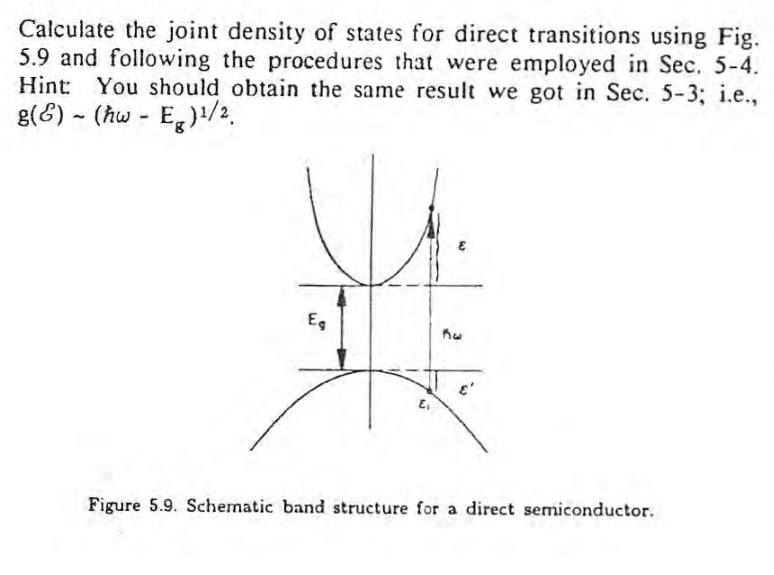
A key principle governing this interaction, which we will derive rigorously in the next lesson, is the conservation of crystal momentum. Since the photon's momentum is negligible compared to the crystal momentum of electrons, the initial and final electron states must have nearly the same wavevector, . This is known as a vertical transition.
Let's model the energy bands near the band edge () using the parabolic approximation we're familiar with:
- Conduction band (electron):
- Valence band (hole):
Here, and are the effective masses of the electron and hole, respectively (for simplicity, we consider a single hole band for now). is the conduction band minimum and is the valence band maximum.
The energy required for a vertical transition at a specific wavevector is the difference between the final and initial electron energies:
Substituting the parabolic band expressions, we get:
The first term is simply the bandgap energy, . We can combine the kinetic terms:
2. The Reduced Effective Mass
The expression for the transition energy contains a term combining the inverse effective masses of the electron and the hole. This structure is analogous to the one that appears in classical mechanics when analyzing a two-body problem (like a planet orbiting the sun). We can simplify it by defining a single quantity, the reduced effective mass, :
Using this definition, the transition energy simplifies beautifully:
This is a profound result. The energy landscape for creating an electron-hole pair via a vertical transition is mathematically identical to that of a single particle with an effective mass in a band with a minimum energy of . This simplification is central to all of exciton physics.
The following video provides a concise and clear explanation of these concepts, motivating why the reduced mass and a new density of states are needed for optical transitions.
Please watch the entire video (0:00 - 8:43). It will reinforce the ideas of vertical transitions and the combination of electron and hole energies, leading to the introduction of the reduced mass.
3. Formulating the Joint Density of States
Now we can address the main question: For a given photon energy , how many pairs of states (one electron state in the conduction band, one hole state in the valence band) are available for this transition? This quantity, per unit volume and per unit energy, is the joint density of states (JDOS), often written as or .
Given that the transition energy has the same form as the energy dispersion for a single particle, we can surmise that the JDOS will have the same functional form as a single-band density of states, but with the effective mass replaced by the reduced effective mass and the band edge energy replaced by .
Let's see this derived rigorously.
Optical absorption in semiconductors
The following lecture notes from David Miller provide a clear, first-principles derivation of the joint density of states.
Please read the section titled 'Total transition rate' (it appears on slide 10 of the PDF). You don't need to follow every detail of the pre-factors from Fermi's Golden Rule. Instead, focus on the core logic: The starting point is a sum over all k-states. This sum is converted into an integral over k-space. The structure of the transition energy, E_J(k), allows for the definition of the 'reduced effective mass'. The argument then follows the standard procedure for finding a density of states in energy, resulting in the expression for the 'joint density of states' g_J(E).
4. The Derivation and Final Result
Let's break down the logic from the reading. The total transition rate is proportional to a sum over all possible initial states (all in the valence band) and final states. Due to momentum conservation, for each initial state , the final state is fixed to be the state with the same in the conduction band. The total rate is therefore proportional to:
where the delta function enforces energy conservation.
To evaluate this, we convert the sum over discrete -states into an integral over the continuous -space. For a crystal of volume , the conversion is , where the factor of 2 accounts for spin degeneracy. For the density (rate per unit volume), this becomes:
The integral on the right is exactly what defines our joint density of states, evaluated at the photon energy .
This is a standard integral. We switch to spherical coordinates for and change variables from to the transition energy . The calculation is identical to the one for a single parabolic band, yielding the final result for :
This equation tells us that for photon energies below the bandgap, there are no states available for absorption (). Above the bandgap, the number of available pairs of states grows as the square root of the excess energy, . This square-root dependence is a classic signature of direct optical absorption in bulk semiconductors and is a direct consequence of the 3D nature of the crystal.
Test your understanding!
How would you expect the functional form of the joint density of states, , to change for a 2D system like a single quantum well? (Hint: Recall how the density of states for a single parabolic band behaves in 2D versus 3D).
Show answer
In 2D, the density of states for a single parabolic band is a constant, independent of energy (for ). Since the joint-energy dispersion retains its parabolic form, the 2D joint density of states will also be a constant for . It will be a step function: zero for and a constant value for . This step-like onset of absorption is a hallmark of 2D electronic systems.
Lesson Summary
Today we have built a critical piece of the framework for understanding light-matter interactions in semiconductors.
- We defined the energy of an electron-hole pair created by a vertical optical transition.
- We introduced the reduced effective mass, , which allows the energy of the e-h pair to be treated as a single quasi-particle. The transition energy is .
- We formulated the joint density of states (JDOS), which counts the number of available transition pathways for a given photon energy.
- We derived the characteristic square-root dependence of the 3D JDOS for energies above the bandgap: .
Preview of the Next Lesson
We now know how many states are available for a transition of a given energy. The next question is: what is the probability that a transition will actually occur? This is governed by quantum mechanical selection rules and transition matrix elements. In the next lesson, we will use Fermi's Golden Rule to evaluate the optical transition matrix elements for direct bandgap semiconductors and formally establish the -selection rule () that we used as a starting point today.