Hello! In our last lesson, we established the crucial condition under which a gas of excitons can be treated as an ideal gas of bosons: the low-density limit, . This means that as long as the excitons are, on average, far apart from each other compared to their own size, we can neglect their internal fermionic structure and the complexities of Pauli blocking.
Today, we will take this idea and run with it. Assuming we have an ideal Bose gas of excitons, what collective quantum phenomena can we expect? This brings us to one of the most remarkable states of matter: the Bose-Einstein Condensate (BEC). This lesson is dedicated to achieving the learning outcome: Derive the critical temperature for Bose-Einstein condensation (BEC) of a 3D ideal exciton gas.
We will embark on a detailed derivation, applying the principles of statistical mechanics you are familiar with to our exciton system. We will determine the specific temperature below which a macroscopic fraction of excitons is predicted to collapse into the single lowest-energy quantum state.
1. The Physical Picture of Condensation
Before diving into the mathematics, let's build a physical intuition for what triggers this phase transition. At its heart, BEC is a consequence of the wave-particle duality of matter. Every exciton has an associated thermal de Broglie wavelength, , which increases as the temperature decreases.
Wolfgang Ketterle, a Nobel laureate for his work on BEC, provides a very clear picture of this process.
2001 Nobel Laureate Lecture in Physics - Wolfgang Ketterle, The Story of Bose-Einstein Condensates
In this segment from his Nobel lecture, Wolfgang Ketterle explains the concept of BEC in terms of overlapping matter waves. This provides the essential physical intuition for the derivation we are about to undertake.
Watch the clip from 13:36 to 16:00. Pay close attention to the relationship between temperature, de Broglie wavelength, and inter-particle spacing as the condition for condensation.
As Ketterle explains, at high temperatures, the excitons behave like classical billiard balls. As the system is cooled, their de Broglie wavelengths grow. The transition to a BEC occurs when the temperature is so low that becomes comparable to the average distance between excitons. At this point, the individual exciton wave packets overlap, lose their individuality, and merge into a single, coherent macroscopic quantum state—a giant matter wave.
Our goal is to translate this picture, , into a precise formula for the critical temperature, .
2. The Bose-Einstein Distribution and the Chemical Potential
The starting point for any analysis of an ideal Bose gas is the Bose-Einstein distribution, which gives the average number of non-interacting bosons, , in a quantum state with energy :
where and is the chemical potential.
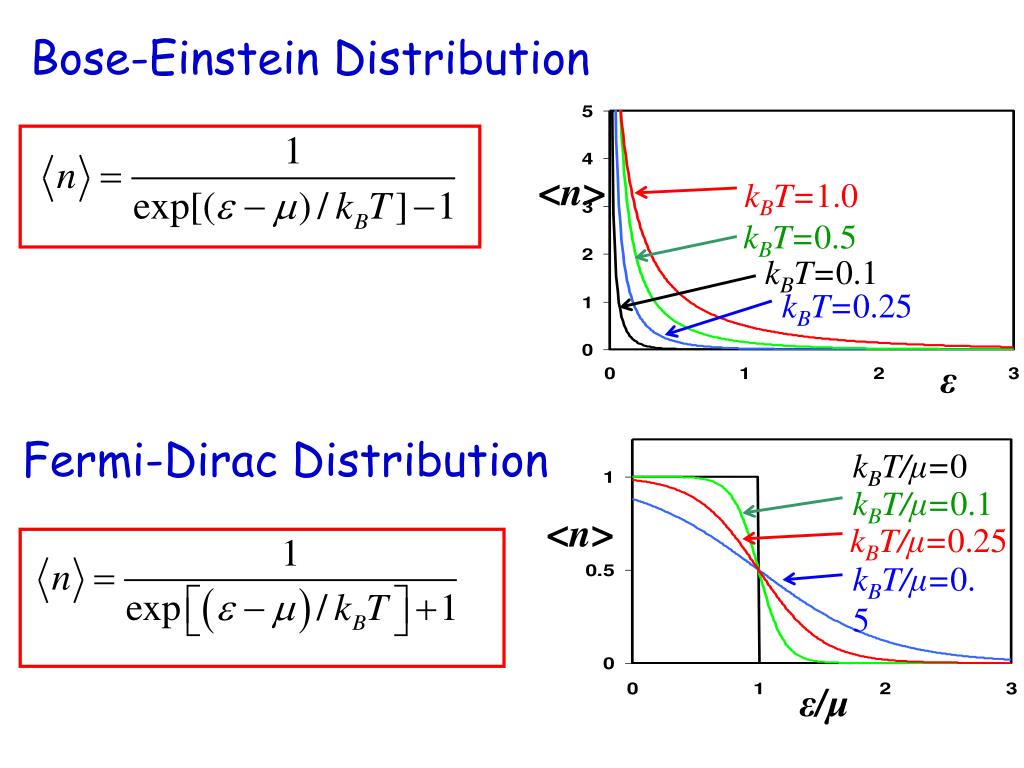
The chemical potential plays a pivotal role. Since the occupation number must be positive or zero for any state, the denominator must always be positive. For the ground state where , this imposes a strict constraint:
Since , this can only be true if is negative. Thus, for a gas of bosons, the chemical potential must always be less than or equal to the ground state energy, which we set to zero.
What happens as we lower the temperature? The system tries to accommodate more and more particles in the lower energy states. To increase for a given , the value of must increase, approaching zero from the negative side. This behavior is the key to identifying the critical point for condensation.
The following video provides an excellent and detailed explanation of the role of the chemical potential and sets up the problem of counting the total number of particles.
PHYS 3113 Lecture 11- Ideal Bose Gas and Bose-Einstein Condensation
This lecture from UNSW Physics provides a clear, step-by-step tutorial on the ideal Bose gas and BEC. The first part focuses on the subtleties of the chemical potential.
Please watch the segment from 2:43 to 11:52. The video will review the Bose-Einstein distribution and carefully explain why the chemical potential \mu must be negative and how it behaves as you cool the system toward BEC.
3. Deriving the Critical Temperature
As the video explains, a subtlety arises when we calculate the total number of excitons, . In the thermodynamic limit, we can replace the sum over discrete states with an integral over a continuous density of states, . However, for a 3D gas of particles, , which means . The integral would therefore completely miss the population of the ground state.
Since BEC is defined by the macroscopic occupation of the ground state, we must treat it separately. We write the total number of excitons as the sum of the number in the ground state, , and the number in all excited states, :
The number in the excited states is given by the integral:
At a given temperature , this integral for is a monotonically increasing function of . Since , the integral has a maximum value which occurs when . This means there is a maximum number of particles, , that can be accommodated in the excited states at temperature .
What happens if the total number of particles is greater than ? The "excess" particles, , have nowhere else to go and must accumulate in the ground state, . This is the onset of Bose-Einstein condensation.
The critical temperature, , is defined as the temperature at which the maximum number of particles the excited states can hold is exactly equal to the total number of particles, . Below this temperature, must be macroscopic. At , we therefore have two conditions:
- , so
We can now find by setting and in our integral equation at :
The derivation now proceeds with this integral.
PHYS 3113 Lecture 11- Ideal Bose Gas and Bose-Einstein Condensation
Continuing with the same UNSW Physics lecture, the next segments walk through the exact mathematical derivation of T_c.
Watch from 11:52 to 21:35. This part first explains how the critical temperature is defined by setting \mu=0. It then substitutes the 3D density of states and performs the integral, making use of the Riemann zeta function to arrive at the final expression for T_c.
Let's summarize the key steps of the derivation you just saw.
- Density of States: For a 3D gas of excitons with mass and spin degeneracy in a volume , the density of states is:
- Integral at : We substitute this into our critical condition integral:
- Change of Variables: Let . Then and . The integral becomes:
- Standard Integral: The integral is a standard form related to the Riemann zeta function and the Gamma function :
For our case, . Using , our integral evaluates to . - Solving for : Substituting this result and rearranging for , we arrive at the expression for the critical temperature. Letting be the exciton density:
where . This is the central result of our lesson. You can also find this formula presented clearly in the thesis by Keeling (resource LINK, Eq. 1.5) and derived in the dissertation by Som (resource LINK, section 1.7.1).
4. Condensate Fraction for
What happens below the critical temperature? For , the chemical potential remains pinned very close to zero (), and the number of excitons in the excited states is:
Following the same integration procedure, we find a simple relationship:
The remaining excitons must be in the ground state. The fraction of excitons in the condensate, , is therefore:
This is a famous result that characterizes the growth of the condensate as the system is cooled below . The UNSW video explains this final step well.
PHYS 3113 Lecture 11- Ideal Bose Gas and Bose-Einstein Condensation
This final clip from the UNSW lecture derives the temperature dependence of the condensate fraction below T_c.
Watch from 21:35 to 29:52. Focus on how the number of particles in the excited state is calculated for T<T_c and how this leads directly to the formula for the condensate fraction.
The function serves as the order parameter for this phase transition. It is zero above the transition and continuously grows from zero as the temperature is lowered below , indicating that this is a continuous, or second-order, phase transition.
Test your understanding!
Let's connect this theory to your research interests. The yellow-series ground-state exciton in Cu₂O has an effective mass of (where is the free electron mass) and is three-fold degenerate (ortho-exciton), so we can take . Assuming you can create an exciton gas with a density of , calculate the critical temperature for BEC.
(Helpful constants: J·s, kg, J/K, ).
Show answer
First, let's assemble the values in SI units:
Now, let's calculate the term in the parentheses:
Raise this to the 2/3 power:
Now, calculate the prefactor:
Finally, multiply them to get :
And solve for :
This calculation shows that for a dense gas of excitons in Cu₂O, BEC is predicted to occur at liquid helium temperatures, which is experimentally accessible. This is a key reason why Cu₂O is a leading platform for studying exciton BEC.
Conclusion
In this lesson, we performed a complete derivation of the critical temperature for Bose-Einstein condensation in a 3D ideal gas, a model directly applicable to a low-density exciton gas.
Key Takeaways:
- BEC occurs when the thermal de Broglie wavelengths of bosons become comparable to their average separation.
- The transition is driven by the saturation of excited states. Below , the excited states cannot hold all the particles, forcing the remainder into the ground state.
- The derivation requires separating the ground state population from the integrated density of excited states .
- The critical temperature is found by setting the chemical potential and is given by:
- For , the fraction of excitons in the condensate is given by the order parameter:
Preview of the Next Lesson
Our entire discussion today was based on a 3D gas. However, many modern semiconductor systems confine excitons to two dimensions (e.g., in quantum wells). Does BEC still occur in 2D? The answer is more complex. In the next lesson, we will investigate this and address the learning outcome: Describe the Berezinskii-Kosterlitz-Thouless (BKT) transition for interacting 2D exciton systems. We will find that while true long-range order is forbidden, a unique phase transition to a "quasi-condensate" with algebraic order is still possible.