Hello! Let's continue our exploration of the fascinating intermediate magnetic field regime.
In our last lesson, we established the fundamental reason for the complex behavior of excitons when . We saw that the competition between the spherical Coulomb symmetry and the cylindrical magnetic symmetry renders the Hamiltonian non-separable and non-integrable. Furthermore, we discovered that for specific magnetic field orientations, the underlying cubic symmetry of the crystal can break even the last remaining antiunitary symmetries. This non-integrability is the gateway to quantum chaos.
Today, we will investigate the observable consequences of this underlying chaotic nature. Our goal is to analyze level repulsion and the phenomenon of avoided crossings in the exciton energy spectrum as signatures of quantum chaos. These are the primary "fingerprints" that physicists look for to identify and characterize chaotic behavior in quantum systems.
Visualizing Chaos: Avoided Crossings and Level Statistics
Before diving into the theory, let's look at what these signatures of chaos look like. The image below illustrates the key concepts we will discuss today.
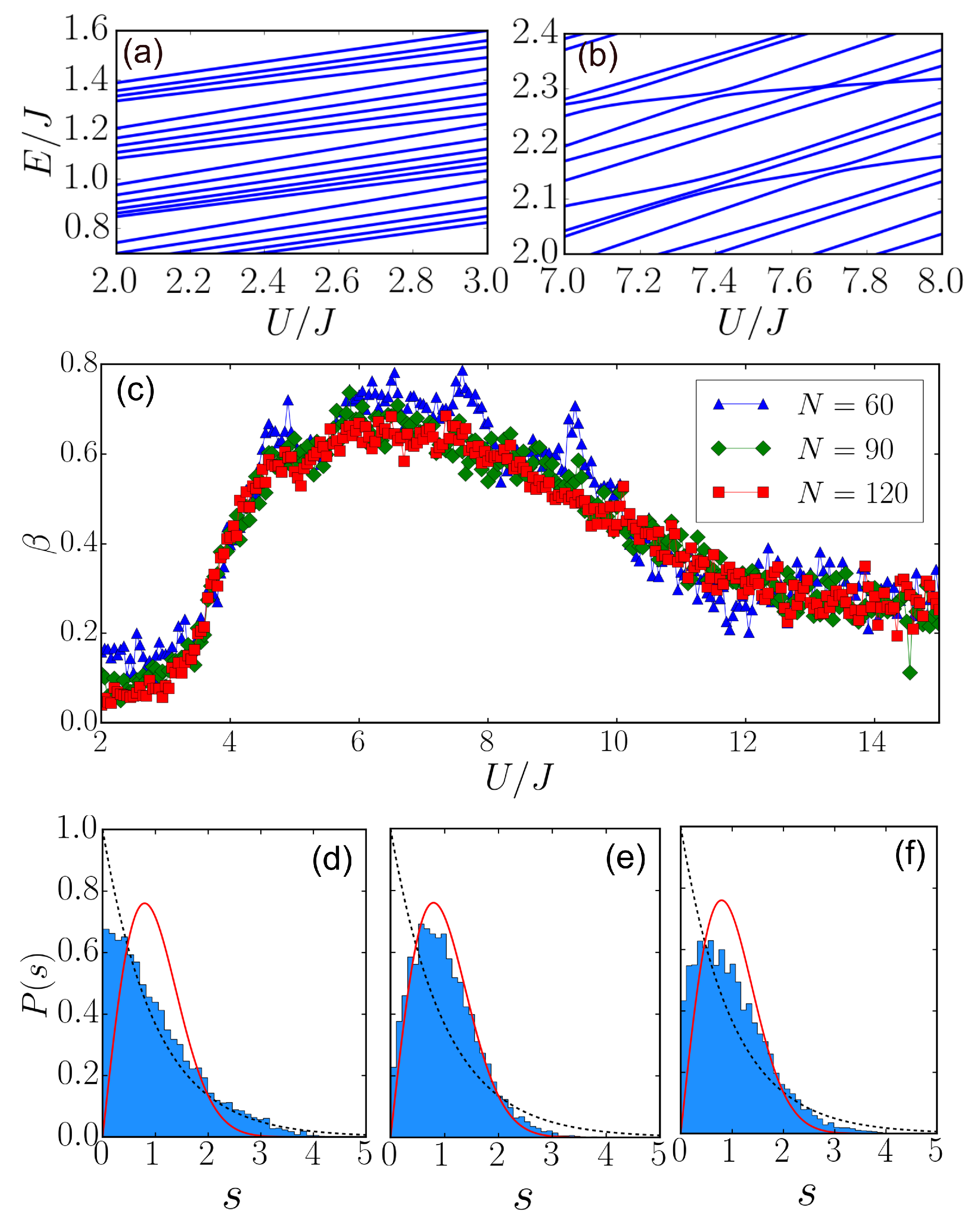
As we see here, the two key signatures are:
- Avoided Crossings: When we plot energy levels as a function of a parameter (like magnetic field strength), the levels in a chaotic system appear to repel each other rather than crossing.
- Level Spacing Statistics: The statistical distribution of the energy gaps between neighboring levels changes dramatically from a regular to a chaotic system.
Let's now understand the physics behind these phenomena.
The Von Neumann-Wigner Theorem: To Cross or Not to Cross
The concept of avoided crossings is formalized by the von Neumann-Wigner theorem. In simple terms, it states that for a generic quantum system whose Hamiltonian depends on a real parameter (like the magnetic field ), the energy levels will not cross unless they belong to states with different symmetries.
Let's consider two energy levels, and .
-
Integrable System: In an integrable system, there are multiple conserved quantities (like parity, total angular momentum, etc.). It's common for two states to have different quantum numbers for one of these conserved quantities. For example, one state might have even parity and another odd parity. The Hamiltonian cannot mix these states, meaning the matrix element . If we vary a parameter like the magnetic field, their energies and can become equal, and the levels will simply cross.
-
Non-Integrable (Chaotic) System: In a non-integrable system, most of the symmetries are broken. There are very few (or no) "good" quantum numbers left to distinguish the states. Therefore, almost any two states will have a non-zero Hamiltonian matrix element connecting them, .
To see what happens, we can use a simple 2x2 matrix model for two states that are approaching degeneracy:
The eigenvalues of this matrix are:
If the levels were to cross, we would need . This would require the term under the square root to be zero. However, since , the term can never be zero. The minimum energy separation between the two levels occurs when , and is given by . The levels approach each other but are forced apart by the coupling , creating an avoided crossing.
This repulsion is a direct consequence of the symmetry breaking and state mixing that characterize a non-integrable system.
From Avoided Crossings to Level Spacing Statistics
While a single avoided crossing is a strong hint of chaos, a more robust and quantitative measure comes from analyzing the statistics of the entire energy spectrum. In a chaotic system, all nearby levels tend to repel each other. This global "level repulsion" profoundly alters the distribution of energy gaps between adjacent levels, known as the Nearest-Neighbor Spacing (NNS) distribution, .
Here, is the spacing between adjacent energy levels, normalized so that the average spacing is 1. The key differences are:
-
Regular (Integrable) Systems: The energy levels are uncorrelated. There is no repulsion, so the probability of finding two levels very close together is high. The NNS distribution follows the Poisson distribution:
Note that , meaning zero spacing is the most probable outcome.
-
Chaotic (Non-Integrable) Systems: Level repulsion suppresses small spacings. The form of this repulsion depends on the fundamental symmetries of the Hamiltonian, as predicted by Random Matrix Theory (RMT).
- Gaussian Orthogonal Ensemble (GOE): This applies to systems that are chaotic but still possess an antiunitary symmetry (like time-reversal). The probability of small spacings is linearly suppressed: . The distribution is the Wigner distribution:
- Gaussian Unitary Ensemble (GUE): This applies to systems where all antiunitary symmetries are broken. The level repulsion is even stronger, with quadratic suppression: . The distribution is:
As you'll recall from our last lesson, magneto-excitons in cubic crystals are remarkable because they can exhibit either GOE or GUE statistics depending on the magnetic field's orientation relative to the crystal axes.
The following reading assignment delves into the mathematical forms of these distributions and their connection to magneto-exciton chaos.
arXiv:1705.06432v1 [nlin.CD] 18 May 2017
The paper 'GOE-GUE-Poisson transitions...' by Schweiner et al. provides the explicit formulas for the Poisson, GOE, and GUE distributions and visually contrasts them.
Please read the first half of Section IV, 'APPEARANCE OF GOE AND GUE STATISTICS'. Focus on the text from the beginning of the section down to and including Eq. (31). Pay close attention to the discussion of linear vs. quadratic level repulsion as the characteristic feature of GOE and GUE statistics.
Analyzing Chaos in Action
Let's now see how these concepts are applied to the exciton problem. The paper by Schweiner et al. provides an excellent case study using the exciton in Cu₂O.
arXiv:1707.02869v1 [cond-mat.mes-hall] 7 Jul 2017
The paper 'Level statistics of magnetoexcitons' by Schweiner et al. contains a figure that beautifully illustrates an avoided crossing and the resulting level repulsion in the NNS distribution.
Please study Figure 5 and its caption carefully. Panel (a) shows a calculated energy spectrum for n=5 exciton states in Cu₂O, with the inset highlighting a clear avoided crossing around B=1.98 T. Then, look at panel (c). This shows the normalized level spacings for three cases: no motional Stark field (blue), a Stark field in the symmetry plane (red), and an averaged Stark field that breaks the symmetry (green). Focus on how the probability of small spacings (s near 0) is progressively suppressed as more symmetries are broken, pushing the system towards a GUE-like distribution.
This analysis in Figure 5 is a powerful demonstration of our learning objective. You can see:
- An explicit avoided crossing in the calculated spectrum, a direct visual manifestation of level repulsion.
- The NNS distribution in panel (c) shows that as the system's symmetry is further reduced (by the motional Stark effect, which we discussed previously in the context of your Cu₂O research), the level repulsion becomes stronger. The green histogram, corresponding to the most broken symmetry, has the lowest probability at small , matching the behavior expected for GUE statistics.
Test your understanding!
An experimentalist performs a magneto-PL experiment on a new semiconductor. They plot the energy levels versus magnetic field and find many instances of avoided crossings. They then compute the nearest-neighbor spacing distribution from their data and find that it is very well described by the Wigner distribution, .
What can you infer about the Hamiltonian of the excitons in this material when the magnetic field is applied?
Show answer
- The system is non-integrable and exhibits quantum chaos. The presence of many avoided crossings and a level spacing distribution that is not Poissonian are clear signatures of this.
- The Hamiltonian possesses an antiunitary symmetry. The fact that the statistics follow the GOE (Wigner) distribution, which is characterized by linear level repulsion (), implies that an antiunitary symmetry, such as time-reversal, is preserved. If all such symmetries were broken, we would expect to see GUE statistics with quadratic repulsion ().
Conclusion
Today we have translated the abstract concept of non-integrability into concrete, observable signatures in the exciton energy spectrum.
Key Takeaways:
- Avoided crossings are the characteristic feature of non-integrable systems when energy levels are plotted against a parameter like the magnetic field. They arise from symmetry-breaking, which allows states to mix and repel each other.
- Level repulsion is the global manifestation of this phenomenon, which is quantitatively measured by the Nearest-Neighbor Spacing (NNS) distribution.
- The shape of the NNS distribution reveals the underlying symmetries of the chaotic system:
- Poisson: Regular (integrable) system.
- GOE (Wigner): Chaotic system with an antiunitary symmetry (e.g., time-reversal). Shows linear () level repulsion.
- GUE: Chaotic system with all antiunitary symmetries broken. Shows stronger, quadratic () level repulsion.
Preview of the Next Lesson
We have now seen why excitons in an intermediate field are chaotic and what the spectroscopic signatures of this chaos are. A natural question arises: how do theorists produce plots like the ones we've analyzed today? The analytical tools of perturbation theory fail in this regime. In our next lesson, we will address this by learning how to apply numerical diagonalization to solve the exciton problem in an arbitrary magnetic field strength. This will bridge the gap between the theoretical Hamiltonian and the complex energy spectra we've been interpreting.