Introduction
Welcome to our next lesson. In our previous session, we explored Ayurveda's strategic framework for health, distinguishing between its preventive, promotive, and curative dimensions and mapping them to modern public health concepts. We established that the ultimate goal of all these strategies is to maintain or restore a state of profound internal balance, or Swasthya.
This lesson will delve into the very nature of that balance. Our learning outcome is to: Analyze the dynamic relationship between Dosha-Dhatu-Mala equilibrium and Swasthya using clinical case scenarios.
We will move beyond the foundational definition of health to explore the intricate, moment-to-moment interactions that maintain it. We will examine the core Ayurvedic principle that defines disease as a specific type of disequilibrium, primarily involving the aggravation of Doshas and the depletion of Dhatus. To ground this deep conceptual analysis in your clinical reality, we will apply these principles to a detailed case scenario.
1. The Core Principle: Samyam as Health, Vaishamyam as Disease
The essence of Ayurvedic physiology and pathology is captured in a single, powerful verse from Charaka Samhita (Sutra Sthana 9/4):
विकारो धातुवैषम्यं साम्यं प्रकृतिरुच्यते।
Vikāro dhātuvaiṣamyaṁ, sāmyaṁ prakṛtirucyate.
This means: "Disease is the disequilibrium (Vaishamyam) of the Dhatus, while their equilibrium (Samyam) is called normalcy/health (Prakriti)."
To fully grasp this, we must understand 'Dhatu' and 'Vaishamyam' in their broadest sense. Please read the introductory sections of the following review paper, which expertly unpacks these terms.
a review on vikara dhatu vaishamyam
The paper 'A Review on Vikara Dhatu Vaishamyam' provides a crucial analysis of this foundational verse. The initial sections will clarify the comprehensive meaning of 'Dhatu' and the nature of 'Vaishamyam'.
Please read the 'INTRODUCTION' and the subsequent section that begins with the verse from Charaka Samhita. Focus on two key points: How the term 'Dhatu' in this context encompasses not just the seven tissues, but also the Doshas and Malas—all elements that 'uphold' the body. How 'Vaishamyam' (disequilibrium) includes both Vriddhi (increase/aggravation) and Kshaya (decrease/depletion).
As the paper explains, Dhatu Samyata refers to the state where the Doshas, Dhatus, and Malas are all in a state of functional harmony. However, this is not a static state. The Doshas, for example, have natural, healthy fluctuations throughout the day.

Swasthya (health) exists when these fluctuations occur within their normal physiological range. It's when a Dosha, Dhatu, or Mala moves beyond this range into a state of pathological excess (Vriddhi) or deficiency (Kshaya) that Vaishamyam—and thus disease—begins.
2. The Pathological Dynamic: Dosha Vriddhi and Dhatu Kshaya
While Vaishamyam can theoretically be either Vriddhi or Kshaya, classical texts and clinical observation reveal a more specific dynamic in the development of most diseases. The general pattern is an aggravation of Doshas leading to a depletion of Dhatus.
Let's explore the reasoning behind this critical concept, which forms the core of our analysis.
a review on vikara dhatu vaishamyam
We will now return to the review paper 'A Review on Vikara Dhatu Vaishamyam' to examine its central argument about the specific nature of disequilibrium in pathogenesis.
Please read the sections titled 'Evaluation of Dosha Vaishamya in Pathogenesis of Diseases' and 'Evaluation of Dhatu Vaishamya in Pathogenesis of Diseases'. While reading, focus on the evidence presented to support these two hypotheses: Why must a Dosha be in a state of Vriddhi (aggravation) to initiate disease? Why does the affliction of a Dhatu by a vitiated Dosha typically result in Dhatu Kshaya (depletion)? Pay attention to the role of Agni and Bala (immunity).
To summarize this crucial dynamic:
- Nidana Sevana (exposure to causative factors) leads to the aggravation of one or more Doshas.
- The aggravated Doshas (Dosha Vriddhi) begin to circulate and look for a site of weakness. A depleted Dosha (Dosha Kshaya) lacks the force to initiate this process.
- The aggravated Doshas lodge in a Srotas (channel) and begin to afflict the associated Dhatu.
- This affliction, coupled with the impaired metabolic fire (Agni) that is the root of most diseases, disrupts the nourishment and formation of the Dhatu.
- The result is qualitative and quantitative depletion of the tissue, or Dhatu Kshaya.
The clinical signs of many diseases are, in fact, the signs of the depletion of the Dhatus involved. For example, as noted in Table 6 of the paper you just read, the symptoms of Rasa Dhatu Kshaya (e.g., palpitations, exhaustion, intolerance to sound) are prominent features in diseases like Jwara (fever) and Pandu (anemia).
3. Completing the Triad: The Role of Mala
The Dosha-Dhatu-Mala triad is a closed-loop system. Health depends not only on the quality of the tissues (Dhatus) but also on the proper formation and elimination of waste products (Malas). There are two categories of Malas to consider:
- The three primary wastes: Purisha (feces), Mutra (urine), and Sweda (sweat).
- The Dhatu Malas: The specific waste products generated during the metabolic transformation of each Dhatu.
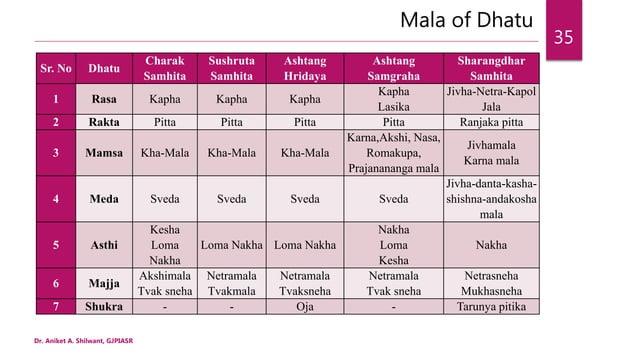
The health of the Dhatvagni (tissue-specific metabolic fire) determines the quality of three outputs:
- The subsequent Dhatu
- The Upadhatu (secondary tissue)
- The Dhatu Mala
If Rasa Dhatvagni is impaired, not only will Rakta Dhatu be poorly nourished, but the Mala of Rasa—which is Kapha—may be produced in excess or in a vitiated state, contributing further to the disease process. Therefore, assessing the state of the Malas provides crucial diagnostic clues about the state of Dhatu metabolism.
Test your understanding!
A patient presents with classic signs of Rajayakshma (a wasting disease, often correlated with tuberculosis), including severe weight loss (Karshya), low-grade fever, and a persistent cough. Based on the principle of Dosha Vriddhi and Dhatu Kshaya, how would you describe the underlying pathological cascade affecting the Dhatus?
Show answer
Rajayakshma is the archetypal disease of Dhatu Kshaya. The pathogenesis, according to Charaka, often involves Srotorodha (channel obstruction) that impairs the nourishment of the very first tissue, Rasa Dhatu.
- Initial Pathology: Vitiated Doshas (predominantly Vata and Kapha) cause obstruction in the channels responsible for nourishing Rasa Dhatu.
- Dhatu Kshaya Cascade (Anuloma Kshaya):
- The impairment of Rasa Dhatu leads to its depletion (Rasa Kshaya). This manifests as dryness, exhaustion, and emaciation.
- Since Rasa is the precursor to Rakta, Rakta Dhatu becomes depleted (Rakta Kshaya), leading to pallor and loss of vitality.
- This sets off a chain reaction, leading to the sequential depletion of all subsequent Dhatus: Mamsa (muscle wasting), Meda (fat loss), Asthi, Majja, and finally Ojas (the essence of all Dhatus), resulting in a profound loss of immunity and vitality.
- Dosha-Dhatu Interaction: In this case, the vitiated Doshas create an environment where the entire Dhatu chain is starved of nourishment, perfectly illustrating the principle of Dhatu Kshaya as the core manifestation of the disease.
4. Clinical Application: Analyzing Sthaulya (Obesity)
Let's now apply this framework to a clinical case. While the general rule is Dhatu Kshaya, some important exceptions exist, such as Sthaulya (obesity), where the primary pathology is the Vriddhi (increase) of a specific Dhatu. This case provides an excellent opportunity to analyze the complex dynamics of the D-D-M relationship.
Please read the background and pathophysiology of the following case report on Medovriddhi (obesity).
PHYSIOLOGICAL MECHANISM OF MEDOVRIDDHI WITH ...
This case report on a patient with obesity and osteoarthritis will allow us to analyze a real-world example of Dosha-Dhatu-Mala imbalance. It perfectly illustrates how the 'Vaishamyam' of one Dhatu can directly impact another.
Please read the 'INTRODUCTION' and the discussion on the pathophysiology of Sthaulya. Pay close attention to: The causative factors that lead to Kapha Dosha vitiation. The role of Medodhatvagni impairment. The concept of Srotorodha and how the excess of Meda Dhatu (fat tissue) leads to the malnourishment of the subsequent Asthi Dhatu (bone tissue).
Let's break down the Samprapti (pathogenesis) of Sthaulya in this patient using our framework:
- Nidana: The patient's history likely includes consumption of Guru (heavy), Snigdha (unctuous) foods and a sedentary lifestyle (Avyayama), which are classic causative factors.
- Dosha Vaishamyam: These factors lead to Kapha Dosha Vriddhi. Kapha's heavy, slow, and unctuous qualities are amplified.
- Dhatu Vaishamyam: This is a multi-layered process:
- The aggravated Kapha, along with increased Jatharagni, overwhelms and impairs the more subtle Medo-Dhatvagni.
- This leads to the improper, excessive formation of adipose tissue—a pathological Meda Dhatu Vriddhi. This is an exception to the Dhatu Kshaya rule.
- However, this abnormal excess of Meda obstructs the channels (Srotorodha).
- This obstruction prevents essential nutrients from reaching the next tissue in the metabolic sequence, the Asthi Dhatu.
- The result is a malnourishment and depletion of bone tissue—Asthi Dhatu Kshaya. This explains why the patient in the case study also suffers from osteoarthritis, a condition linked to tissue degeneration. This is a perfect illustration of the dynamic relationship: one Dhatu's Vriddhi causing another's Kshaya.
- Mala Vaishamyam: The Mala of Meda Dhatu is Sweda (sweat). In Sthaulya, a characteristic symptom is Atisweda (excessive sweating) with Daurgandhya (foul odor). This indicates a vitiation in the formation and function of the Dhatu's waste product, providing another key diagnostic clue about the state of Medo-Dhatvagni.
This case beautifully demonstrates that even in a disease defined by excess tissue, the underlying principles of Dosha Vriddhi and consequent Dhatu Kshaya (in a subsequent tissue) still hold true.
Conclusion
In this lesson, we have moved from a simple definition of health to a dynamic analysis of the physiological and pathological processes that govern it.
Key Takeaways:
- Swasthya is a state of dynamic equilibrium (Samyam) where Dosha, Dhatu, and Mala function harmoniously within their physiological ranges.
- Disease (Vikara) is Dhatu Vaishamyam, which in most clinical scenarios manifests as a cascade of Dosha Vriddhi (aggravation) leading to Dhatu Kshaya (depletion).
- The health of the Dhatus is interdependent. Pathological increase (Vriddhi) or obstruction (Srotorodha) related to one Dhatu can cause the depletion (Kshaya) of subsequent Dhatus.
- The state of the Dhatu Malas provides valuable clinical insights into the functioning of the corresponding Dhatvagni.
- By analyzing clinical conditions like Sthaulya, we can see these intricate relationships in action, guiding both diagnosis and treatment strategy.
Preview of the Next Lesson:
Throughout this lesson, we have repeatedly mentioned the central role of Agni—the metabolic fire—in transforming nutrients and maintaining the integrity of the Dhatus. In our next lesson, "Evaluate the role of Agni variations (Tikshna, Manda, Sama, Vishama) across different physiological states and their impact on health," we will focus directly on this master agent of metabolism. Understanding Agni is the key to understanding how Samyam is maintained and how Vaishamyam begins.