Introduction
Welcome back. In our last lesson, we mastered the art of community diagnosis by learning how to conduct a comprehensive Community Health Needs Assessment (CHNA). We framed this as the public health equivalent of Rogi Pariksha, enabling us to move from assumptions to an evidence-based understanding of a community's specific health challenges.
Having identified the what and the why of a community's health needs, our task now is to design the intervention—the Chikitsa for the community. Today's lesson focuses on precisely that. Our learning outcome is to design the core components of a community health workshop based on Swasthawritta principles (e.g., a 'Seasonal Eating' workshop).
We will shift from the diagnostic phase to the therapeutic design phase. You will learn to construct a structured, engaging, and effective educational experience that translates the principles of Swasthawritta into practical, actionable steps for a target audience. Think of this as formulating a Pathya-kalpana (therapeutic regimen), not for a single patient, but for a group, with the goal of empowering them to maintain their own health.
1. The Anatomy of a Health Workshop
An effective workshop is more than just a lecture; it's a carefully architected experience. Whether the topic is seasonal eating, stress management, or sleep hygiene, every successful workshop is built upon a foundation of core components. Let's break them down.
Component 1: The Foundation - Setting the Stage
Before you even think about content, you must define the workshop's purpose and scope. This involves three key elements:
- Target Audience & Prioritized Need: Who is this workshop for? What specific, evidence-based need (identified in your CHNA) are you addressing? For example: "University students struggling with seasonal allergies and low energy in the spring," or "Office workers with digestive complaints and sedentary habits."
- Learning Objectives: What should participants be able to do or explain by the end of the workshop? Well-defined objectives guide your content and allow you to measure success. They should be specific and action-oriented.
- Weak Objective: "Participants will learn about Ritucharya."
- Strong Objective: "By the end of the workshop, participants will be able to identify three key dietary changes to make for the upcoming Varsha Ritu to support their Agni."
- Core Ayurvedic Principle: What central Swasthawritta concept will anchor your workshop? For a seasonal eating workshop, the core principle is Ritucharya. For a stress management workshop, it might be the principles of Dinacharya, Sadvritta, and the role of Pranayama.
Component 2: The Structure - Crafting the Flow
A logical flow is crucial for keeping participants engaged and ensuring the information is absorbed. A highly effective and practical structure for an intervention session was used in a study on Ayurvedic practices. We can adapt this for our workshop design.
Effects of Ayurvedic practices on quality of life of health ...
The paper 'Effects of Ayurvedic practices on quality of life of health...' describes a successful intervention program for healthcare workers. While not a single workshop, its session structure provides an excellent model for us to follow.
Please read the subsection titled 'The intervention programme'. Focus on the three-part structure they used for each session: (1) Anchor, (2) Discussion, and (3) Challenge. This model provides a powerful framework for moving from personal connection to conceptual understanding and finally to practical application.
Based on this model, we can structure our workshop as follows:
- Anchor (Connect): An initial activity to ground participants in the present moment and connect them personally to the topic. It answers the "Why should I care?" question.
- Discussion (Learn): The core teaching segment where you explain the Ayurvedic principles. This is where you deliver the "What" and "Why" of the concept.
- Challenge/Application (Act): A practical, interactive segment where participants learn how to apply the knowledge. This delivers the "How."
Component 3: The Content - Activities and Materials
This component focuses on how you will deliver the information and what tangible resources participants will leave with.
To get ideas for engaging activities, we can look at official public health guidelines which often include community-level wellness strategies.
The 'Wellness Interventions' operational guidelines from the National Health Systems Resource Centre provide a wealth of ideas for community health activities.
Please skim the section titled 'ii) Community-level wellness interventions' starting on page 23. Note the variety of activities suggested, such as group counselling, yoga camps, 'Community kitchen for wellness', and integration with health days. These are excellent, field-tested methods to make your workshop interactive and impactful.
Drawing from this, your activities and materials could include:
- Interactive Activities:
- Group discussions and brainstorming sessions.
- Quizzes or games to reinforce learning.
- Live demonstrations (e.g., cooking a seasonal dish, showing a Pranayama technique).
- Practical skill-building (e.g., participants creating their own seasonal meal plan).
- Educational Materials (Handouts):
- A concise summary of the key concepts.
- Visual aids like charts and infographics.
- Practical lists (e.g., seasonal grocery lists).
- Recipe cards.
- Checklists for daily or seasonal practices.
Component 4: The Logistics - Evaluation and Planning
This final component ensures your workshop runs smoothly and that you can assess its effectiveness.
- Logistics: Time, duration, venue, required materials (projector, flip chart, cooking supplies), and budget.
- Evaluation: How will you measure if you met your learning objectives?
- Process Evaluation: A simple feedback form asking participants about the workshop's clarity, relevance, and engagement.
- Outcome Evaluation (Short-term): A brief pre- and post-workshop quiz to measure knowledge gain.
- Outcome Evaluation (Longer-term): A follow-up email or message after 2-4 weeks with a one-question poll, e.g., "Have you incorporated any seasonal eating principles into your diet since the workshop?"
2. Blueprint for a "Seasonal Eating" Workshop
Let's now apply this four-component framework to design a concrete workshop on seasonal eating, specifically for the transition into Hemanta Ritu (early winter).
Workshop Title: Hemanta Hitakara: Eating for Energy and Immunity in Early Winter
1. Foundation:
- Target Audience: General adults from a community where the CHNA identified common complaints of winter lethargy, digestive sluggishness, and frequent colds.
- Learning Objectives: By the end of this 90-minute workshop, participants will be able to:
- Explain why digestive fire (Agni) is strongest in Hemanta Ritu.
- List 5 foods/tastes to favor and 3 to limit during this season.
- Create a simple, balanced meal plan for one day in Hemanta Ritu.
- Core Principle: Ritucharya, focusing on the diet and lifestyle for Hemanta and the characteristics of Visarga Kala.
2. Structure & Content (90-minute session):
-
Part 1: Anchor - "Winter Reflections" (15 minutes)
- Activity: Facilitated group discussion. Ask open-ended questions: "What changes do you notice in your appetite, energy levels, and mood as the weather gets colder?" "What foods do you naturally start craving?"
- Purpose: To connect the abstract concept of Ritucharya to the participants' lived experiences.
-
Part 2: Discussion - "The Wisdom of Winter" (30 minutes)
- Activity: Interactive presentation with visual aids.
- Visual 1: Dosha Cycle. Use a chart to explain the basics of Adana and Visarga Kala and how the Doshas fluctuate.
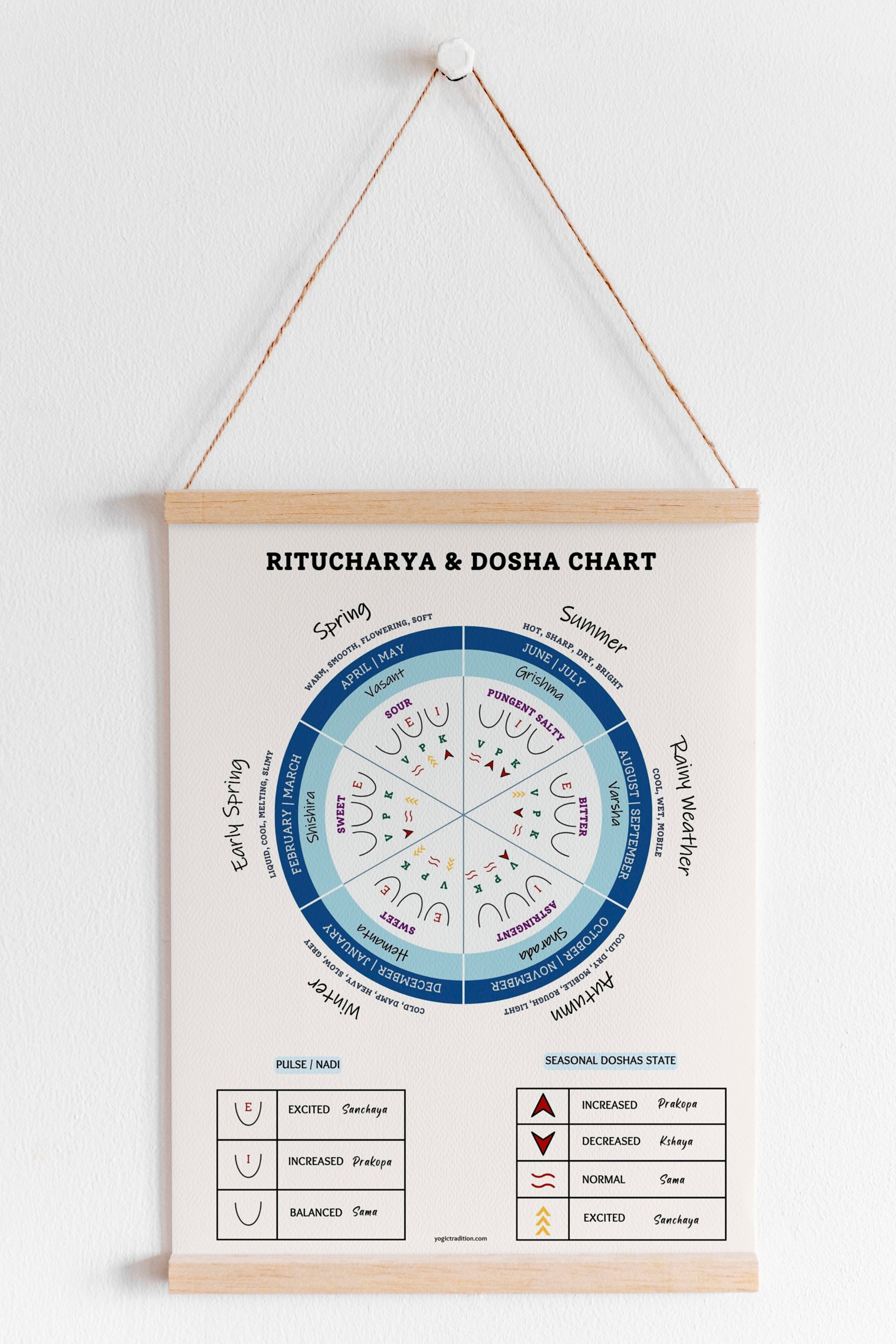
    *This chart visually explains the six Ritus and their effect on the Doshas. You can use it to point out Hemanta Ritu and the corresponding state of Vata, Pitta, and Kapha, making the concept less abstract.*

*   **Concept 1:** Explain that in *Hemanta*, the strong external cold traps body heat inside, leading to a powerful *Agni*. This is why our appetite increases.
*   **Concept 2:** Discuss the need to pacify the accumulated *Vata* from the previous seasons and nourish the body to build *Bala* (strength) for winter. Explain that the diet should be heavier, nourishing, and warm.
- Part 3: Application - "Nourishing Your Agni" (35 minutes)
- Activity 1: The Seasonal Pantry. Present a list of recommended foods and spices for Hemanta.

    *This infographic is an excellent template for a handout. It clearly lists what to eat (sour, salty, heavy meals, milk products) and what to avoid (bitter, pungent, cold foods), along with lifestyle tips.*

*   **Activity 2: Group Meal Planning.** Divide participants into small groups. Give them a blank meal plan template and the handout. Ask them to create a sample breakfast, lunch, and dinner for a day in *Hemanta*. Have each group share one idea. This fosters active learning and peer-to-peer sharing.
*   **Activity 3 (Optional/if resources permit):** A simple "Community Kitchen" style demonstration, like preparing a warm, spiced *dal* or a sweet treat made with jaggery and sesame seeds.
- Part 4: Wrap-up & Q&A (10 minutes)
- Summary: Briefly recap the key message: In winter, listen to your strong Agni and provide it with nourishing, warm, and substantial food.
- Challenge: Encourage each participant to commit to trying one new Hemanta-friendly recipe or food in the coming week.
- Distribute Materials: Hand out the recipe card and the seasonal food list.
- Q&A.
Test your understanding!
Imagine your CHNA for a corporate office identified high levels of employee burnout, anxiety, and poor sleep quality. You decide to design a workshop on "Managing Stress with Dinacharya".
Using the framework we've discussed, outline the Anchor and Application components for this workshop. What specific activities would you plan for each?
Show answer
Workshop Title: The 24-Hour Reset: Managing Stress with Ayurvedic Daily Routines
-
Anchor Component (Connect): "Mapping Your Energy"
- Activity: Give participants a simple chart with a 24-hour timeline. Ask them to privately plot their energy levels, focus, and stress throughout a typical workday. Then, facilitate a brief, voluntary sharing session with questions like: "At what time of day do you feel most productive?" and "When does the 'afternoon slump' hit you?"
- Purpose: This makes the concept of circadian rhythms (Dosha clock) immediately personal and relevant, highlighting their existing energy patterns and problem areas before you introduce the Ayurvedic solution.
-
Application Component (Act): "Building Your '5-Minute Sanity' Toolkit"
- Activity 1: Practice Session. Instead of just talking about stress-busters, guide them through two practical, office-friendly techniques:
- A 3-minute guided Anulom Vilom Pranayama (alternate nostril breathing) that they can do at their desk.
- A 2-minute mindful "tea break" where you guide them to focus on the senses while sipping warm water or herbal tea.
- Activity 2: Action Planning. Provide a worksheet with a list of simple Dinacharya practices (e.g., consistent wake-up time, digital detox 1 hour before bed, short mid-day walk). Ask them to choose only one practice they are willing to commit to for the next seven days and write down how they plan to implement it.
- Purpose: This section focuses on empowerment and feasibility. It moves beyond theory to give them practical tools they can use immediately and encourages a small, sustainable commitment rather than an overwhelming overhaul.
- Activity 1: Practice Session. Instead of just talking about stress-busters, guide them through two practical, office-friendly techniques:
Conclusion
Today, we've constructed a blueprint for translating Swasthawritta principles into an effective community health workshop. You have learned that a successful workshop is not just about sharing information, but about creating a structured and engaging experience that empowers participants to take practical steps toward better health.
Key Takeaways:
- Designing a workshop requires a systematic approach based on four core components: Foundation (audience, objectives), Structure (Anchor-Discussion-Application), Content (activities, materials), and Logistics (planning, evaluation).
- The "Anchor-Discussion-Application" model is a powerful tool for structuring a session that moves participants from personal relevance to conceptual understanding and finally to practical action.
- Interactive activities like group discussions, live demonstrations, and action planning are far more effective than passive lectures for promoting real behavioral change.
Preview of the Next Lesson:
You've designed a needs assessment and now a workshop. The next crucial question is: how do you prove your program worked? In our next lesson, we will address this by learning to "Define key performance indicators (KPIs) and outcome measures for evaluating a community-based Swasthawritta program." We will move into the world of measurement, learning how to select the right metrics to demonstrate the impact and value of your Swasthawritta interventions.