Introduction
Welcome to our next lesson. In our previous sessions on Ritucharya, we have explored how to adapt diet and lifestyle for different seasons and even for patients with chronic conditions like Amavata. We established that Ayurveda's preventive strategy includes not only seasonal adaptation but also periodic cleansing, known as Ritu Shodhana, to eliminate Doshas that naturally accumulate and aggravate with the changing seasons.
Today, we transition from theoretical principles to practical, clinical design. We will tackle the learning outcome: Design a detailed Vamana (emesis) protocol for Vasanta Ritu as a seasonal detoxification measure, considering individual suitability.
Vamana, therapeutic emesis, is the primary Shodhana for Kapha Dosha. Since Kapha reaches its peak of aggravation (Prakopa) in Vasanta Ritu (spring), performing Vamana during this season is a cornerstone of Ayurvedic preventive medicine (Swasthasya Swasthya Rakshanam). In this lesson, we will move beyond simply knowing that it's done; you will learn how to design a complete, safe, and effective protocol, from patient selection to post-procedure care. This process demands meticulous clinical reasoning, which we will explore through a practical, case-based approach.
1. The 'Why' and 'Who' of Vasantika Vamana
Before designing the protocol, we must be clear on its rationale and the ideal candidate. The classical texts are unambiguous: Vasanta Ritu is the prime time to expel aggravated Kapha.
As Charaka Samhita states:
“Kapha utsarga vasanta ritu” – Charaka Samhita, Sutra Sthana 6/43
(Kapha is naturally aggravated and ready for elimination in spring)
This aggravation, if left unaddressed, can lead to a host of spring-related ailments like allergies, respiratory congestion, lethargy, and metabolic sluggishness. Vasantika Vamana acts as a preemptive strike, cleansing the primary site of Kapha (Amashaya) and restoring balance.
However, this powerful procedure is not for everyone. Assessing individual suitability (Yogya-Ayogya Vichara) is your first and most critical responsibility as a clinician.
To understand the specifics of who is a suitable candidate and who is not, please review the following resources.
A study on Vasantika Vamana (therapeutic emesis in ...
First, read the article 'A study on Vasantika Vamana' from the National Center for Biotechnology Information (NCBI). It provides a research-based overview and clearly lists indications and contraindications based on classical principles.
Please read the section titled 'Vasantika Vamana–Contra-Indications/Indications'. Focus on the two lists provided: who should avoid Vamana and for whom it is highly beneficial. Pay attention to the types of constitutions and specific disorders mentioned.
Vamana Panchakarma treatment in Ayurveda
Next, review the webpage 'Vamana Panchakarma treatment in Ayurveda' from Adyant Ayurveda. This article presents the information in a very accessible format, including a clear table.
First, study the table under the heading 'Contraindications of Vamana'. Then, read the second question in the FAQ section at the end of the article, 'Who is a suitable candidate for Vamana?' This will reinforce your understanding of patient selection.
From these resources, we can summarize the key criteria for selection:
- Ideal Candidates (Yogya):
- Healthy individuals with Kapha or Kapha-Pitta Prakruti seeking preventive care.
- Individuals with strong Bala (physical and mental strength).
- Patients suffering from Kapha-pradhana disorders like asthma, chronic rhinitis/sinusitis, certain skin diseases (e.g., psoriasis), obesity, PCOS, and metabolic syndrome.
- Contraindicated Individuals (Ayogya):
- The very young (<12) and very old (>65-70).
- Pregnant women.
- Extremely emaciated or weak individuals.
- Patients with severe cardiovascular conditions, hypertension, or bleeding disorders of the upper gastrointestinal tract.
- Those with predominantly Vata Prakruti or active, severe Vata disorders.
2. Designing the Protocol: A Case-Based Approach
To make this practical, let's design a Vasantika Vamana protocol for a hypothetical but typical candidate.
Case Profile:
- Patient: Mr. Anand, a 38-year-old software engineer.
- Prakruti: Kapha-Pitta.
- Vikruti: Mild Kapha increase. Reports feeling heavy, sluggish, and unmotivated every spring. Experiences morning congestion and has a slightly dulled appetite (Mandagni).
- Bala: Madhyama to Pravara (moderate to good strength).
- Goal: Wishes to undergo Vamana as a preventive measure to improve energy levels and prevent seasonal issues.
- Clinical Assessment: No major chronic illnesses. Blood pressure and other vitals are normal. He is a suitable candidate (Yogya).
The entire procedure is divided into three stages: Purva Karma (preparatory), Pradhana Karma (main procedure), and Paschat Karma (post-procedure care). Let's design each stage for Mr. Anand.
Part A: Purva Karma (The Preparatory Phase)
The goal of Purva Karma is to prepare the body for elimination. This involves digesting Ama, liquefying the Doshas with oleation (Snehana), and bringing them from the peripheral tissues (Shakha) into the gastrointestinal tract (Koshtha) for expulsion.
The resource "A study on Vasantika Vamana" outlines the standard sequence of these preparatory steps.
A study on Vasantika Vamana (therapeutic emesis in ...
To understand the structure of the preparatory phase, please refer back to the NCBI article.
Read the section titled 'Purva Karma (Pre-operative preparation)'. Note the sequence: Pachana and Deepana, Abhyantara Snehana, Abhyanga and Swedana, and the specific diet on the day before Vamana. We will now detail each of these for our patient.
Protocol for Mr. Anand (Purva Karma - approx. 5-9 days total):
-
Deepana-Pachana (Day 1-3):
- Objective: To clear any existing Ama and kindle the Agni before starting oleation.
- Prescription: Trikatu Churna (2g) or Chitrakadi Vati (2 tablets, 500mg each) to be taken twice a day with warm water before meals.
- Diet: Simple, warm, and light food (e.g., mung dal khichdi, vegetable soup).
-
Abhyantara Snehana (Internal Oleation, starts Day 4, lasts 3-7 days):
- Objective: To internally saturate the body with unctuousness, which helps to dissolve and detach the adherent Doshas.
- Sneha Selection: For a healthy Kapha-Pitta individual like Mr. Anand, Shuddha Go-Ghrita (plain cow's ghee) is an excellent choice.
- Dosage (Arohana Krama - Ascending Dose):
- Day 4: Start with a dose of 30 ml on an empty stomach in the morning.
- Subsequent Days: Increase the dose by 15-20 ml each day (e.g., 50 ml, 70 ml...) based on the time it takes to digest the previous day's ghee (typically, it should be digested by lunchtime). The dose is adjusted based on the patient's Agni and Koshtha.
- Duration: Continue until Samyak Snigdha Lakshanas (signs of proper oleation) appear. This usually takes 3 to 7 days. For Mr. Anand, we can anticipate 4-5 days.
- Assessment of Proper Oleation (Samyak Snigdha Lakshanas): You must monitor for these signs daily:
- Vatanulomana (downward movement of Vata, no bloating)
- Deepta Agni (strong appetite after ghee is digested)
- Snigdha Varcha (unctuous, soft, oily stools)
- Twak Snigdhata (oily, smooth skin)
- Klesha Asahishnuta (aversion to fat/ghee)
- Diet during Snehapana: The patient must follow a strict diet: only warm, liquid, fat-free food (like plain rice gruel or mung dal soup) and only when hungry. Only warm water should be consumed for drinking.
-
Vishrama Kala (Rest Period, 1 day after Snehapana is complete):
- Objective: To allow the mobilized Doshas to settle in the Koshtha.
- Procedure: Gentle full-body Abhyanga with a warm oil (like Bala Taila) followed by Sarvanga Swedana (full-body steam therapy) for about 15-20 minutes. This further liquefies the Doshas. This is done once or twice on this day.
- Diet: On the evening before Vamana, a Kapha-utkleshaka (Kapha-aggravating) diet is given. This includes items like curd, milk, black gram (masha), sweets, and khichdi. This ensures a peak level of aggravated Kapha in the stomach, ready for expulsion.
Part B: Pradhana Karma (The Main Procedure)
This is the day of induced emesis, which must be conducted with utmost care and continuous observation.
A study on Vasantika Vamana (therapeutic emesis in ...
The following sections from the NCBI resource detail the main procedure and the rationale behind the timings and drug choices. Reading this will give you a clear, step-by-step understanding of the Vamana day.
First, read the section 'Pradhana Karma (Induction of Vamana)'. Pay close attention to the sequence of administration: Aakantha pana, Vamana Yoga, and the use of Vamanopaga Kashaya. Then, read the first two paragraphs of the 'Discussion' section to understand the clinical reasoning behind the timing and choice of substances like Ksheera (milk) and Madanaphala.
Protocol for Mr. Anand (Pradhana Karma):
- Timing: Early morning, between 6 AM and 9 AM (during the natural Kapha Kala). The patient should have had a good night's sleep.
- Preparation:
- The patient sits comfortably on a knee-high chair. Vitals (BP, pulse) are recorded.
- A final Abhyanga and localized Swedana (chest and back) can be performed.
- Procedure:
- Aakanthapana (Stomach-full drink): Mr. Anand is asked to drink milk or yavaagu (barley gruel) to his full capacity, until he feels nauseous. This provides a large volume in the stomach, which facilitates forceful emesis and prevents the emetic drugs from causing irritation.
- Administration of Vamana Yoga: Immediately after Aakanthapana, the main emetic formulation is given. A standard, safe combination is:
- Madanaphala Pippali Churna (powder of Randia dumetorum seeds): 5-6 g
- Vacha Churna (Acorus calamus): 2-3 g
- Saindhava Lavana (rock salt): 1-2 g
- Mixed with Honey (Madhu) to form a paste.
- Inducing Emesis: After about 15-45 minutes, the emetic reflex should begin.
- During each bout (Vega), the patient's forehead should be supported, and their back should be gently massaged in an upward direction.
- Between bouts, he should be encouraged to sip on Vamanopaga Kashaya—a decoction or infusion that supports emesis, such as Yashtimadhu Phanta (licorice infusion) or simple salt water (Lavanodaka). This ensures the emesis process continues until completion.
- Assessment of Proper Emesis (Samyak Shuddhi):
- Vegiki (Number): For Madhyama Shuddhi (moderate cleansing), we expect 6-8 projectile bouts.
- Maniki (Quantity): The total output should be measured. For Madhyama Shuddhi, the eliminated Dosha (output minus input) should be approximately 1.5 Prastha (around 810 ml).
- Antiki (Endpoint): The vomiting should continue until bile (Pitta) is seen in the vomitus. This signifies that the Kapha has been completely cleared from the stomach, and Pitta has started to follow. This is the crucial signal to stop the procedure.
- Laingiki (Symptoms): After the procedure, Mr. Anand should report feeling lightness in the chest and head, clarity of the senses (Indriya Prasadana), and a sense of well-being.
Part C: Paschat Karma (Post-Procedure Care)
The care provided after Vamana is as critical as the procedure itself. The digestive fire (Agni) is extremely weak, akin to a small flame after a storm. The goal is to protect and gradually strengthen it.
A study on Vasantika Vamana (therapeutic emesis in ...
Finally, let's detail the post-procedure care. This phase is crucial for ensuring the benefits of Vamana are sustained. The NCBI article describes the immediate care and the all-important dietary regimen.
Read the section 'Pashchata Karma (Post operative care)'. Focus on the three components: Dhumapana and Gandusha, behavioral/dietetic restrictions, and the Samsarjana Krama.
Protocol for Mr. Anand (Paschat Karma):
-
Immediate Care:
- After the last bout, the patient should rest. Hands, face, and feet are washed with warm water.
- Gandusha: He should gargle with warm water to cleanse the mouth.
- Dhumapana (Medicated smoke inhalation): Inhaling a medicated smoke (e.g., from a Haridra stick) helps to clear any residual Kapha from the throat and sinuses.
- Rest: Complete mental and physical rest is advised for the remainder of the day.
-
Samsarjana Krama (Graduated Dietary Regimen):
- This is the structured reintroduction of food to rebuild Agni. The duration depends on the level of cleansing achieved (Shuddhi). For Mr. Anand's anticipated Madhyama Shuddhi, a 5-day regimen is appropriate.
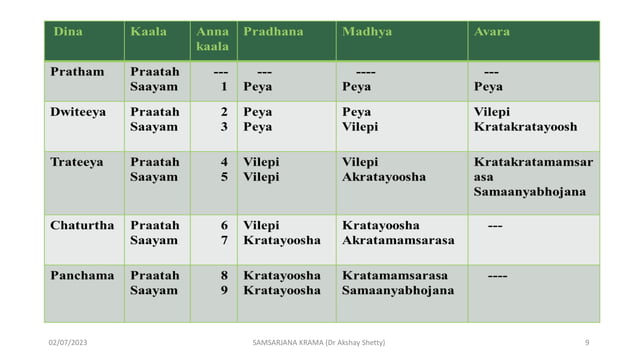
*This image details the Samsarjana Krama, or post-purification dietary regimen. For a Madhyama (moderate) purification, one follows the sequence for 5 days, progressively moving from thin gruel to a light, normal diet to rebuild digestive strength.*

**5-Day Plan for Mr. Anand:**
*   **Day 1 (of Paschat Karma):** *Peya* (thin rice gruel, unsalted, no fat) for the evening meal.
*   **Day 2:** *Vilepi* (thicker rice gruel, lightly salted) for both meals.
*   **Day 3:** *Akrita Yusha* (mung bean soup without spices/fat) with a small portion of cooked rice.
*   **Day 4:** *Krita Yusha* (mung bean soup with light spices like ginger and a little ghee) with rice.
*   **Day 5:** Light, normal diet. From Day 6 onwards, he can gradually return to his normal, healthy diet.
3. Behavioral Restrictions (Pariharya Vishaya): For the duration of the Samsarjana Krama, Mr. Anand must avoid:
* Loud speech, excessive walking, travel.
* Day sleep and staying up late.
* Exposure to cold wind, sun, or dew.
* Suppressing or forcing natural urges.
* Mental stress (anger, grief).
Test your understanding!
A 45-year-old Kapha-Prakruti patient is undergoing Abhyantara Snehana for a planned Vasantika Vamana. On the morning of Day 5, after taking 90ml of ghee, she reports that she still feels nauseous and heavy by late afternoon and has no appetite for her evening meal of khichdi. What do these signs indicate, and what should be your immediate clinical action for the next day?
Show answer
Indication: The symptoms of prolonged nausea, heaviness, and lack of appetite indicate that the ghee from the morning has not been fully digested. This is a sign of Ajirna (indigestion) and that her Agni is unable to handle the current dose. It is a sign of Atisnigdha (excessive oleation) for her current digestive capacity.
Immediate Clinical Action:
- Stop the Snehapana: Do not administer any ghee the next day. This is the most important step.
- Prescribe Rukshana and Deepana/Pachana measures: To counter the heaviness and digest the remaining Sneha and Ama, prescribe remedies like:
- Sipping hot water throughout the day.
- Administering a Deepana-Pachana formulation like Trikatu Churna or Hingvashtak Churna with warm water.
- Advise complete fasting until true hunger returns. Once hungry, she should only have a very light meal like plain rice gruel (Peya).
- Re-evaluate: Only after her Agni has returned to normal and all symptoms of heaviness have subsided can you consider resuming the Snehapana, likely at a lower dose than before, or concluding the Snehapana if other signs of proper oleation are present. Proceeding with Vamana while the patient has Sneha-Ajirna is a major contraindication and can lead to complications.
Conclusion
You have now walked through the entire process of designing a comprehensive Vasantika Vamana protocol. This lesson highlights that Panchakarma is far from a one-size-fits-all procedure; it is a highly personalized and dynamic clinical process.
Key Takeaways:
- Systematic Approach: A successful Vamana requires meticulous execution of all three stages: Purva, Pradhana, and Paschat Karma. Neglecting any one stage, especially Paschat Karma, can undermine the entire therapy.
- Individual Suitability is Paramount: The initial assessment of Yogya and Ayogya is the most critical step to ensure safety and efficacy.
- Clinical Observation is Key: Throughout the protocol, you must act as a vigilant observer, constantly assessing the patient's Agni, monitoring for Samyak Snigdha Lakshanas, and evaluating the Shuddhi to make real-time clinical decisions.
- Samsarjana Krama is Non-Negotiable: The gradual rebuilding of Agni through the post-procedure diet is what solidifies the benefits of the cleansing and prevents relapse.
Preview of the Next Lesson:
Having mastered the design of Vamana for the spring season, we will turn our attention to the next major seasonal purification. In our next lesson, we will focus on: "Design a detailed Virechana (purgation) protocol for Sharad Ritu as a seasonal detoxification measure, considering individual suitability." We will apply the same rigorous, three-stage design process to address the Pitta aggravation that is characteristic of the autumn season.