Introduction
Welcome back. In our previous lessons, we designed detailed protocols for Vamana in Vasanta Ritu to address Kapha aggravation and Virechana in Sharad Ritu to manage Pitta aggravation. This completes our exploration of seasonal purification for two of the three Doshas.
Today, we turn our attention to the king of the Doshas, Vata, and its management during the monsoon season. This lesson will guide you through the learning outcome: Design a detailed Basti (enema) protocol for Varsha Ritu as a seasonal detoxification measure, considering individual suitability.
We will explore why Basti is the cornerstone of Vata management and how to construct a complete, individualized protocol for a patient seeking seasonal wellness during the challenging Varsha Ritu. You will learn to formulate the Basti Dravya (medicinal enema) and schedule a course of therapy that combines cleansing and nourishing actions, truly showcasing why Basti is revered as Ardha Chikitsa (half of all treatment).
1. The Rationale: Why Basti in Varsha Ritu?
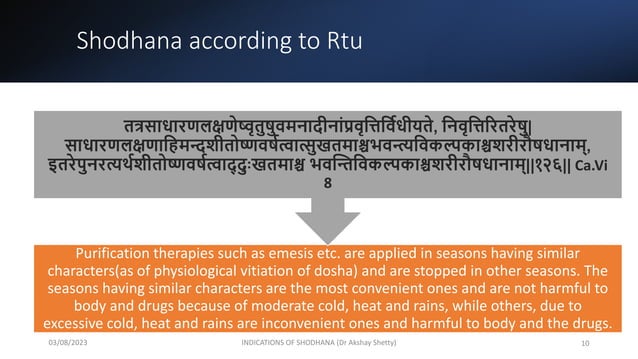
The fundamental principle of Ritu Shodhana is to preemptively pacify the Dosha that is naturally aggravated in a given season. In the case of Vata, this aggravation occurs during the monsoon.
- Sanchaya (Accumulation) in Grishma Ritu: The intense heat and dryness of summer (Grishma) lead to a natural increase in the dry and light qualities within the body, causing Vata to accumulate.
- Prakopa (Aggravation) in Varsha Ritu: The onset of the monsoon (Varsha) brings a sudden change. The atmosphere becomes cold and damp, the ground releases gases (Bhoomi Bāṣpa), and the water becomes acidic. This environment severely vitiates the already accumulated Vata. This leads to a generalized decrease in digestive power (Agni Mandya) and a host of Vata disorders like joint pain, stiffness, bloating, and nervous system imbalances.
Since the primary seat (Mulasthana) of Vata Dosha is the large intestine (Pakwashaya), the most direct and effective way to pacify it is through the rectal route. This is precisely what Basti Karma achieves.
2. Understanding Basti: The Foundational Types
Basti is a broad term encompassing various types of enemas. For our purpose of seasonal Shodhana, two primary types are used in combination:
- Niruha Basti (Asthapana Basti): This is a decoction-based enema. Its primary purpose is Shodhana (cleansing). It has a scraping (Lekhana) and eliminating (Nirharana) action on the morbid Doshas lodged in the colon.
- Anuvasana Basti: This is an oil-based enema. Its primary purpose is Snehana (oleation), Brimhana (nourishing), and pacification of Vata. It lubricates the channels, calms the nervous system, and strengthens the body.
A Ritu Shodhana protocol for Varsha rarely involves just one type. Instead, it uses a structured schedule alternating between Niruha and Anuvasana Basti to achieve both cleansing and pacification without overly drying or weakening the system. Common schedules are named based on their duration, such as Yoga Basti (8 days), Kala Basti (16 days), and Karma Basti (30 days).
3. Individual Suitability: The Yogya-Ayogya Vichara
Your clinical acumen in prescribing Basti begins with a thorough assessment of the patient's suitability. While Basti is the primary treatment for Vata, it is not appropriate for everyone.
To understand the indications and, more importantly, the contraindications for Basti (specifically Niruha), study the following resource.
standardization o panchakarma - ndardization of pediatric ...
The document 'Standardization of Panchakarma' provides comprehensive lists of indications and contraindications for Basti, which are essential for safe clinical practice.
In this document, please read the section 'Indications and Contraindications' under the heading 'Basti Karma'. Pay close attention to the extensive list of conditions where Basti is contraindicated. This knowledge is non-negotiable for patient safety.
Summary of Key Suitability Criteria:
-
Ideal Candidates (Yogya):
- Healthy individuals, especially of Vata Prakruti, for seasonal wellness.
- Patients with Vata-pradhana disorders: neurological conditions (Sarvanga/Ekanga Vata), constipation (Malasanga), bloating (Adhmana), lower back pain (Katishula), joint pain, and emaciation (Mamsakshaya).
- Those with moderate to strong physical constitution (Madhyama/Pravara Bala).
-
Contraindicated Individuals (Ayogya):
- Patients with severe indigestion (Ajirna), acute diarrhea (Amatisara), or significant Ama.
- Those with intestinal obstruction (Baddha Gudodara), perforation (Chidrodara), or ascites (Dakodara).
- The extremely weak (Atidurbala), emaciated (Atikrusha), hungry, or thirsty.
- Immediately after other Panchakarma procedures like Vamana or Virechana.
- Patients with acute cough, breathlessness, or hiccoughs.
- Conditions like severe anemia (Pandu) and certain skin diseases (Kushtha).
4. Designing the Protocol: A Case-Based Approach for Varsha Ritu
Let's design a Varsha Ritu Basti protocol for a suitable candidate. We will use a Yoga Basti schedule, a standard 8-day course ideal for seasonal wellness.
Case Profile:
- Patient: Mr. Anand, a 45-year-old software engineer.
- Prakruti: Vata-Pitta.
- Vikruti: Vata aggravation. Complains of generalized body aches, joint stiffness (especially in the lower back), bloating, and constipation that significantly worsen during the monsoon.
- Koshta: Krura (hard bowel, difficult to purge).
- Bala: Madhyama (moderate strength).
- Goal: To undergo Ritu Shodhana to manage his seasonal Vata symptoms.
- Clinical Assessment: Vitals are stable, Agni is moderate, and there are no signs of significant Ama. He is a suitable candidate (Yogya) for Basti.
The Yoga Basti Schedule (8 Days)
The classical schedule for an 8-day Yoga Basti is an alternation of Anuvasana and Niruha to balance oleation and cleansing. The typical sequence is:
- Day 1: Anuvasana Basti
- Day 2: Niruha Basti
- Day 3: Anuvasana Basti
- Day 4: Niruha Basti
- Day 5: Anuvasana Basti
- Day 6: Niruha Basti
- Day 7: Anuvasana Basti
- Day 8: Anuvasana Basti
Part A: Purva Karma (Preparatory Phase)
Unlike Vamana and Virechana, extensive internal oleation (Snehapana) is not a prerequisite for Basti, as Sneha is an integral component of the Basti itself. The preparation is more immediate.
Protocol for Mr. Anand:
-
Deepana-Pachana (3 days before starting Basti):
- Objective: To ensure Agni is optimal and the channels are clear of Ama.
- Prescription: Trikatu Churna (2-3g) or Hinguvachadi Churna (3g) twice daily with warm water before meals.
- Diet: Light, warm, and easily digestible food. Avoid heavy, cold, and fried items.
-
Immediate Purva Karma (On the day of Basti):
- The patient should have a light meal and ensure it is digested before the procedure.
- Niruha Basti is given on a relatively empty stomach, while Anuvasana Basti is given after a small meal.
- Abhyanga & Swedana: Just before administration, a gentle massage (Abhyanga) is performed over the lower back, hips, and abdomen using a Vata-pacifying oil like Dhanwantaram Tailam. This is followed by localized steam (Nadi Sweda) or a hot water bag fomentation over the same area. This relaxes the muscles and channels, facilitating the smooth entry and action of the Basti.
Part B: Pradhana Karma (The Administration Phase)
This is the core of the procedure, repeated daily for 8 days according to the schedule.
1. Formulating the Basti Dravya
For Anuvasana Basti (Days 1, 3, 5, 7, 8):
- Objective: To provide oleation, nourishment, and pacify Vata.
- Medicine: Dhanwantaram Tailam is an excellent choice for Mr. Anand's symptoms of pain and stiffness.
- Dose: Approximately 60-80 ml. The oil should be warmed to body temperature before administration.
For Niruha Basti (Days 2, 4, 6):
- Objective: To cleanse the colon and eliminate aggravated Vata.
- The preparation of Niruha Basti is an art. It involves mixing several ingredients in a specific sequence to form a homogenous emulsion.
- The standard order of mixing is: Madhu (Honey) → Saindhava Lavana (Rock Salt) → Sneha (Medicated Oil) → Kalka (Herbal Paste) → Kwatha (Decoction) → Any other liquids like milk or urine.

Niruha Formulation for Mr. Anand (Vata-hara Basti):
- Madhu (Honey): 1 prasṛta (~96 ml)
- Saindhava Lavana (Rock Salt): 1 kola (~6 g)
- Sneha (Medicated Oil): Dhanwantaram Tailam, 3 prasṛta (~288 ml)
- Kalka (Herbal Paste): A paste of Vacha, Pippali, Bilva, Shatapushpa, etc., 1 pala (~48 g)
- Kwatha (Decoction): Dashamoola Kwatha, being the classic decoction for Vata, 5 prasṛta (~480 ml)
- Total Quantity: ~920 ml.
2. Administration Procedure
For a detailed understanding of the administration, mixing, and patient positioning, refer to this resource.
Niruha Basti (Kashaya Basti) Panchakarma Method, Uses, ...
The following video from 'Easy Ayurveda' provides a practical demonstration and explanation of the Niruha Basti procedure.
Watch the sections on 'Purva karma' (from 10:20) and 'Pradhana karma' (from 24:30). Focus on the method of mixing the ingredients (20:30), patient positioning (25:20), and the technique of administration (26:00).
Key Steps:
- Patient Position: Left lateral position, with the right leg flexed and the left leg extended.
- Lubrication: The anal orifice and the tip of the Basti Netra (nozzle) are lubricated.
- Administration: The nozzle is gently inserted into the anal canal, parallel to the spine. The Basti Putaka (enema bag/pot) is squeezed gently and steadily to administer the fluid.
- Post-Administration: The patient remains in the same position for a minute, then lies supine. Gentle tapping on the buttocks and raising the legs can help the medicine to be retained and spread.
3. Observation
- Niruha Basti Return Time (Pratyagamana Kala): The decoction should be expelled within a maximum of one Muhurta (approx. 48 minutes). Retention beyond this can cause complications.
- Anuvasana Basti Return Time: The oil may be retained for several hours or even be fully absorbed. It should ideally be expelled within 9-12 hours.
- Signs of Proper Basti (Samyak Yoga Lakshana): The patient should experience lightness of the body, reduction in symptoms, improved appetite, and proper elimination of flatus, urine, and stool.
Part C: Paschat Karma (Post-Procedure Care)
Daily Care (during the 8-day course):
- Diet: After a Niruha Basti, once the bowels have been evacuated and the patient feels hungry, a light, warm meal should be given. For Vata conditions, Mamsarasa (meat soup) with rice or a medicated Yusha (like Mung soup) is ideal. After Anuvasana Basti, the patient can drink warm water and have a light meal when hungry.
- Lifestyle: The patient must adhere to strict restrictions (Pariharya Vishaya): avoid cold exposure, travel, excessive talking, emotional stress, day sleep, and sexual activity.
Final Care (after the 8-day course is complete):
- The patient should continue the dietary and lifestyle restrictions for a period double the duration of the therapy (i.e., 16 days).
- Gradually return to a normal diet and routine, while maintaining a Vata-pacifying regimen.
Test your understanding!
A 50-year-old female patient with a Vata-Kapha Prakruti and Madhyama Koshta wants to undergo Varsha Ritu Basti. She complains of joint stiffness, heaviness, and a sluggish metabolism.
How would you modify the Niruha Basti formulation for her, compared to the one designed for Mr. Anand? Refer to the image LINK and your knowledge of Dravya Guna.
Show answer
For a patient with significant Kapha involvement, the Basti needs to have more Ushna (hot), Teekshna (sharp), and Lekhana (scraping) properties to counter the cold, heavy, and sticky nature of Kapha.
- Reduce Sneha: As per the table in the image LINK for Kapha Roga, the quantity of Sneha should be reduced to 1/8th of the Kwatha. This makes the Basti more drying and less heavy.
- Add Gomutra: The addition of Gomutra (cow's urine) is a classic modification for Kapha-dominant conditions. Its hot, sharp, and penetrating qualities are excellent for cutting through Kapha and Ama.
- Modify Kalka/Kwatha: The choice of herbs for the Kalka and Kwatha would shift towards those with more pungent and bitter tastes. While Dashamoola is still good, one might use a decoction with added herbs like Trikatu (ginger, pepper, long pepper) or Musta to enhance the Deepana and Lekhana effects. The Kalka can also be made more pungent.
In essence, the Basti would be made less unctuous and more stimulating to address the dual Vata-Kapha pathology.
Conclusion
You have now learned to construct a comprehensive Basti protocol for Varsha Ritu, the cornerstone of seasonal Vata management. This therapy exemplifies the sophistication of Panchakarma, where cleansing and nourishing are artfully balanced to restore equilibrium.
Key Takeaways:
- Ritu-Dosha Correlation: Basti is the specific Shodhana for Varsha Ritu because it directly targets the Pakwashaya, the primary seat of Vata Dosha, which is naturally aggravated during this season.
- Basti is a Combined Therapy: A typical Basti course like Yoga Basti skillfully combines cleansing (Niruha) and nourishing (Anuvasana) actions to effectively pacify Vata without causing excess dryness.
- Formulation is Key: The efficacy of Basti lies in its formulation. The selection and proportion of Kwatha, Kalka, Sneha, and other ingredients must be tailored to the patient's specific Dosha imbalance.
- Procedure Matters: Correct preparation (Purva Karma) and post-procedure care (Paschat Karma), including diet and lifestyle, are integral to the safety and success of the therapy.
Preview of the Next Lesson:
We have addressed the peak seasons of aggravation for Kapha, Pitta, and Vata. However, the transitional periods between seasons, known as Ritusandhi, are often when people are most vulnerable to falling ill. In our next lesson, we will "Analyze the concept and clinical management of Ritusandhi (inter-seasonal period) to prevent seasonal disorders," equipping you with the crucial strategies to guide patients through these delicate times.