Introduction
Welcome back. In our last lesson, we delved into the crucial process of translating Ayurvedic concepts like Agni and Nidra into measurable, specific, and relevant outcome parameters for clinical research. We saw how we could either develop new scoring systems based on classical lakshanas or adapt existing, validated tools like the Pittsburgh Sleep Quality Index (PSQI).
Today, we will broaden this perspective. The ultimate aim of Swasthawritta is not just to alleviate symptoms, but to enhance overall health, vitality, and well-being—concepts that Ayurveda holistically terms Swasthya. To quantify the impact of our interventions on this broader state, we need tools that are recognized and understood in the global scientific community.
Therefore, our learning outcome for this lesson is to identify commonly used standardized assessment tools for quality of life, stress, and wellness in health research. This will equip you with a foundational toolkit of validated questionnaires that can serve as primary or secondary outcomes in your future Swasthawritta studies, allowing you to measure the very essence of what you aim to improve.
1. Understanding the Concepts: Quality of Life, Wellness, and Well-Being
Before we look at the tools, it's essential to understand the concepts they aim to measure. These terms are often used interchangeably, but in research, they can have distinct theoretical underpinnings. A robust understanding of these foundations is critical for selecting the appropriate tool.
Measuring Well-Being: A Review of Instruments
The review paper 'Measuring Well-Being: A Review of Instruments' provides an excellent academic overview of the different theoretical frameworks used to conceptualize and measure well-being.
Please read the section titled 'Primary Approaches to Conceptualizing Well-Being' (starting on page 731). As you read, focus on distinguishing between the four main approaches: Hedonic: What are its core components (pleasure, happiness, life satisfaction)? Eudaimonic: How does it differ by focusing on potential, purpose, and optimal functioning? Quality of Life (QoL): Note its broader, often biopsychosocial scope, frequently used in medical contexts. Wellness: Understand its holistic and lifestyle-oriented nature, which has roots in counseling.
As you can see, the choice of a tool is not just a practical decision; it's a theoretical one. A study focused on the immediate, subjective happiness derived from a lifestyle change might use a hedonic measure. In contrast, a study on Achara Rasayana might benefit from a eudaimonic or wellness tool that captures concepts like personal growth and purpose. The QoL approach is often the most comprehensive for clinical research, assessing how health status affects a person's overall life.
2. Standardized Tools for Quality of Life (QoL)
QoL instruments are among the most common outcome measures in health research. They provide a standardized way to assess an individual's perception of their position in life. Let's explore some of the most influential ones.
The WHOQOL-BREF: A Cross-Cultural Standard
The World Health Organization Quality of Life (WHOQOL) instrument is designed to be a cross-culturally valid measure. The WHOQOL-BREF is a shorter, 26-item version that is widely used in clinical trials and population studies.
It assesses QoL across four main domains:
- Physical Health: Pain, energy, sleep, daily activities, mobility.
- Psychological Health: Positive/negative feelings, self-esteem, thinking, learning.
- Social Relationships: Personal relationships, social support.
- Environment: Physical safety, home environment, financial resources, access to healthcare.
This structure allows for a nuanced assessment, which can be highly relevant for Swasthawritta research. For example, you could hypothesize that a Dinacharya protocol not only improves the Physical Health domain (via Vyayama, Abhyanga) but also the Psychological domain (via a structured, calming routine).
Understanding how to score this tool is a key practical skill.
WHOQOL-Brief Scoring.#medicine #statistics #questionnaire #reseach #datacollection #students
This video, 'WHOQOL-Brief Scoring', provides a concise and practical guide to calculating scores for this questionnaire. It walks through the process from raw data to a comparable final score.
Please watch the video from 00:57 to 08:45. Pay close attention to these key steps: Domains and Items (00:57 - 02:50): Understand which questions belong to which of the four domains. Reverse Scoring (02:50 - 06:09): Note that specific negatively phrased questions (Q3, Q4, Q26) must have their scores reversed. This is a common feature in psychometric scales. The Transformation Formula (06:09 - 08:45): This is the most critical part. Understand the formula used to convert the raw domain score into a standardized score ranging from 0-100. This transformation is what allows for comparison across studies and over time.
The key takeaway is that higher scores on the WHOQOL-BREF indicate a better quality of life. By using this tool, you can quantify the effect of an Ayurvedic intervention using a globally accepted metric.
Health-Related Quality of Life (HRQOL) Tools
While WHOQOL is broad, some tools focus more specifically on Health-Related Quality of Life (HRQOL), which assesses aspects of life directly affected by health status.
The SF-36 (Medical Outcomes Study Short-Form 36) is another giant in this field. As listed in Table 1 of the review paper LINK, it measures eight domains: physical functioning, role limitations due to physical problems, bodily pain, general health, vitality, social functioning, role limitations due to emotional problems, and mental health.
Another common tool is the HRQOL Questionnaire developed by the Centers for Disease Control and Prevention (CDC). It is often used in public health surveillance.
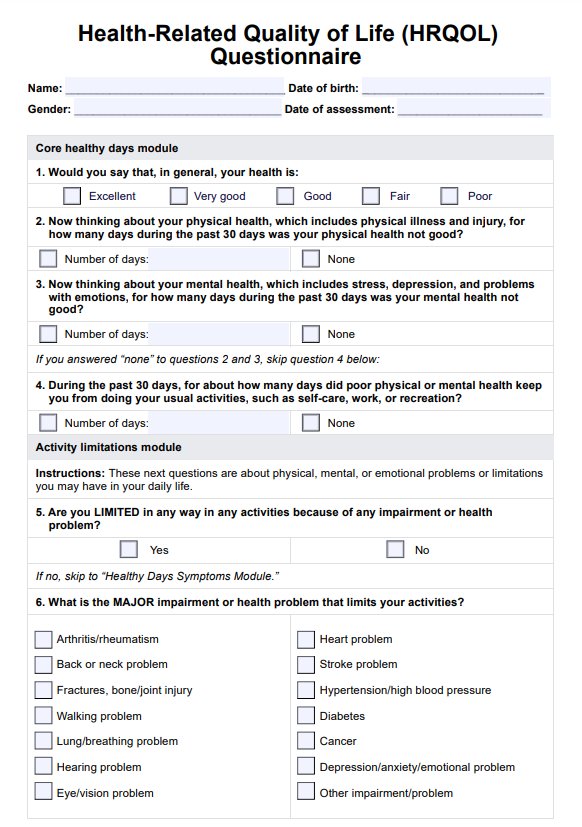
These HRQOL tools are excellent for studies where the primary focus is on how a health condition and its treatment (including Swasthawritta protocols) impact daily functioning and well-being.
3. A Standardized Tool for Perceived Stress
Managing stress is a core component of Swasthawritta, especially through Sadvritta (ethical conduct) and practices that promote Sattva. To measure the effectiveness of such interventions, we need a reliable tool to quantify stress.
The Perceived Stress Scale (PSS) is the most widely used instrument for measuring the perception of stress. It assesses the degree to which situations in one's life are appraised as stressful.

The PSS is a powerful tool for a Swasthawritta researcher. For example, in a study on the effects of Pranayama and meditation on workplace stress, the PSS would be an ideal primary outcome measure. It is short, easy to administer, and directly measures the subjective experience of stress, which is often the target of our interventions.
4. Standardized Tools for Wellness
The concept of "wellness" is perhaps the most closely aligned with the holistic vision of Swasthya. Wellness instruments often go beyond the absence of disease to include dimensions of optimal functioning and lifestyle.
Let's revisit the review paper LINK, which discusses several such tools.
Measuring Well-Being: A Review of Instruments
The review paper we looked at earlier provides a good summary of wellness instruments. They are typically more comprehensive and lifestyle-focused.
Please read the subsection 'Wellness instruments' under 'Examination of Instruments by General Category' (page 747). Also, refer back to Table 1 and locate the 'Wellness' section (pages 740-741). Notice the types of domains these instruments measure, such as: Five Factor Wellness Evaluation of Lifestyle (5F-WEL): Measures creative self, coping self, social self, essential self, and physical self. Optimal Living Profile: Measures environmental, intellectual, spiritual, emotional, social, and physical health.
These instruments are particularly useful when your research question addresses the broader, life-enhancing aspects of Swasthawritta. For instance, a study evaluating a comprehensive Swasthawritta protocol (including Dinacharya, Ritucharya, Sadvritta) could use the 5F-WEL to capture changes across multiple dimensions of a person's life, reflecting a true shift toward holistic well-being.
Test your understanding!
You are designing a clinical trial to evaluate the impact of an 8-week integrated Yoga and Ratricharya (night regimen) protocol on well-being in corporate professionals complaining of burnout and poor sleep. Which of the tools discussed today would you choose as your primary outcome measure, and which would you choose as a secondary outcome measure? Justify your choices.
Show answer
A strong approach would be:
-
Primary Outcome Measure: Perceived Stress Scale (PSS)
- Justification: The core complaint is "burnout," which is fundamentally a stress-related syndrome. The PSS directly and efficiently measures the subjective experience of stress, which the intervention (Yoga and a calming night routine) is directly intended to reduce. It is specific to the central problem.
-
Secondary Outcome Measure: WHOQOL-BREF
- Justification: While the primary goal is stress reduction, the intervention is expected to have broader benefits. The WHOQOL-BREF is an excellent secondary measure because it can capture these widespread effects. The Physical Health domain could reflect improved energy and sleep, the Psychological domain could reflect better mood and less negative affect, and the Social Relationships and Environment domains could even show improvement as the individual's overall well-being and functioning improve. It provides a comprehensive picture of the intervention's holistic impact beyond just stress.
(Note: The PSQI from the previous lesson would also be an essential secondary measure to specifically track the 'poor sleep' complaint).
5. How to Select the Right Tool
We have identified several tools, but how do you choose the best one for your specific study? This is a critical step in research design.
5 Quality of Life Questionnaires and Assessments
The article '5 Quality of Life Questionnaires and Assessments' from PositivePsychology.com provides practical advice on this.
Please read the section 'How to Select the Best QOL Assessment'. Focus on the key considerations mentioned: Appropriateness for your study design (e.g., longitudinal vs. cross-sectional). Avoiding floor and ceiling effects, where a scale is not sensitive enough to detect changes because most people score at the very bottom or top. Considering the psychometric properties, population relevance, and practical aspects like length and cost.
In summary, when choosing a tool, always ask:
- Relevance: Does it measure the concept I am most interested in?
- Validity: Has it been proven to measure what it claims to measure?
- Reliability: Does it produce consistent results?
- Responsiveness: Is it sensitive enough to detect changes resulting from my intervention?
- Feasibility: Is it practical for my participants (length, language) and my research (cost, access)?
Conclusion
Today we have expanded our research toolkit significantly. We have moved from specific Ayurvedic parameters to globally recognized, standardized instruments that measure the holistic outcomes at the heart of Swasthawritta.
Key Takeaways:
- Standardized tools for Quality of Life (WHOQOL-BREF, SF-36), Perceived Stress (PSS), and Wellness (5F-WEL) provide a way to quantify the impact of Swasthawritta interventions in a scientifically robust manner.
- Each tool is based on a specific theoretical framework (hedonic, eudaimonic, QoL, wellness), and understanding this is key to proper selection.
- Scoring these tools often involves specific procedures, such as reverse-scoring and transforming raw scores to a standardized scale (e.g., 0-100).
- Selecting the right tool requires careful consideration of your research question, study population, and the tool's psychometric properties and feasibility.
Preview of the Next Lesson:
Having identified this arsenal of tools, our next logical step is to practice using them. In the next lesson, we will focus on the learning outcome: "Select appropriate assessment tools for given Swasthawritta research questions based on their validity and reliability." We will work through specific case scenarios, where you will be tasked with choosing and justifying the best set of assessment tools to build a robust research protocol.