Introduction
Welcome to our new lesson. In our last session, we constructed a modified Dinacharya protocol to manage Sthaulya, a classic Santarpanajanya Vyadhi (disease of over-nourishment). We established how daily routines can be transformed into a therapeutic regimen based on the principle of Apatarpana Chikitsa.
Today, we elevate the clinical complexity. We will apply the same strategic thinking to a more systemic and challenging category of disorders: autoimmune conditions. Your learning outcome for this lesson is to analyze the application of Dinacharya principles in managing symptoms of a specific autoimmune condition through a case study.
We will explore the Ayurvedic understanding of autoimmunity, where the body's immune intelligence (Ojas, Bala) becomes misguided, leading it to attack its own tissues. You will learn how the principles of Dinacharya, far from being a simple preventive routine, form a foundational strategy to manage the root cause—impaired Agni and the formation of Ama—which is central to the pathogenesis of these conditions.
1. The Ayurvedic View of Autoimmunity: The Role of Ama
In modern medicine, an autoimmune disorder is defined by the immune system mistakenly attacking the body's own cells. Ayurveda provides a powerful explanatory framework for this phenomenon, centering on the concept of Ama.
Ama refers to the toxic, undigested metabolic by-product that arises from a weakened or impaired digestive fire (Mandagni). This sticky, morbid substance is not recognized by the body's tissues and systems. When it circulates and lodges in various tissues (Dhatus) or channels (Srotas), it behaves like a foreign antigen, provoking an immune response.
To understand this core concept, please watch the beginning of the following video.
Ayurvedic Remedies for Autoimmune Disorders REVEALED | Maharishi Ayurveda | Rini Shrivastava | 2025
In this video, 'Ayurvedic Remedies for Autoimmune Disorders REVEALED', Dr. Kalpana Sehra provides a clear explanation of the Ayurvedic perspective. Focus on how she links impaired digestive fire, Ama formation, and the development of conditions like Rheumatoid Arthritis and Psoriasis.
Please watch from the beginning until timestamp 03:40. Pay close attention to the definition of autoimmunity in Ayurvedic terms and the explanation of how Ama is the 'main culprit'.
As the video explains, this process of Ama lodging in a specific site (Khavaigunya) determines the manifestation of the disease:
- If Ama lodges in the joints (Sandhi), it can lead to Amavata (correlated with Rheumatoid Arthritis).
- If it deposits in the skin (Twacha), it may manifest as Kitibha Kushtha (correlated with Psoriasis).
- If it affects the gut (Grahani), it can contribute to conditions like Ulcerative Colitis.
The pathogenesis (Samprapti) of Amavata serves as a classical model for understanding this process.
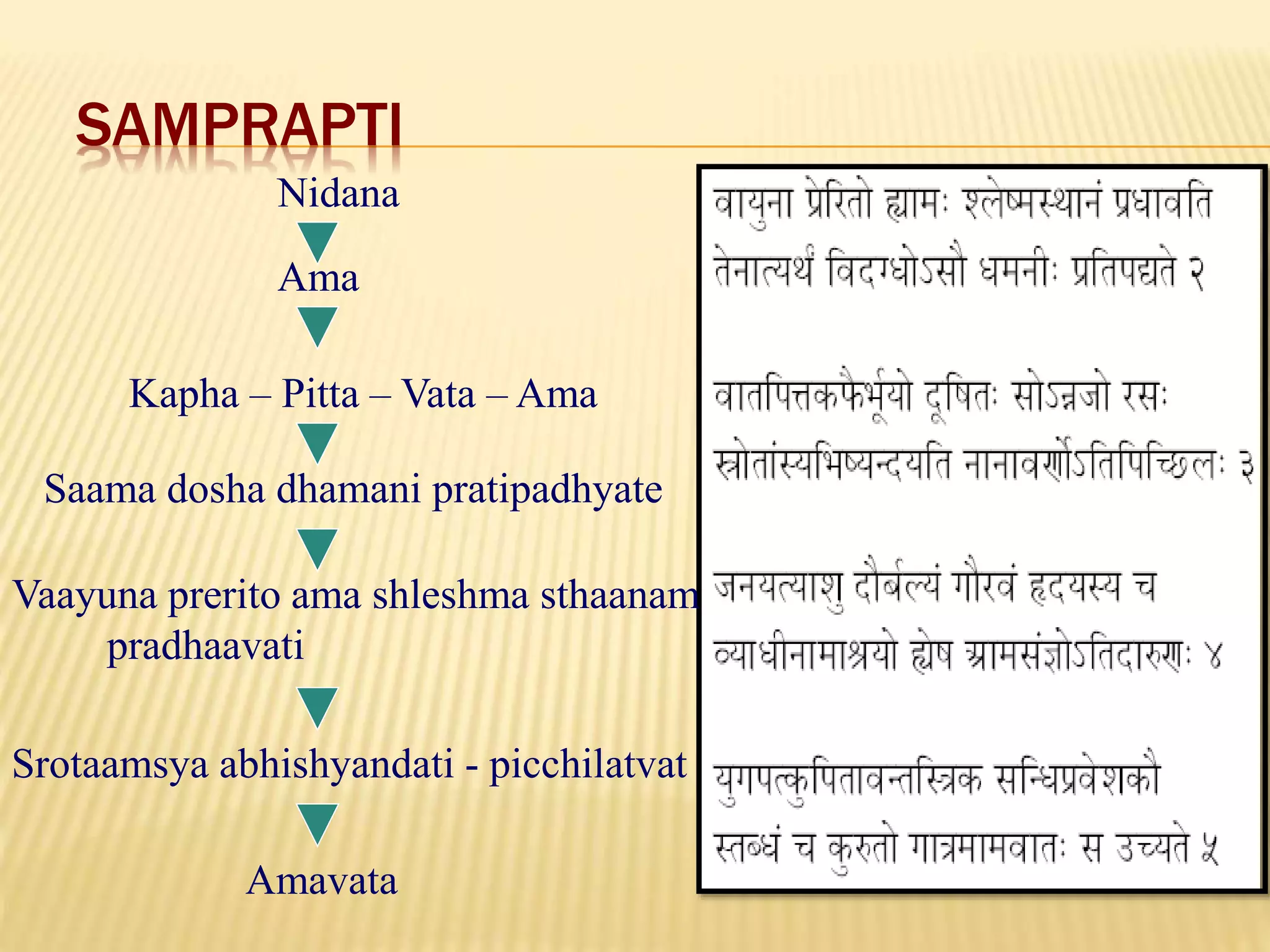
Given this understanding, the primary therapeutic goal is to stop the production of Ama and pacify the vitiated Doshas. This is where Dinacharya becomes a cornerstone of management. A disciplined daily routine is the most effective way to regulate Agni, prevent Ama formation, and manage the underlying lifestyle and stress-related triggers.
2. Case Study Analysis: Managing Ankylosing Spondylitis (AS)
Let's now apply these concepts to a real-world clinical scenario. We will analyze a detailed case study on the long-term management of Ankylosing Spondylitis (AS), a chronic inflammatory autoimmune disease primarily affecting the spine.
Efficacy of standalone personalized Ayurveda ...
This paper, 'Efficacy of standalone personalized Ayurveda...', provides a twelve-year follow-up of a patient with AS. It demonstrates how a multi-faceted Ayurvedic approach can manage symptoms and improve quality of life. We will dissect this case to extract the principles of a modified Dinacharya.
Please review the following sections: Patient information & Diagnostic assessment (Sections 2 & 3): Understand the patient's history, symptoms (back pain, stiffness), and the chronicity of the condition. Note the triggers mentioned, such as PTSD and trauma (abhighata). Therapeutic intervention (Section 4 & Table 2): Skim through the list of internal medicines. You'll see patterns of Ama pachana, Rasayana, and Vata shamana. In-patient care (Section 4.2 & Table 3): Pay close attention to the external therapies like Abhyangam, Dhanyamladhara, and Matra Vasti. These are key modifications relevant to a daily routine. Discussion (Section 6): Read this section carefully. It connects causative factors like mithyahara (improper diet), sedentary lifestyle, and psychological distress directly to the pathogenesis.
3. Deconstructing the Modified Dinacharya from the Case Study
The case study outlines a comprehensive treatment plan, not just a Dinacharya. Our task is to identify the principles and practices that can be adapted into a sustainable daily routine for the patient to manage their condition long-term.
A. Foundational Principle: Nidana Parivarjana (Avoidance of Cause)
The "Discussion" section clearly identifies several triggers:
- Mithyahara (incompatible diet) and sedentary lifestyle.
- Psychological distress (PTSD), which impairs Agni.
- Abhighata (trauma), which aggravates Vata.
A therapeutic Dinacharya must be designed to systematically counteract these factors daily.
B. Modifying Vihara (Lifestyle and Therapies)
This is where we see the most significant adaptations. The goal is to pacify Vata, reduce inflammation (Shopha), and alleviate pain (Shoola) and stiffness.
-
Abhyanga (Therapeutic Massage): The case uses specific medicated oils like Dhanwantaram Tailam and Narayana Tailam. A patient would be counselled to perform a daily self-Abhyanga with such oils. The rationale is Vatahara (pacifying Vata) and Shoolahara (analgesic), directly addressing the stiffness and pain. This contrasts with the Udvartana we prescribed for Sthaulya; here, the goal is Shamana (pacification) and Brumhana (nourishment), not Lekhana (scraping).
-
Matra Vasti (Therapeutic Enema): Table 3 shows the use of Matra Vasti with Narayana Tailam. Vasti is the primary treatment for Vata Dosha. While not performed daily by everyone, a Matra Vasti (low-dose oil enema) is a simple and safe procedure that can be incorporated into a regular home regimen (e.g., weekly or as advised) for chronic Vata conditions to maintain gut health and pacify systemic Vata.
-
Vyayama (Exercise): For AS, the goal of exercise is to maintain flexibility and prevent joint fusion, not vigorous calorie burning. The Dinacharya would include gentle, specific stretching exercises or Yoga Asanas that focus on spinal mobility without causing inflammatory flare-ups.
-
Mental Well-being: The link between PTSD and flare-ups in the case study is critical. This underscores the necessity of integrating practices like meditation, Pranayama (e.g., Anuloma Viloma), and mindful conduct (Sadvritta) into the Dinacharya. This is not an optional add-on but a core part of managing the neuro-immunological axis. The video resource also strongly advocated for meditation in managing Psoriasis.
C. Modifying Ahara (Diet) and Daily Aushadhi (Medicine)
-
Dietary Regimen: The core principle is to eat foods that are easy to digest (Laghu) and promote good Agni. This means strict avoidance of known triggers like incompatible foods (Virudhahar), which are discussed in the video LINK. Foods should be warm, freshly cooked, and appropriately spiced with Deepana-Pachana herbs like ginger (Shunti) and cumin (Jeeraka).
-
Daily Rasayana (Rejuvenation): Both the AS case study and the Scleroderma case study (LINK) use Rasayana herbs. The video LINK specifically highlights immunomodulatory (Rasayana) herbs like Guduchi (Giloy) and Yashtimadhu (Licorice). A modified Dinacharya for an autoimmune patient would include the daily intake of such a Rasayana formulation to modulate the immune response, nourish the Dhatus, and build resilience (Bala).
4. Synthesizing a General Dinacharya Protocol for Autoimmune Conditions
Based on our analysis, we can create a template for a daily regimen for a patient with a chronic autoimmune condition like Amavata or AS.
| Time | Activity | Rationale for Modification in Autoimmunity |
|---|---|---|
| Morning | ||
| 06:00 AM | Wake up. Drink warm water, possibly with a pinch of Shunti (dry ginger). | Ushnodaka stimulates Agni and bowel movement. Shunti is an excellent Ama Pachaka. |
| 06:30 AM | Bowel evacuation. | Clear channels and prevent Vata vitiation. |
| 07:00 AM | Gentle Vyayama: Specific prescribed Yoga asanas or stretches focusing on joint mobility. | Prevents stiffness (Stambha), improves circulation, but avoids aggravating inflammation. |
| 07:45 AM | Abhyanga: Self-massage with a prescribed Vata-shamaka oil (e.g., Dhanwantaram Tailam). | Pacifies Vata, reduces pain and stiffness, nourishes tissues. |
| 08:15 AM | Snana (Bath) with warm water. | Relieves stiffness and cleanses the body. |
| 09:00 AM | Breakfast: Warm, light, and easy-to-digest (e.g., thin rice or millet porridge). | Supports Agni, prevents Ama formation. Avoids cold, heavy, or raw foods. |
| Daytime | ||
| - | Daily Rasayana: Take prescribed immunomodulatory herb (e.g., Guduchi Ghanavati). | Modulates immune response, builds Bala and Ojas. |
| 1:00 PM | Lunch: Main meal, well-cooked with digestive spices. Strictly avoid Virudhahar. | Proper nourishment without overloading Agni. |
| Evening | ||
| 6:30 PM | Dinner: Very light and warm (e.g., vegetable soup, Mudga Yusha). | Ensures digestion is complete before sleep, preventing nighttime Ama formation. |
| 8:00 PM | Meditation/Pranayama: 15-20 minutes of mindfulness or alternate nostril breathing. | Manages stress, a key trigger for flare-ups. Calms the Manovaha Srotas. |
| 10:00 PM | Bedtime. | Adequate sleep is crucial for pacifying Vata and for cellular repair. |
To further solidify your understanding, the "Discussion" section of the case study on Scleroderma explicitly connects Dinacharya to deeper physiological regulation.
2025 | Volume: 13th | Issue: 2nd
The paper 'Comprehensive Ayurvedic Approach to Scleroderma Management...', which diagnoses the condition as Vatarakta, offers a powerful statement on the role of daily routines.
Please read the short 'Discussion' section. Note the line: 'Genetic expressions may also be modulated through lifestyle changes like Dinacharya (daily regimen) and positive conduct.' This connects our topic to advanced concepts like epigenetics, aligning with your goal to integrate modern perspectives.
Test your understanding!
A 35-year-old female patient diagnosed with Amavata (Rheumatoid Arthritis) reports significant morning stiffness. Her current morning routine involves drinking a cold fruit-and-yogurt smoothie for breakfast, followed by a 30-minute high-intensity interval training (HIIT) session to "stay active." Based on this lesson, identify the two major errors in her routine and propose specific, reasoned corrections.
Show answer
-
Error 1: Cold Fruit-and-Yogurt Smoothie. This breakfast is deeply problematic. It is Sheeta (cold), Guru (heavy, from yogurt), and Abhishyandi (channel-clogging, from yogurt). This combination will severely impair her already compromised Agni, leading to increased Ama formation—the root cause of her Amavata.
- Correction: She should replace this with a warm, light (Laghu), and easy-to-digest breakfast. An ideal choice would be a warm porridge made from barley or old rice, or a warm soup of green gram (Mudga Yusha), seasoned with ginger and cumin to support digestion.
-
Error 2: High-Intensity Interval Training (HIIT). While exercise is important, HIIT is excessively strenuous for an Amavata patient. Such intense activity can aggravate Vata, put excessive strain on inflamed joints, and potentially trigger a flare-up.
- Correction: She should replace HIIT with gentle, mindful exercise (Vyayama) focused on improving flexibility and reducing stiffness. This could include a specific sequence of Yoga asanas designed for arthritis, gentle stretching, or swimming in a warm pool. The goal is to facilitate movement without causing aggravation.
Conclusion
In this lesson, we have seen how the principles of Dinacharya can be skillfully adapted to form a foundational part of managing complex autoimmune diseases. The focus shifts from general prevention to a highly targeted therapeutic strategy aimed at the core of the pathology.
Key Takeaways:
- The Ayurvedic management of autoimmunity is centered on rectifying Agni and preventing the formation of Ama.
- A modified Dinacharya is a primary tool for achieving this, acting as a continuous, daily intervention.
- Key modifications for autoimmune conditions include using therapeutic medicated oils for Abhyanga, choosing gentle and specific forms of Vyayama, adhering to a strict anti-Ama and Agni-promoting diet, and integrating daily Rasayana herbs and stress-management techniques.
- This approach is not a one-size-fits-all protocol but a principle-based framework that can be personalized for conditions like Ankylosing Spondylitis, Rheumatoid Arthritis, and others diagnosed under frameworks like Amavata and Vatarakta.
Preview of the Next Lesson:
Having explored how to modify the entire daily routine for different conditions, we will now zoom in on its most impactful component: diet. In our next lesson, we will integrate Aharavidhi Visheshayatana principles to design personalized daily meal plans based on individual constitution and digestive capacity. We will move from general dietary rules to the intricate art and science of crafting meals that are perfectly aligned with an individual's unique physiological needs.