In our previous lesson, we established a foundation for string manipulation by tackling problems like reversal, palindrome detection, and anagram checking. We saw how different algorithmic approaches, such as the two-pointer technique and frequency counting, can lead to more optimal solutions. Today, we'll continue this exploration by addressing another classic interview question: finding the longest common prefix among an array of strings.
This problem requires you to find the longest string that is a shared starting sequence for every string in a given collection. For instance, given ["flower", "flow", "flight"], the answer is "fl". Following your preferred learning style, we will progress from a straightforward brute-force method to a more elegant and optimal solution, analyzing the trade-offs of each.
1. Defining the Problem
First, let's ensure we have a clear understanding of the task. The goal is to identify the longest prefix shared by all strings in an array. If no such prefix exists (e.g., in ["dog", "racecar", "car"]), the result should be an empty string "".
The "takeuforward" article, which is part of the TUF DSA sheet you're following, provides a concise definition and examples.
Longest Common Prefix - Tutorial
This article from takeuforward.org will be our main guide for the optimal solution. First, let's use it to ground our understanding of the problem statement.
Read the Problem Statement and Examples at the beginning of the article. This will clarify the input and expected output.
2. Approach 1: Brute-Force (Vertical Scanning)
The most direct way to solve this is to compare the strings character by character, vertically. Imagine the strings are listed one below the other. We check the first character of all strings. If they all match, we append it to our result and move to the second character. We continue this process until we find a mismatch or one of the strings ends.
The logic is as follows:
- Iterate through the characters of the first string, using an index
i. - For each character
catstrs[0].charAt(i), start a second loop to iterate through all the other strings in the array (fromstrs[1]onwards). - In the inner loop, check two conditions:
- Has the current string (
strs[j]) become too short (i.e.,iis out of bounds)? - Does the character
strs[j].charAt(i)not matchc?
- Has the current string (
- If either of these is true, we have found the end of the common prefix. The answer is the substring of the first string from the beginning up to the current index
i. - If the loops complete without any mismatches, it means the entire first string is the common prefix.
This method is often called "Vertical Scanning" because we are effectively scanning down the "columns" of characters at each index. The following video provides an excellent, detailed walkthrough of this exact approach, including a line-by-line debugging session.
Leetcode | 14. Longest Common Prefix | Easy | Java Solution
This video from Developer Docs breaks down the vertical scanning method.
First, watch the explanation of the core strategy, which visualizes how the two loops work. Next, review the Java code implementation and the accompanying complexity analysis. Finally, watch the step-by-step debug of the code. This trace makes the flow of the nested loops very clear.
The time complexity is roughly , where is the number of strings and is the length of the longest common prefix. This is because, in the best case, we check characters for all strings.
3. Approach 2: A Better Method (Horizontal Scanning)
An alternative approach is to work "horizontally." Instead of comparing character by character across strings, we can take the entire first string as our initial candidate for the prefix and then shorten it as needed.
The logic works like this:
- Initialize the
prefixvariable with the first string in the array (strs[0]). - Iterate through the rest of the strings in the array, from
strs[1]onwards. - For each string, check if it starts with the current
prefix. In Java,string.indexOf(prefix) != 0is a common way to do this. - If it doesn't, shorten the prefix by removing the last character. Repeat this until the string starts with the prefix or the prefix becomes empty.
- If the prefix becomes empty at any point, we can stop early and return
"". - The
prefixthat survives this process for all strings is the final answer.
This "Horizontal Scanning" method is intuitive and easy to implement. The video below explains this concept clearly.
LeetCode 14. Longest Common Prefix Solution Explained - Java
This video from Nick White explains the horizontal scanning approach, where you start with a full prefix and shorten it.
Watch the segment from this timestamp to understand the core algorithm of setting the first word as the prefix and then reducing it. Then, follow the code walkthrough, where the presenter explains how to use Java's indexOf and substring methods to implement this logic.
The time complexity of this approach is , where is the sum of all characters in all strings. In the worst case, where all strings are nearly identical, this can be quite inefficient as the indexOf operation repeatedly scans the strings. However, it's a valid and common approach you should be aware of.
4. Approach 3: An Optimal and Elegant Solution (Sorting)
Now, let's explore a particularly clever solution that aligns with the Striver DSA sheet. This approach leverages a key insight about lexicographical ordering.
If you sort an array of strings alphabetically, the longest common prefix for the entire array must be contained within the common prefix of the very first and very last strings in the sorted array. Why? Because the first and last elements are the ones that are most different from each other. Any prefix they share must also be shared by all the strings that lie between them.
This simplifies the problem dramatically:
- Sort the input array of strings.
- Compare just two strings: the first one and the last one.
- Their common prefix is the answer for the entire array.

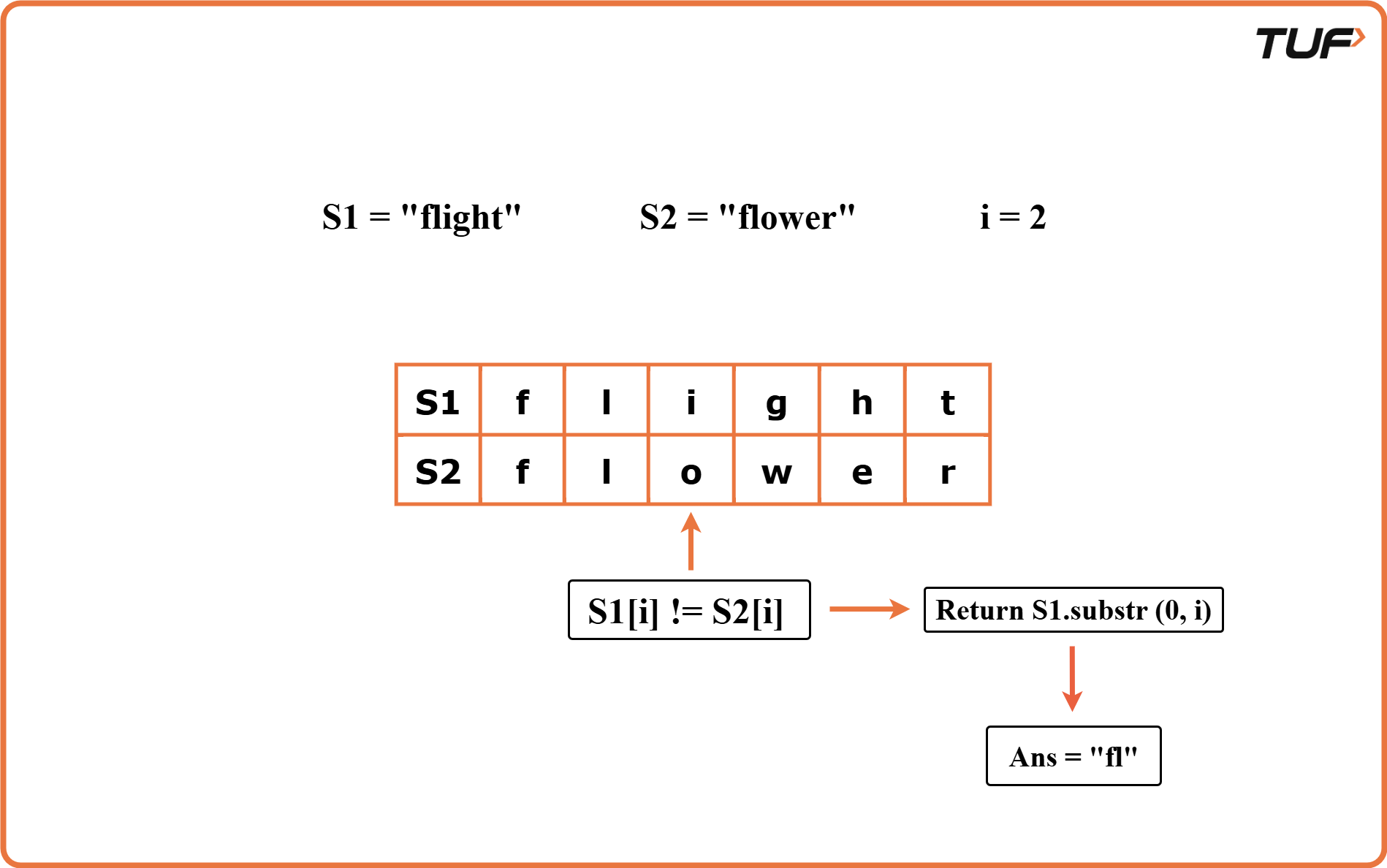
This is a powerful technique that reduces a problem of comparing N strings to a problem of comparing just two strings, with the main cost being the initial sort. Let's study the implementation from the takeuforward resource.
Longest Common Prefix - Tutorial
This article details the optimal sorting-based solution.
First, read the Algorithm section, which explains the intuition behind this approach. Next, carefully study the Java code to see how this logic is implemented using Arrays.sort(). Finally, review the Complexity Analysis.
The time complexity is dominated by the sorting step. The resource gives it as . This assumes the cost of comparing two strings is constant. A more precise analysis would be , where is the average string length, because each comparison during the sort takes time proportional to the string length. Nonetheless, the sorting-based approach is very efficient and demonstrates a creative problem-solving mindset highly valued in interviews. The space complexity is typically or depending on the implementation of the sorting algorithm, plus for storing the resulting prefix.
Conclusion
In this lesson, we explored three different ways to find the longest common prefix. Each approach reveals a different way of thinking about the problem, a skill that is crucial for technical interviews.
Key Takeaways:
- Vertical Scanning: A direct, brute-force method that compares characters column by column. It's simple to understand and implement.
- Horizontal Scanning: An iterative approach that assumes a prefix and shortens it. It provides an alternative perspective on the problem.
- Sorting Approach: The most elegant and often optimal solution. It relies on the clever insight that sorting the array reduces the problem to a comparison between just the first and last elements.
You've now added another important string problem to your toolkit. In our next lesson, we will pivot to a powerful new pattern for solving string and array problems: the sliding window technique. We'll start by applying it to problems with a fixed-size window, such as finding the maximum sum of a subarray of a specific size.