In our last lesson, you learned how to analyze recursive algorithms from a high-level, mathematical perspective using recurrence relations and the Master Theorem. This gave you the power to determine their time complexity. Today, we'll dive from that high-level view into the machine's inner workings to see exactly how recursion operates.
This lesson focuses on a fundamental concept for any programmer: the call stack. You will learn to trace the step-by-step execution of a recursive function, visualizing how each call is managed in memory. Understanding this mechanism is crucial for debugging, reasoning about space complexity (which we touched on before), and truly mastering recursion. It demystifies the "magic" and turns it into a concrete, predictable process.
The Call Stack: Your Program's To-Do List
Before we can understand how recursion works, we must first understand how any function call works in Java. When a function is called, it doesn't just magically execute. The program needs to keep track of what's currently running, where to return when it's done, and what the local variables are for that specific call. This is all managed by the call stack.
Think of the call stack as a pile of plates. You can only add a new plate to the top, and you can only take a plate from the top. This is known as a Last-In, First-Out (LIFO) structure. In programming:
- When a function is called, a new "plate" called a stack frame is pushed onto the top of the stack. This frame holds all the information for that specific call, like its parameters and local variables.
- The function at the top of the stack is the one currently executing.
- When a function finishes (i.e., hits a
returnstatement or its last line), its stack frame is popped off the top, and control returns to the function below it in the stack.
Introduction to Recursion - Learn In The Best Way
To see this in action, we'll watch a segment from a video by Kunal Kushwaha. He provides one of the clearest explanations of how the call stack works for a sequence of normal, non-recursive function calls. This foundation is essential.
Watch the segment from how the call stack is working internally. Pay close attention to how main calls print1, which calls print2, and so on. Notice how each function call adds a new frame to the stack, and how the stack unwinds one by one as each function completes its task and returns.
Recursion on the Call Stack
So, what happens when a function calls itself? The exact same mechanism applies! A new stack frame is created for each recursive call and pushed onto the stack. Each frame has its own independent copy of the parameters and local variables.
This is why, for factorial(n), the call to factorial(n-1) gets its own n (which is n-1), and the original call's n remains untouched in its own frame, waiting for the result.
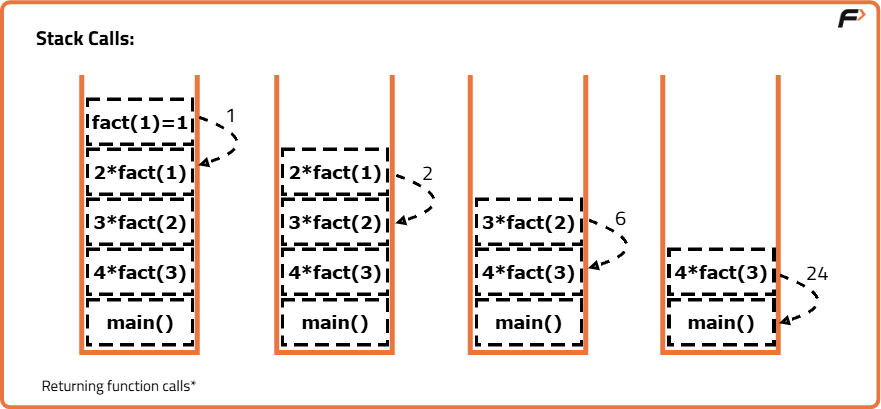
This process of stacking up function calls continues until a base case is reached. The base case is the condition that stops the recursion. When a function call meets the base case, it returns a value without making another recursive call. This starts a chain reaction: the frame pops off the stack, returning its value to the frame below it, which can then finish its computation, pop off, and so on, until the entire stack has unwound back to the original call.
What if there's no base case, or it's never reached? The function will keep calling itself, pushing new frames onto the stack indefinitely until the computer runs out of memory allocated for the stack. This is a very common runtime error called a StackOverflowError.
Re 1. Introduction to Recursion | Recursion Tree | Stack Space | Strivers A2Z DSA Course
The instructor in this take U forward video, Striver, does a great job of explaining this exact scenario. He demonstrates what happens during an infinite recursion and connects it directly to the concept of stack space and stack overflow.
Watch from the beginning to understand the definition of recursion and the problem with infinite calls: what is a recursion. Pay close attention to his explanation of how unfinished function calls pile up in the stack space. Then, watch the next segment on how a base condition solves this problem by providing a stopping point, allowing the stack to unwind gracefully: until a specified condition is met.
Tracing in Practice: From Linear to Tree-like Recursion
Now let's apply this knowledge to trace the execution of a couple of recursive functions. Tracing on paper or a whiteboard is a critical skill for interviews to demonstrate your understanding.
Example 1: Factorial (Linear Recursion)
Factorial is an example of linear recursion because each call only makes one other recursive call. This creates a simple, linear chain of calls on the stack.
11.1.5. Tracing Recursive Methods — CS Java
This resource from CS Java provides a clear, step-by-step trace of factorial(5). It's a great example of how you should think through recursive execution.
Start by reading the introductory paragraph: Each recursive call has its own local variables. Next, carefully follow the two-part trace for factorial(5). The first part shows the build-up: the call stack upside down. This shows how each call pauses and waits for the result of the next call. The second part shows the unwinding: substituting back. This shows how the return values are passed back up the chain to compute the final result. The resource also provides a link to a Java Visualizer. I highly recommend you click the factorial link and step through the code yourself. This tool animates the call stack, making the entire process transparent.
Example 2: Fibonacci (Tree Recursion)
The Fibonacci function, fib(n) = fib(n-1) + fib(n-2), is an example of tree recursion. Each call can make multiple other recursive calls. This is where tracing becomes more complex, but the underlying call stack mechanism remains the same. The execution flow mirrors a traversal of a tree.
Let's trace fib(4). The main call fib(4) first calls fib(3). fib(3) is now at the top of the stack and must resolve completely before the fib(2) call in fib(4)'s body can even be made. This means the program will fully explore the "left" branch of the recursion tree (fib(3)) before starting the "right" branch (fib(2)).
[PDF] Tracing Recursion and Call Stacks - DePaul University
This PDF from DePaul University contains an exceptionally detailed, step-by-step visualization of the call stack for fib(4). It's the perfect resource for seeing how a tree-like recursion is handled.
Find the section that begins with the code for fib(4). Then, slowly go through each of the 19 diagrams. For each step, observe: Which function is being called (PUSHING). Which function is returning (POPPING). The state of the variables (n, nMinus1, nMinus2) within each stack frame. Notice the order of execution. See how the stack grows all the way down to fib(1) (step 5) before any values are returned. Then watch how it partially unwinds and then grows again to handle the other branches of the recursion tree.
To see this in a more dynamic way, Kunal Kushwaha's video also includes a fantastic debugging session for the Fibonacci function.
Introduction to Recursion - Learn In The Best Way
Watching a live debugging session is invaluable. It connects the static recursion tree diagram to the actual flow of control in the code.
Watch the detailed walkthrough of debugging the Fibonacci function. The most important part is from how this is working internally. Follow along with his stack memory diagram and the debugger view in the IDE. This will solidify your understanding of how the left and right branches of the recursion are executed sequentially.
Key Takeaways
- Call Stack: A LIFO data structure that manages active function calls. Each call gets a stack frame containing its parameters and local variables.
- Recursive Execution: A recursive call pushes a new frame for itself onto the stack. Each call has its own isolated memory.
- Base Case: The condition that stops recursion. When met, a function returns a value without another recursive call, which begins the process of unwinding the stack.
- Stack Overflow: An error that occurs when recursion lacks a proper base case, causing the call stack to run out of memory.
- Tracing: The process of manually tracking the state of the call stack, including pushes, pops, and return values. For tree recursion, this involves fully resolving one branch (e.g., the left) before starting another.
Conclusion
You have now moved from analyzing recursion's complexity to understanding its mechanical execution. Being able to trace recursive functions on the call stack is not just an academic exercise; it's a practical skill that separates beginner from advanced programmers and is frequently tested in technical interviews. It gives you the confidence to write, debug, and reason about even the most complex recursive logic.
In our next lesson, we will switch gears slightly to another fundamental topic that is often a source of clever, optimized solutions in interviews: bitwise operators. You will learn how to manipulate numbers at the bit level to solve problems in ways you might not have thought possible.