Hello! In our previous lesson, we saw how a HashSet could be used to optimize the "Longest Consecutive Sequence" problem to linear time by providing constant-time lookups. This highlighted a key principle: using hash-based data structures to quickly check for the existence of elements is a powerful strategy for avoiding slower, repetitive searches in arrays.
Today, we'll continue exploring this theme by tackling another classic interview problem: counting all subarrays that sum to a specific value, k. This problem introduces a new and extremely useful technique called prefix sums. When combined with a HashMap, prefix sums allow us to develop a highly efficient solution. As per your preference, we will walk through the problem from a brute-force approach to a better one, and finally arrive at the optimal solution.
Problem: Subarray Sum Equals K
First, let's be very clear about the problem. You are given an array of integers (which can include positive numbers, negative numbers, and zeros) and an integer k. Your task is to find the total number of contiguous subarrays whose elements sum up to exactly k.
For example, if the array is [1, 2, 3] and k = 3, there are two such subarrays:
[1, 2](since1 + 2 = 3)[3]
The final count is 2. The takeUforward article below provides a clear definition and more examples.
Count Subarray sum Equals K - Tutorial
This article from the takeUforward site clearly defines the problem and what constitutes a subarray.
Read the problem statement and examples to ensure you understand the goal. Note the emphasis on a subarray being a contiguous non-empty sequence.
Approach 1: The Brute-Force Solution (O(n³))
The most direct way to solve this is to generate every single possible subarray, calculate the sum of each one, and check if that sum equals k.
The algorithm is as follows:
- Use a loop with index
ito select the starting point of a subarray. - Use a nested loop with index
jto select the ending point of the subarray. This defines the subarrayarr[i...j]. - Use a third loop with index
mto iterate fromitoj, adding up all the elements to get the sum. - If
sum == k, increment a counter.
This method is exhaustive and guaranteed to be correct, but as you might guess, it's very slow. The triple-nested loop structure gives it a time complexity of approximately .
The video from 'take U forward' walks through this logic.
Count Subarray sum Equals K | Brute - Better -Optimal
Striver explains the problem and the initial brute-force approach.
Watch the segment from this timestamp where he discusses the definition of a subarray and derives the three-loop brute-force solution.
Approach 2: A Better Solution (O(n²))
We can make a simple but significant optimization. Notice that the third loop, which recalculates the sum for every subarray, is doing a lot of repeated work. For a fixed starting point i, as we extend the end point j, we are constantly re-summing the same initial elements.
We can eliminate the third loop by maintaining a running sum.
- Use a loop with index
ito select the starting point. - Initialize
sum = 0. - Use a nested loop with index
jstarting fromi. In each iteration of this inner loop:
a. Addarr[j]to thesum.
b. Check if thesumequalsk. If it does, increment our counter.
This approach reduces the complexity to . It's a definite improvement and a good step in an interview, but for large arrays, it will likely result in a "Time Limit Exceeded" (TLE) error.
560. Subarray Sum Equals K — LeetCode Medium Problem — Full Solution and approach explained
This article explains the O(n²) approach clearly and also provides context on why it might fail in a coding challenge scenario due to time limits.
Read the section titled "Optimized Brute Force Method". Pay attention to the logic of accumulating the sum on the fly and the explanation of why an O(n^2) solution leads to TLE.
Approach 3: The Optimal Solution with Prefix Sums and a HashMap (O(n))
To get to a linear time solution, we need a new insight. This is where the prefix sum technique comes into play.
A prefix sum at index j, let's call it prefixSum[j], is the sum of all elements from the start of the array up to j. That is, prefixSum[j] = arr[0] + arr[1] + ... + arr[j].
With prefix sums, the sum of any contiguous subarray arr[i...j] can be found in time:sum(arr[i...j]) = prefixSum[j] - prefixSum[i-1]
Our goal is to find the number of pairs (i, j) such that sum(arr[i...j]) = k. Using our new formula, this means we are looking for:prefixSum[j] - prefixSum[i-1] = k
If we rearrange this equation, we get the key insight:prefixSum[j] - k = prefixSum[i-1]
This changes the problem entirely. Instead of searching for subarrays, we can iterate through the array once, calculating the current prefix sum at each index j. At each step, we ask: "How many times have we previously seen a prefix sum that equals currentPrefixSum - k?"
Each time we find such a past prefix sum, it means we have found a new subarray ending at j whose sum is k.
A HashMap is the perfect tool for this. We can store the prefix sums we have seen so far and their frequencies (prefix sum -> count).
The algorithm is:
- Initialize a
HashMapto store prefix sum frequencies. A crucial first step is to put(0, 1)into the map. This handles cases where a subarray starting from index 0 sums tok. Think of it as the "empty" prefix before the array begins, which has a sum of 0 and occurs once. - Initialize
count = 0andcurrentPrefixSum = 0. - Iterate through the array. For each element:
a. Add the element tocurrentPrefixSum.
b. Calculate the required "past" prefix sum:remove = currentPrefixSum - k.
c. Check the map: ifremoveexists as a key, add its frequency (map.get(remove)) tocount.
d. Update the map: increment the frequency ofcurrentPrefixSum. If it's not in the map, add it with a frequency of 1. - Return
count.
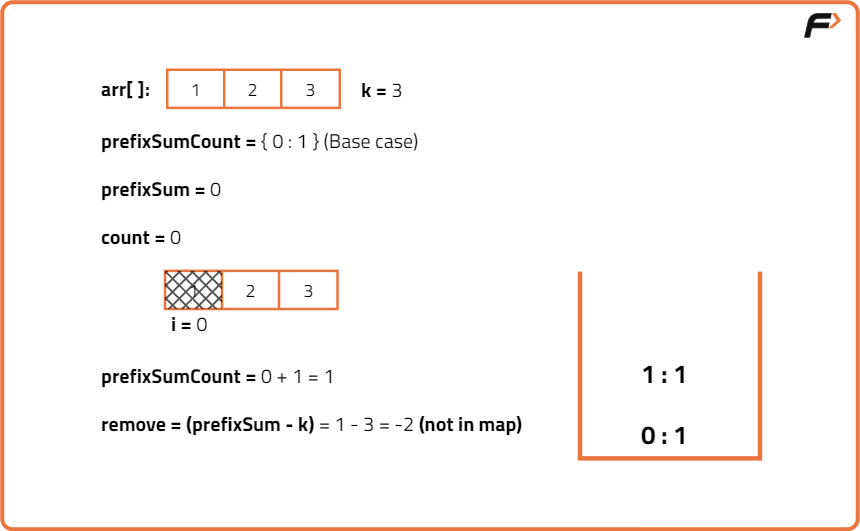
Let's trace this with arr = [1, 2, 3] and k = 3.
-
Initial:
map = {0: 1},count = 0,prefixSum = 0. -
i = 0, element = 1:
prefixSumbecomes0 + 1 = 1.remove = 1 - 3 = -2. Is-2in the map? No.- Update map with
prefixSum = 1.mapis now{0: 1, 1: 1}.
-
i = 1, element = 2:
prefixSumbecomes1 + 2 = 3.remove = 3 - 3 = 0. Is0in the map? Yes, its frequency is 1.countbecomes0 + 1 = 1. (We found the subarray[1, 2]).- Update map with
prefixSum = 3.mapis now{0: 1, 1: 1, 3: 1}.
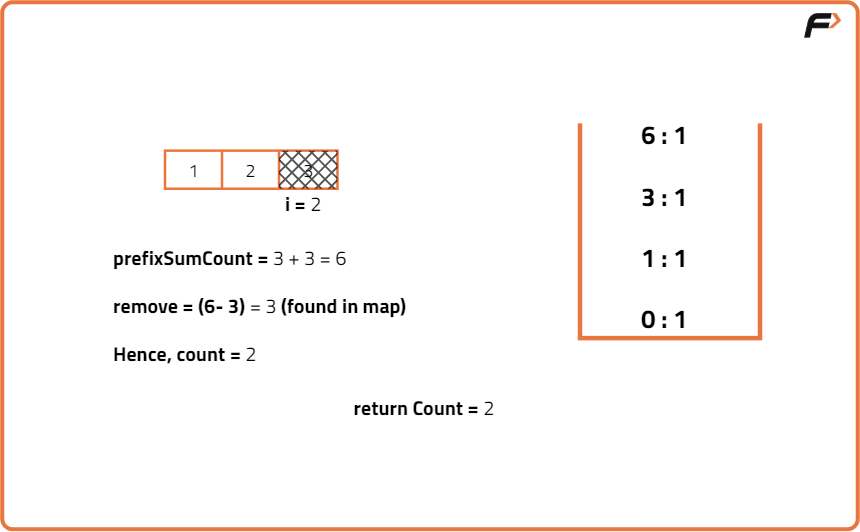
-
i = 2, element = 3:
prefixSumbecomes3 + 3 = 6.remove = 6 - 3 = 3. Is3in the map? Yes, its frequency is 1.countbecomes1 + 1 = 2. (We found the subarray[3], which is the part betweenprefixSum=6and the previousprefixSum=3).- Update map with
prefixSum = 6.mapis now{0: 1, 1: 1, 3: 1, 6: 1}.
-
End: Final
countis 2.
The images below, from the takeUforward article, illustrate these steps.
This approach is extremely powerful because it solves the problem in a single pass. The takeUforward article provides a superb written explanation of this.
Count Subarray sum Equals K - Tutorial
This is the core of the lesson. It details the prefix sum and HashMap-based optimal solution.
Read the section explaining the algorithm. Focus on understanding the relationship prefix sum of remove-part = x - k. Also, pay close attention to the explanation for initializing the map with (0, 1).
For a dynamic, step-by-step walkthrough, Striver's video is an excellent resource.
Count Subarray sum Equals K | Brute - Better -Optimal
Striver provides a detailed conceptual explanation and a dry run of the optimal prefix sum and HashMap approach.
First, watch the section explaining the core intuition behind using prefix sums. Then, follow the detailed dry run. This will solidify how the map is used to track prefix sum frequencies to find the answer.
Here is the complete Java code for the optimal solution:
import java.util.HashMap;

public class Solution {
    public int subarraySum(int[] nums, int k) {
        // HashMap to store prefix sums and their frequencies
        // Key: prefix sum, Value: frequency
        HashMap<Integer, Integer> prefixSumMap = new HashMap<>();

        // Base case: A prefix sum of 0 exists once (the empty prefix)
        prefixSumMap.put(0, 1);

        int count = 0;
        int currentPrefixSum = 0;

        for (int num : nums) {
            // Update the current prefix sum
            currentPrefixSum += num;

            // Calculate the prefix sum we need to find in the map
            int removeSum = currentPrefixSum - k;

            // If the map contains the required 'removeSum', it means we have found
            // one or more subarrays ending at the current position with a sum of k.
            if (prefixSumMap.containsKey(removeSum)) {
                count += prefixSumMap.get(removeSum);
            }

            // Add the current prefix sum to the map, updating its frequency.
            prefixSumMap.put(currentPrefixSum, prefixSumMap.getOrDefault(currentPrefixSum, 0) + 1);
        }

        return count;
    }
}
Complexity Analysis:
- Time Complexity: , because we iterate through the array only once. Each
HashMapoperation (insertion and retrieval) takes on average. - Space Complexity: , as in the worst case, the
HashMapmight storendistinct prefix sums if all prefix sums are unique.
Conclusion
In this lesson, we explored a powerful pattern for solving subarray problems. By combining the prefix sum technique with the fast lookups of a HashMap, we were able to optimize a problem from a brute-force or solution down to an optimal single-pass solution.
Key Takeaways:
- Problem-Solving Progression: We moved from a naive brute-force method to a better, and finally to an optimal solution, a crucial skill for interviews.
- Prefix Sums: This technique is fundamental for problems involving sums of ranges or subarrays. The formula
sum(i, j) = prefixSum[j] - prefixSum[i-1]is one you should commit to memory. - HashMap for Frequencies: The key insight was to rearrange the equation to
prefixSum[j] - k = prefixSum[i-1]and use aHashMapto store frequencies of past prefix sums, enabling an efficient lookup for theremoveSum. - Edge Case Handling: The
map.put(0, 1)initialization is a subtle but critical detail that correctly handles subarrays starting from the beginning of the array.
We have now concluded the "Arrays & Hashing" module. You've learned several foundational patterns, including the two-pointer technique, Kadane's algorithm, and using hash sets/maps with prefix sums for efficient lookups.
In our next lesson, we will begin the Sorting & Searching Algorithms module. We'll start by implementing the fundamental sorting algorithms—Selection Sort, Bubble Sort, and Insertion Sort—to build a strong foundation for more advanced techniques like Merge Sort and Quick Sort.