Welcome back! In our last session, we introduced the powerful slow-fast pointer technique to find the middle of a linked list. You saw how this two-pointer pattern provides an elegant, single-pass solution that is far more efficient than a naive two-pass approach.
Today, we will deepen your mastery of this pattern by applying it to solve a classic and more complex pair of interview questions: detecting if a cycle exists in a linked list and, if so, finding the exact node where the cycle begins. We will follow your preferred learning path, starting with an intuitive brute-force method using hashing, and then progressing to the optimal solution, Floyd's Cycle-Finding Algorithm, also known as the "Tortoise and Hare" algorithm. This lesson will not only give you a solution to a common problem but also provide a deeper understanding of pointer arithmetic and problem decomposition.
1. The Brute-Force Approach: Hashing Visited Nodes
The most direct way to think about this problem is to consider what defines a cycle. A cycle exists if, during our traversal of the list, we encounter a node that we have already visited. The first time we encounter such a "repeat" node, we have found the starting point of the loop.
How can we keep track of visited nodes? A hash set is a perfect data structure for this. We can traverse the list one node at a time, and for each node:
- Check if the node is already in our hash set.
- If it is, we have found the start of the cycle. We can immediately return this node.
- If it isn't, we add the node to the hash set and move to the next node.
If we traverse the entire list and reach null without finding a repeated node, we can conclude that no cycle exists.
The following video from the takeUforward channel provides an excellent walkthrough of this hashing-based strategy.
L17. Find the starting point of the Loop/Cycle in LinkedList | Multiple Approaches
This video segment explains how to use a hash map (or hash set) to solve the problem of finding the starting node of a loop. Pay close attention to why we must store the node object itself, not just its value.
Watch the explanation of the brute-force approach from this segment. Striver covers the logic, the pseudo-code, and the complexity analysis, which highlights the main drawback of this method.
To reinforce this, you can also read through the following text resource, which lays out the algorithm and provides a clean Java implementation.
Starting point of loop in a Linked List - Tutorial
This article from takeUforward provides a clear, step-by-step explanation of the hashing approach.
Read the section titled Algorithm to understand the logic. Then, examine the full Java code provided in the subsequent section to see how HashSet<ListNode> is used to implement this idea.
This method is correct and easy to understand.
- Time Complexity: O(N), as we visit each node at most once. Hash set lookups and insertions take, on average, O(1) time.
- Space Complexity: O(N), because in the worst-case scenario (a list with no cycle), we would store every single node in the hash set.
For interviews at top companies, you'll be expected to do better. The O(N) space complexity is the key issue an interviewer would want you to optimize. This brings us to the optimal approach.
2. The Optimal Approach: Floyd's Cycle-Finding Algorithm
Here is where the slow-fast pointer technique we learned previously truly shines. It allows us to solve this problem in O(1) space. The algorithm is a two-step process:
- Detect the Cycle: Use slow and fast pointers to determine if a cycle exists.
- Find the Starting Node: If a cycle is detected, use the pointers' meeting point to find the cycle's entry point.
Step 1: Detecting the Cycle
We start both a slow and a fast pointer at the head of the list.
slowmoves one node at a time (slow = slow.next).fastmoves two nodes at a time (fast = fast.next.next).
If the linked list has no cycle, the fast pointer will eventually reach the end of the list (null). However, if there is a cycle, the fast pointer will lap the slow pointer and they will eventually meet at some node within the cycle.
The intuition for why they must meet is based on their relative speed. Inside a cycle, the fast pointer gains on the slow pointer by one step for every move. Think of two runners on a circular track; the faster runner will inevitably lap the slower one.

The video below explains this detection phase and provides the crucial proof for why collision is guaranteed.
L14. Detect a loop or cycle in LinkedList | With proof and Intuition
This video from takeUforward focuses on the first part of our problem: simply detecting the loop. It also includes an excellent mathematical intuition for why the pointers are guaranteed to meet.
First, watch the segment from the algorithm to see how the pointers move and collide. Then, to understand why this works, watch the intuition and proof section. This proof is key to a deep understanding.
The condition for the traversal loop is while (fast != null && fast.next != null). If this loop finishes, it means no cycle was found. If slow == fast at any point inside the loop, we have detected a cycle and can proceed to the next step.
Step 2: Finding the Cycle's Starting Point
Once slow and fast have met at a collision point, we can find the start of the loop with a clever reset. The algorithm is as follows:
- Leave the
fastpointer at the collision point. - Reset the
slowpointer back to theheadof the linked list. - Now, move both
slowandfastone step at a time (slow = slow.next,fast = fast.next). - The node where they meet again is the starting point of the loop.
This works due to a neat mathematical property. It can be proven that the distance from the head of the list to the start of the loop is equal to the distance from the collision point to the start of the loop.
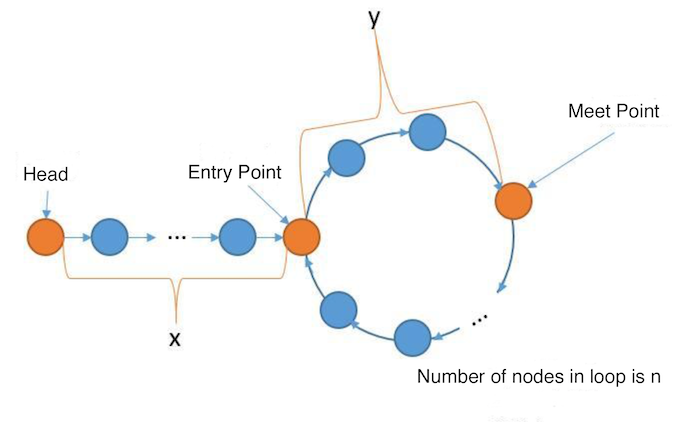
The proof for this is fascinating and relies on the distances covered by each pointer. The following video and text resource walk through this logic beautifully.
L17. Find the starting point of the Loop/Cycle in LinkedList | Multiple Approaches
This video demonstrates the second step of the algorithm and provides the mathematical proof that makes it work. This is the core of today's lesson.
Watch the segment from the algorithm to see the pointer reset in action. To understand the underlying mathematics, watch the excellent in-depth proof.
For a written explanation and the final Java code, please review the optimal approach in the takeUforward article.
Starting point of loop in a Linked List - Tutorial
This article details the elegant two-step Floyd's algorithm, including the mathematical proof and a complete Java implementation.
Read the step-by-step breakdown under the Algorithm heading. Then, carefully study the proof for this algorithm to solidify your understanding. Finally, review the complete Java implementation and its complexity analysis.
This optimal algorithm achieves the best possible complexities:
- Time Complexity: O(N), as the pointers traverse the list a constant number of times.
- Space Complexity: O(1), as we only use two extra pointers (
slowandfast).
Practice Problems
Now you are equipped to solve two related LeetCode problems. The first asks you only to detect the cycle, and the second asks you to find its starting point.
- LeetCode 141: Linked List Cycle (Detect if a cycle exists)
- LeetCode 142: Linked List Cycle II (Find the node where the cycle begins)
Try to implement the solutions in Java using Floyd's algorithm from scratch.
Conclusion
In this lesson, we took the slow-fast pointer technique a step further, applying it to detect and locate cycles in a linked list. This pattern is a cornerstone of many advanced linked list problems and is frequently asked in technical interviews.
Key Takeaways:
- Brute-Force: A
HashSetcan track visited nodes to find a cycle's start in O(N) time and O(N) space. - Floyd's Algorithm (Optimal): A two-step, O(1) space solution.
- Step 1 (Detection): Move a
slowpointer by one and afastpointer by two. If they collide, a cycle exists. - Step 2 (Find Start): After collision, reset
slowto thehead. Move bothslowandfastby one step until they meet again. This second meeting point is the start of the loop.
- Step 1 (Detection): Move a
- The "Why": The mathematical proof, based on the distances traveled by the pointers, is what guarantees that this two-step process correctly identifies the starting node.
In our next lesson, we will shift our focus from manipulating a single list to operating on multiple lists by tackling another classic problem: merging two sorted linked lists.