Welcome back. In our previous lessons, we focused on the anatomy of linked lists, building both singly and doubly linked implementations from scratch. You've become proficient in handling next and prev pointers for insertion and deletion. Now, we shift our focus from constructing the data structure to manipulating it to solve a classic problem.
Today, we will tackle one of the most fundamental and frequently asked interview questions: reversing a singly linked list. This exercise is a perfect test of your understanding of pointer manipulation and will introduce two powerful problem-solving paradigms: an iterative, in-place solution and an elegant recursive one. Following your preferred learning path, we will progress from a simple brute-force method to the more optimized approaches you'd be expected to produce in a technical interview.
1. Brute-Force: Reversing with a Stack
When first approaching this problem, a natural thought is to use an auxiliary data structure that can reverse the order of elements for us. The stack, with its Last-In-First-Out (LIFO) behavior, is perfectly suited for this.
The idea is simple:
- Traverse the linked list from head to tail, pushing the value of each node onto a stack.
- Once all values are in the stack, traverse the list again from the head.
- For each node, pop a value from the stack and overwrite the node's current value.
Because of the LIFO principle, the last value we pushed (from the tail of the list) will be the first one we pop, effectively reversing the sequence of values in the list.
Let's watch a short explanation of this approach.
L9. Reverse a LinkedList | Iterative and Recursive
This video segment from the "take U forward" channel explains the intuition behind using a stack to reverse a linked list.
Watch from the explanation of the brute-force solution. Notice that this method only changes the data within the nodes, not the pointers connecting them.
While this method works, it has two significant drawbacks for an interview setting:
- Space Complexity: It requires O(n) extra space for the stack, where n is the number of nodes in the list.
- Pointer Invariance: It doesn't actually reverse the list structure; it just shuffles the data within the existing nodes. An interviewer will almost always expect you to modify the pointers themselves.
This brute-force solution is a good starting point, but let's move on to the more efficient, in-place method.
2. The Optimal Iterative Approach: The Three-Pointer Technique
To reverse the list in-place without using extra space, we need to change the direction of the next pointers of each node. A node that points forward to its successor must be rewired to point backward to its predecessor.
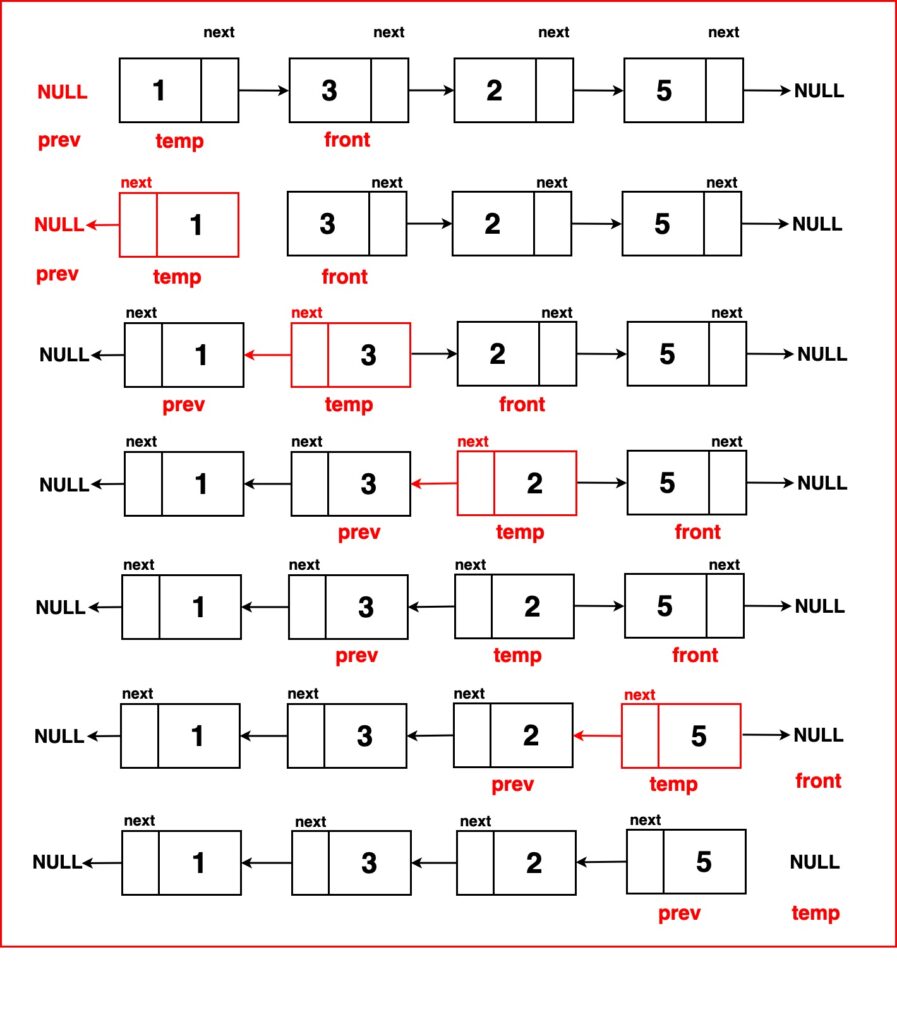
The main challenge here is that as soon as you change a node's next pointer (e.g., current.next = prev), you lose the link to the rest of the original list. To prevent this, we use a classic three-pointer strategy:
prev: Tracks the node that comes before the current node in the reversed sequence. It starts asnullbecause the original head will become the new tail, pointing to nothing.temp(orcurrent): This is our main traversal pointer, iterating through the list one node at a time. It starts athead.front(ornextTemp): This pointer "scouts ahead" and stores a reference to the next node in the original list before we break the link.
The process for each node is a four-step dance:
- Save the next node:
front = temp.next. - Reverse the link:
temp.next = prev. - Move
prevone step forward:prev = temp. - Move
tempone step forward:temp = front.
We repeat this until temp becomes null. At that point, prev will be pointing to the new head of the reversed list.
The diagram below illustrates this step-by-step pointer manipulation.
To see this in action, the following video provides an excellent animated dry run.
L9. Reverse a LinkedList | Iterative and Recursive
This segment provides a detailed walkthrough of the iterative three-pointer technique, complete with a dry run and Java code.
Watch from the optimal approach. Pay close attention to how the three pointers (prev, temp, front) interact to reverse the links without losing any part of the list.
Now, let's consolidate this with a reading that presents the formal algorithm and a clean Java implementation.
Reverse a Linked List - Tutorial
This article from takeUforward formalizes the iterative algorithm and provides the code you'll need.
Read the section titled Optimal Approach. Focus on the step-by-step algorithm and compare the Java code provided with the logic you saw in the video.
This iterative solution is highly efficient, with a time complexity of O(n) and a space complexity of O(1), making it the preferred solution in most interview scenarios.
3. The Recursive Approach
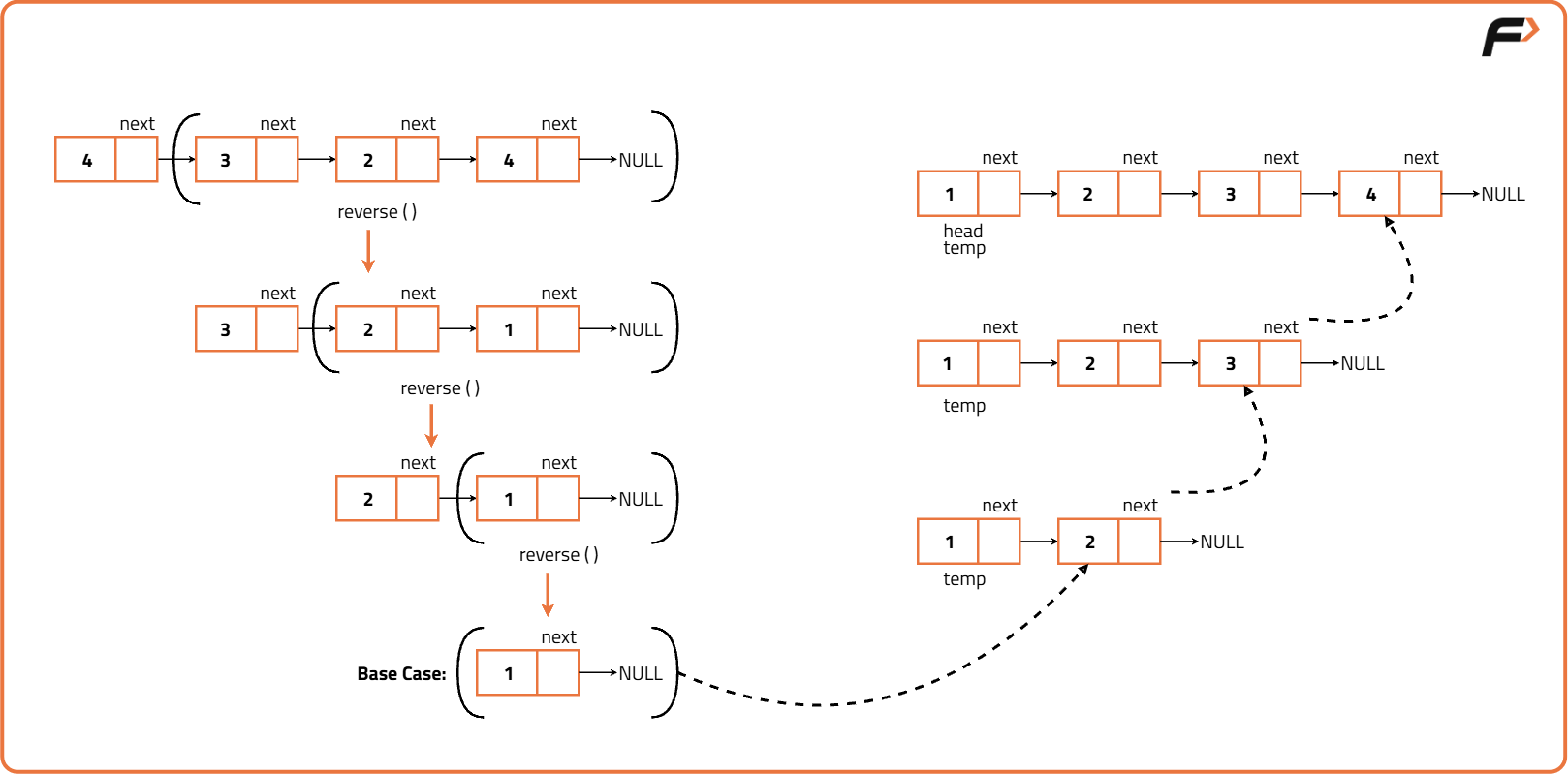
Recursion offers another powerful way to think about this problem. The core idea is to apply a "leap of faith": assume you can reverse the rest of the list, and then figure out what to do with the current node.
Here's the recursive logic:
- Base Case: If the list is empty (
head == null) or has only one node (head.next == null), it's already reversed. Returnhead. - Recursive Step:
- Call the
reverseListfunction onhead.next. This call will recursively reverse the entire sublist that starts after the head and, crucially, will return thenewHeadof that reversed sublist (which is the original tail of the list). - Now, the
headnode is still pointing to its original successor. Let's call thisfront = head.next. In the reversed sublist,frontis now the last node, and itsnextpointer isnull. - We need to attach
headto the end of this reversed sublist. We do this by settingfront.next = head. - Finally, we must set
head.next = null. This makes the currentheadthe new tail and prevents a cycle in the list (a very common bug!). - Return the
newHeadthat was returned by the initial recursive call.
- Call the
This can be tricky to visualize. The image below shows how the problem is broken down recursively and then reassembled.
The following video provides an exceptionally clear dry run of the recursion, showing how the call stack manages the state at each step.
L9. Reverse a LinkedList | Iterative and Recursive
This final segment explains the recursive solution, from the initial breakdown of the problem to a detailed trace of the execution.
Watch from the recursive explanation. The key is to understand what the function returns at each level of recursion and how the pointers head.next.next = head and head.next = null work together.
For a final review, let's look at the code and a concise summary of the logic.
Reverse a Linked List - Tutorial
This section of the takeUforward article provides the complete algorithm and Java code for the recursive solution.
Please read the Recursive Approach section. After watching the video, this code should feel intuitive. Also, it's worth reading the "Common Pitfalls" section in the NeetCode article (resource_id="3b325"), which highlights the importance of setting head.next = null to avoid cycles.
The recursive solution has a time complexity of O(n), same as the iterative one. However, its space complexity is O(n) due to the recursive call stack depth. While elegant, the iterative solution's O(1) space usage makes it superior in memory-constrained environments.
As promised, here is the link to the problem on LeetCode. I highly recommend you try to implement both the iterative and recursive solutions yourself.
Conclusion
You have now learned and analyzed three different ways to reverse a singly linked list. This is a significant milestone that solidifies your command over pointer manipulation.
Key Takeaways:
- Brute-Force (Stack): An intuitive but space-inefficient approach that only modifies data, not pointers. Time: O(n), Space: O(n).
- Iterative (Three-Pointers): The most optimal solution. It reverses the list in-place by carefully re-wiring
nextpointers. Time: O(n), Space: O(1). - Recursive: An elegant solution that demonstrates a deep understanding of recursion. It solves the problem by breaking it down, but at the cost of space. Time: O(n), Space: O(n).
- Interview Context: In an interview, you should be able to explain all three, starting with the brute-force idea, and then coding the optimal iterative solution. Being able to also code the recursive one is a huge plus.
In our next lesson, we will explore another powerful linked list pattern: the slow-fast pointer technique. This will enable us to solve problems like finding the middle of a linked list efficiently.