Welcome to our next lesson. In our previous discussion, we focused on what to do when we find evidence of confounding: we calculate a Mantel-Haenszel adjusted estimate to provide a single, corrected summary of the association. This entire process was built on a key assumption—that the stratum-specific measures of association (e.g., the odds ratios in each age group) were all similar to one another.
This lesson tackles the other possibility. What happens if, after stratifying our data, we find that the stratum-specific estimates are not similar? This situation signals a different, and in many ways more interesting, phenomenon. Today, we will address the learning outcome: Define and identify effect modification (interaction) using stratified analysis. You will learn that unlike confounding, which is a bias to be corrected, effect modification is a genuine finding about the nature of the relationship, one that we need to highlight rather than adjust away.
What is Effect Modification?
Effect modification, also known as interaction, occurs when the magnitude or direction of an association between an exposure and an outcome differs depending on the level of a third variable. This third variable is called an effect modifier.
Think back to confounding. A confounder creates a spurious association or distorts a real one, but the true underlying association is the same in every stratum. With effect modification, the association is genuinely different in different subgroups.
- Confounding is a problem of a biased comparison. We want to control for it to get to the single "true" answer.
- Effect Modification is a real biological or social phenomenon. The fact that the effect is different in different groups is the interesting story. We want to describe it, not eliminate it.
The following video provides a concise introduction to the concept and distinguishes it from confounding.
This video by Dr. Terry Shaneyfelt clearly defines effect modification and highlights its importance in identifying high-risk subgroups.
Watch the initial segment defining the concept (the definition). Then, watch the conclusion, which provides an excellent summary of the conceptual difference between confounding and effect modification (the summary).
Identifying Effect Modification with Stratified Analysis
The method for identifying effect modification is the same one we used for confounding: stratified analysis. However, we are looking for a different pattern in the results.
The key steps are:
- Calculate the crude (unadjusted) measure of association between the exposure and outcome.
- Stratify the data by the potential effect modifier (e.g., into male and female groups, or different age categories).
- Calculate the stratum-specific measures of association within each stratum.
- Compare the stratum-specific measures to each other.
If the stratum-specific measures are substantially different from one another, we have evidence of effect modification. For example, a drug might be highly effective in women (e.g., Risk Ratio = 0.5) but have no effect in men (Risk Ratio = 1.0). In this case, gender is an effect modifier.
The following resource provides a superb, step-by-step walkthrough of this process.
Effect Modification – Foundations of Epidemiology
This chapter from an open-source epidemiology textbook offers a clear definition and a detailed example of identifying effect modification.
First, read the introduction to solidify the conceptual difference between confounding and effect modification. Then, carefully follow the worked example about the association between sleep and GPA. Notice how the crude risk ratio (RR) is 1.0, suggesting no association. However, when stratified by gender, the RRs are 0.68 for men and 1.7 for women—they are not only different in magnitude but also in direction! This is a classic signature of effect modification.
What to Do When You Find Effect Modification
The example you just read highlights the most important rule: When you find effect modification, you do not report an adjusted measure. Calculating a single Mantel-Haenszel estimate would be misleading. An adjusted RR would average out to be near 1.0, completely hiding the important fact that the effect of sleep is different for men and women.
Instead, you must report the stratum-specific estimates separately. Your conclusion would be something like:
"The association between hours of sleep and GPA was modified by gender. Among male students, sleeping fewer than 8 hours was associated with a 32% lower risk of a low GPA (RR = 0.68). In contrast, among female students, sleeping fewer than 8 hours was associated with a 70% higher risk of a low GPA (RR = 1.7)."
This is a much richer and more informative conclusion than simply stating that, on average, there is no effect.
A Tale of Two Analyses: Confounding vs. Effect Modification
Let's now consolidate the entire decision-making process. The analysis starts the same way—stratification—but the path diverges depending on what you find. The flowchart below illustrates this fork in the road. In our previous lessons, we took the "YES" path. Today, we are exploring the "NO" path.
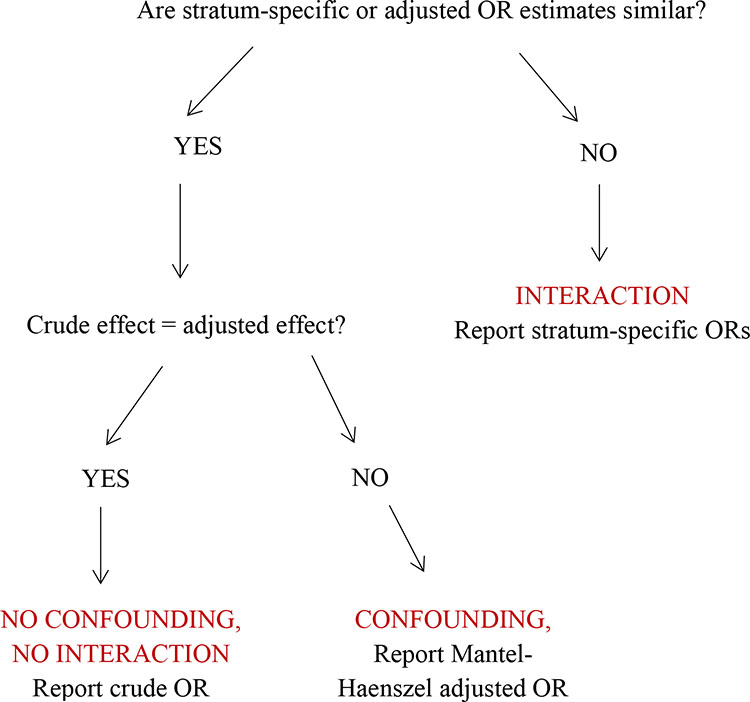
The following image provides a brilliant visual summary of the difference. On the left (confounding), adjusting for age changes the estimate from a crude OR of 3.0 to an adjusted OR of 1.5. This implies the "true" effect is 1.5, and the crude value was biased. On the right (effect modification), the effect is simply different in the two strata (OR=3.0 for women, OR=1.5 for men). There is no single "true" effect; the effect depends on the subgroup.

This distinction is so fundamental that it's worth reviewing one more time in a more formal text.
Effect Modification – Foundations of Epidemiology
This reading solidifies the practical differences in how you analyze and report confounding versus effect modification.
Please read the section titled "Differences between Confounding and Effect Modification". Pay close attention to the summary table at the end of that section, which provides a side-by-side comparison of the entire process. Finally, review the concluding summary table, "One final, put-it-all-together table". It presents clear numerical scenarios to help you instantly recognize whether a variable is acting as a confounder, an effect modifier, or neither.
To see one more numerical example, the video below walks through a scenario involving smoking, alcohol use, and cancer, where the odds ratio changes dramatically across strata.
Confounding and Effect modification: Lecture
This video provides another clear, narrated example of identifying effect modification by observing changes in odds ratios across strata.
Watch the segment from the example. The presenter defines an effect modifier and then shows how stratifying by alcohol use dramatically changes the association between smoking and head/neck cancer, strengthening it in one group and weakening it in the other. This reinforces the core pattern you are looking for.
Conclusion
In this lesson, we completed our exploration of how to handle third variables in epidemiological analysis. We've seen that stratified analysis is the key diagnostic tool, but the interpretation of its results depends entirely on the pattern you observe.
Here are the key takeaways:
- Effect modification (or interaction) occurs when the association between an exposure and outcome differs across levels of a third variable.
- It is identified in a stratified analysis when the stratum-specific measures of association are meaningfully different from one another.
- Unlike confounding, effect modification is considered a real and important finding, not a bias to be eliminated.
- When effect modification is present, you must report the stratum-specific estimates separately and should not calculate a single adjusted measure like the Mantel-Haenszel estimate.
You now have a complete framework for assessing the roles of confounding and effect modification. With these concepts of study design and analysis in hand, we are ready to turn our attention to a specific and highly influential type of study: the clinical trial. In our next lesson, we will begin our next module by exploring the ethical principles and regulatory phases that govern how new medical interventions are tested in humans.