Introduction
Welcome back. In our last lesson, we constructed a vital piece of external architecture: a code of conduct for the husband's professional interactions with the mentor. By defining rules for "single-role zones" and communication protocols, we created a framework to protect the integrity of the mentorship from the complexities of the personal relationships.
Today, we turn our attention back from external behaviors to the husband's internal emotional landscape. Your goal for this lesson is to learn to differentiate between professional envy regarding the mentor's attention and romantic jealousy regarding the wife's affection. These two powerful emotions can feel hopelessly tangled, yet they stem from different sources and require different responses. Misidentifying them is like using the wrong map; you can't get to a healthy resolution if you've misdiagnosed the starting point. This lesson will provide the diagnostic tools to tell them apart.
Part 1: Defining the Core Concepts: Jealousy vs. Envy
While often used interchangeably in casual conversation, psychology and relationship coaching make a sharp distinction between jealousy and envy. Understanding this difference is the first step in untangling the husband's feelings.
Let's start with a foundational reading that lays out this distinction clearly.
What's the difference between jealousy and envy?
The article 'What's the difference between jealousy and envy?' from Minka Guides provides an excellent and accessible explanation. It introduces a simple 'numbers game' to distinguish the two emotions.
Please read the sections titled 'Jealousy definition' and 'Envy definition'. As you read, focus on the 'triangular' nature of jealousy versus the two-person dynamic of envy. Note the core emotion associated with each—fear for jealousy, and desire for envy.
As the article explains, the easiest way to separate these emotions is to count the number of parties involved in the core emotional dynamic.
-
Jealousy is triangular. It involves three people: you, a person you value (your beloved), and a third party you perceive as a threat or "interrupter." The core feeling is fear of loss—the fear that you will lose what you have (e.g., your partner's affection, time, or commitment) to this third party.
-
Envy is dyadic. It involves two people: you and someone else. The core feeling is desire or longing for something the other person possesses that you lack—such as their skills, success, possessions, or, in this case, the professional validation they receive.
Part 2: Visualizing the Distinction
To reinforce this crucial difference, let's look at two visual aids that summarize these concepts.
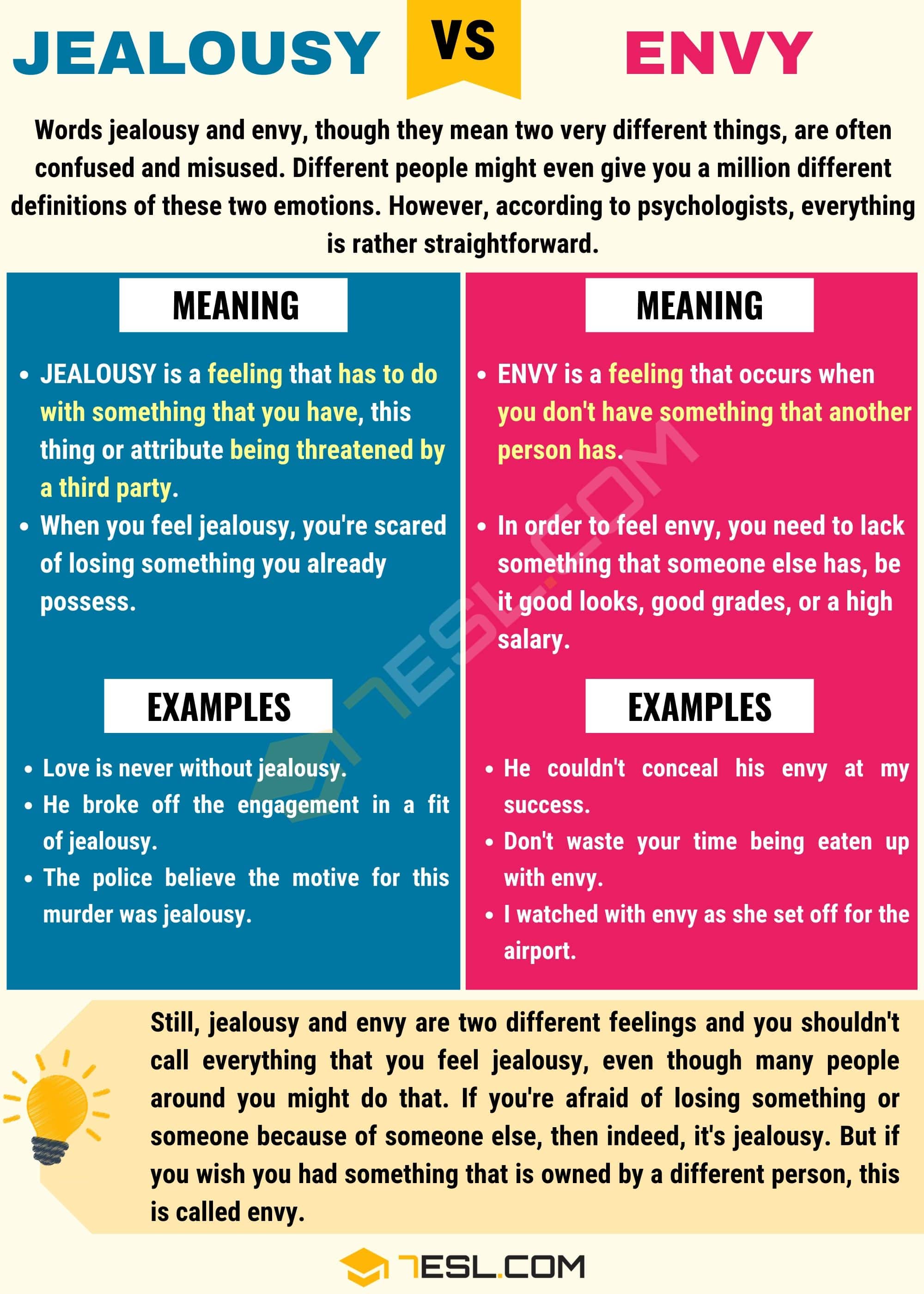

These visuals make it clear:
- Romantic Jealousy is about the relationship with the wife.
- Professional Envy is about the relationship with the mentor and the status he confers.
Part 3: Applying the Framework to the Husband's Experience
Now, let's move from theory to practice by applying this framework to concrete scenarios the husband might face.
Scenario A: A Clear Case of Romantic Jealousy
- The Trigger: The husband walks into the living room to find his wife and the mentor sitting closely on the sofa, laughing over a shared memory from a trip they took together. The mentor reaches out and tucks a stray strand of hair behind the wife's ear. The moment feels exclusive and deeply intimate.
- The Husband's Internal Reaction: A cold knot forms in his stomach. His thoughts are: "Look at them. He's intruding on our life, in our home. I'm losing her. That's a gesture a husband should make. He is taking my place."
- Analysis: This is romantic jealousy.
- The Triangle: The Husband (self), the Wife (beloved), the Mentor (perceived interrupter).
- The Core Emotion: Fear of losing his unique, primary position and his wife's affection to the mentor. The focus is on protecting what he has.
Scenario B: A Clear Case of Professional Envy
- The Trigger: During a triad "kitchen table" meeting where they discuss both personal and professional goals, the mentor reviews a project proposal the husband and wife each developed. He praises the wife's work extensively, calling it "groundbreaking," while giving the husband's proposal polite but standard feedback. He then suggests the wife's project should be the team's top priority.
- The Husband's Internal Reaction: A hot flush of resentment and inadequacy. His thoughts are: "Why does she always get that reaction from him? I worked just as hard. I want that level of recognition. I wish he saw my work as 'groundbreaking'. I want to be the one leading the priority project."
- Analysis: This is professional envy.
- The Dyad: The Husband (self) and the Wife (the one who has what he desires).
- The Object of Desire: The mentor's enthusiastic professional validation and the resulting high-status project. The husband isn't afraid of losing his wife here; he is longing for the professional status she has just received from the mentor.
Part 4: A Practical Diagnostic Tool for the Husband
In the heat of the moment, it can be difficult to perform this analysis. To help the husband self-diagnose his feelings, he can use a simple question. When a negative emotion arises involving the wife and mentor, he should pause and ask himself:
"What is the core of this feeling? Am I afraid of losing something I have with my wife, or do I want something that she has just received?"
-
If the answer points to a fear of losing his wife's love, time, or unique connection, the emotion is primarily jealousy. The appropriate response involves reconnecting with his wife, seeking reassurance, and working on their bond.
-
If the answer points to a desire for the professional praise, opportunity, or status his wife received from the mentor, the emotion is primarily envy. The appropriate response involves addressing his own professional goals, seeking feedback for his own growth, and separating his professional worth from the mentor's validation.
Confusing the two leads to disaster. If he responds to professional envy by accusing his wife of abandoning him (a jealousy-based reaction), it will only create confusion and conflict.
Conclusion
Today we've drawn a bright line between two complex emotions that are central to the husband's experience. By understanding this distinction, he gains a powerful tool for emotional clarity.
Key Takeaways:
- Romantic Jealousy is triangular, rooted in the fear of losing the wife's affection to the mentor. The focus is on what you have and fear losing.
- Professional Envy is dyadic, rooted in the desire for the professional validation or status the mentor gives to the wife. The focus is on what someone else has that you want.
- The key diagnostic question is: "Am I afraid of losing something, or do I desire something?"
- Correctly identifying the emotion is the first and most critical step toward addressing it effectively.
Preview of the Next Lesson:
Now that we can differentiate envy from jealousy, we can explore the nuances of the "rivalry" the husband feels. In our next lesson, we will contrast the mentor's internal focus on the wife's pleasure during sex with the husband's external perception of rivalry. This will involve analyzing one of the mentor's internal monologues during intimacy—a core requirement of this course—to see how his private experience might starkly contrast with the competitive narrative driven by the husband's professional envy.