Introduction
Welcome back. In our last lesson, we developed a powerful perspective-taking exercise. We saw how the husband can analyze a hypothetical internal monologue of the mentor during intimacy with the wife, transforming a feeling of exclusion into a confirmation of respect for the entire relationship structure.
This lesson builds directly on that cognitive skill. Our goal today is to formulate cognitive reframing techniques to distinguish professional admiration for the mentor from personal feelings about the mentor's intimacy with the wife. It's common for these two powerful sets of feelings to become entangled, creating confusion and resentment. Today, we will learn how to meticulously pull them apart.
Given your background in statistics, you can think of this challenge as a case of emotional "collinearity," where two distinct variables—professional respect and personal unease—are so intertwined that it's difficult to assess their individual effects. Our task is to develop a method to isolate these variables so they can be understood and managed independently. We will use principles from Cognitive Behavioral Therapy (CBT) to build a practical tool for this purpose.
Part 1: The Problem of Emotional Contamination
When the husband interacts with the mentor, he is dealing with two realities at once:
- The Professional Reality: The mentor is a source of guidance, authority, and valuable career support. This rightly elicits feelings of respect and admiration.
- The Personal Reality: The mentor is his wife's lover. This can trigger a complex range of personal feelings, including jealousy, insecurity, or simply a sense of strangeness.
The risk is that these feelings "contaminate" each other. A moment of pure professional admiration—for instance, after receiving brilliant advice—can be instantly spoiled by the intrusive thought of the personal reality. Conversely, lingering personal unease can make it difficult for the husband to accept professional feedback with an open mind, causing him to doubt its sincerity or intent.
Our goal is not to erase the personal feelings but to prevent them from distorting the professional relationship, and vice versa. This requires a disciplined mental practice of separating and addressing them on their own terms.
Part 2: A Tool for Emotional Deconstruction
Cognitive Behavioral Therapy (CBT) provides a structured way to examine and reshape our thought patterns. One of the foundational techniques is the "thought record." To learn more about this approach, please start by reading the following article.
3 Easy-to-Use CBT Techniques for Jealousy
This article, '3 Easy-to-Use CBT Techniques for Jealousy' from UNK.com, offers a clear introduction to using CBT for complex emotions like jealousy. We will adapt its core principles for our specific scenario.
Please read the introduction and the section titled 'Technique one: Ask your client to make a thought record'. Pay close attention to the five components of a thought record: Trigger, Emotion, Thoughts, Evidence for/against, and Balanced thought. This will be the framework for our exercise.
As the article explains, a thought record allows us to slow down our mental process, identify the automatic thoughts that cause distress, and consciously replace them with more balanced and realistic ones. Now, let's adapt this technique specifically for the husband's challenge.
Part 3: The "Split-Column" Thought Record: An Exercise
We will create a specialized version of the thought record designed to disentangle professional and personal feelings. The husband can use this exercise whenever he feels a confusing blend of emotions regarding the mentor.
Here is the step-by-step process:
Step 1: Identify the Triggering Event
Write down the specific, objective event that prompted the emotional response.
- Example: "During our weekly check-in, the mentor gave me highly positive feedback on the Q3 report I led."
Step 2: Name the Initial Blended Emotion(s)
Acknowledge the immediate, unfiltered emotional cocktail. It's okay if it feels contradictory.
- Example: "I felt a surge of pride, but also a wave of discomfort and suspicion."
Step 3: Deconstruct the Thoughts (The Split-Column)
This is the core of the exercise. Create two columns and sort the automatic thoughts that arose into their appropriate categories.
| Professional Thoughts (Admiration) | Personal Thoughts (Unease/Intimacy-Related) |
|---|---|
| "His praise feels good. He recognizes my hard work." | "Is he just saying this because he feels guilty about sleeping with my wife?" |
| "This validation from an expert is really valuable for my career." | "This praise feels hollow coming from him." |
| "I genuinely respect his professional judgment." | "Everyone on the team sees him praising me. Do they know the whole situation?" |
| "This feedback confirms I'm on the right track with this project." | "I can't fully enjoy this success because he's a part of it." |
Step 4: Challenge and Reframe the Personal Thoughts
Focus only on the "Personal Thoughts" column. Challenge their validity using logic and evidence. This is where you can bring in the perspective-taking tool from our last lesson.
-
Challenging the thought: "Is he just saying this because he feels guilty?"
-
Counter-evidence/Reframing: "In our last lesson, we established that the mentor's integrity lies in his ability to compartmentalize. His professional feedback must be objective to honor his commitment to me. Therefore, it's more likely the praise is genuine, as tainted feedback would violate the very principle that makes this arrangement work. His professional role is separate."
-
Challenging the thought: "I can't fully enjoy this success because he's a part of it."
-
Counter-evidence/Reframing: "This success is mine. He is the guide, but I did the work. My ability to succeed professionally is independent of his role in my personal life. I can choose to accept the professional validation while separately managing my personal feelings about the dynamic."
Step 5: Formulate Distinct, Balanced Conclusions
Finally, write two new, separate concluding statements—one for the professional sphere and one for the personal.
- New Professional Conclusion: "I accept and value my mentor's professional feedback. His expertise is an asset to my growth, and I will treat his guidance on its professional merits."
- New Personal Conclusion: "I acknowledge the feelings of discomfort his dual role creates. These feelings are separate from his professional capacity. I can hold this discomfort without letting it invalidate my professional achievements or his professional judgment."
By performing this mental separation, the husband doesn't ignore or suppress his feelings. Instead, he categorizes them, validates the legitimate parts (professional admiration), and actively reframes the parts rooted in cognitive distortion.
Part 4: Normalizing the Emotional Experience
It is crucial for the husband to understand that his emotional responses are not abnormal. The combination of roles is inherently complex. The following chart, which illustrates common emotional reactions to jealousy in polyamorous relationships, can help contextualize his experience.
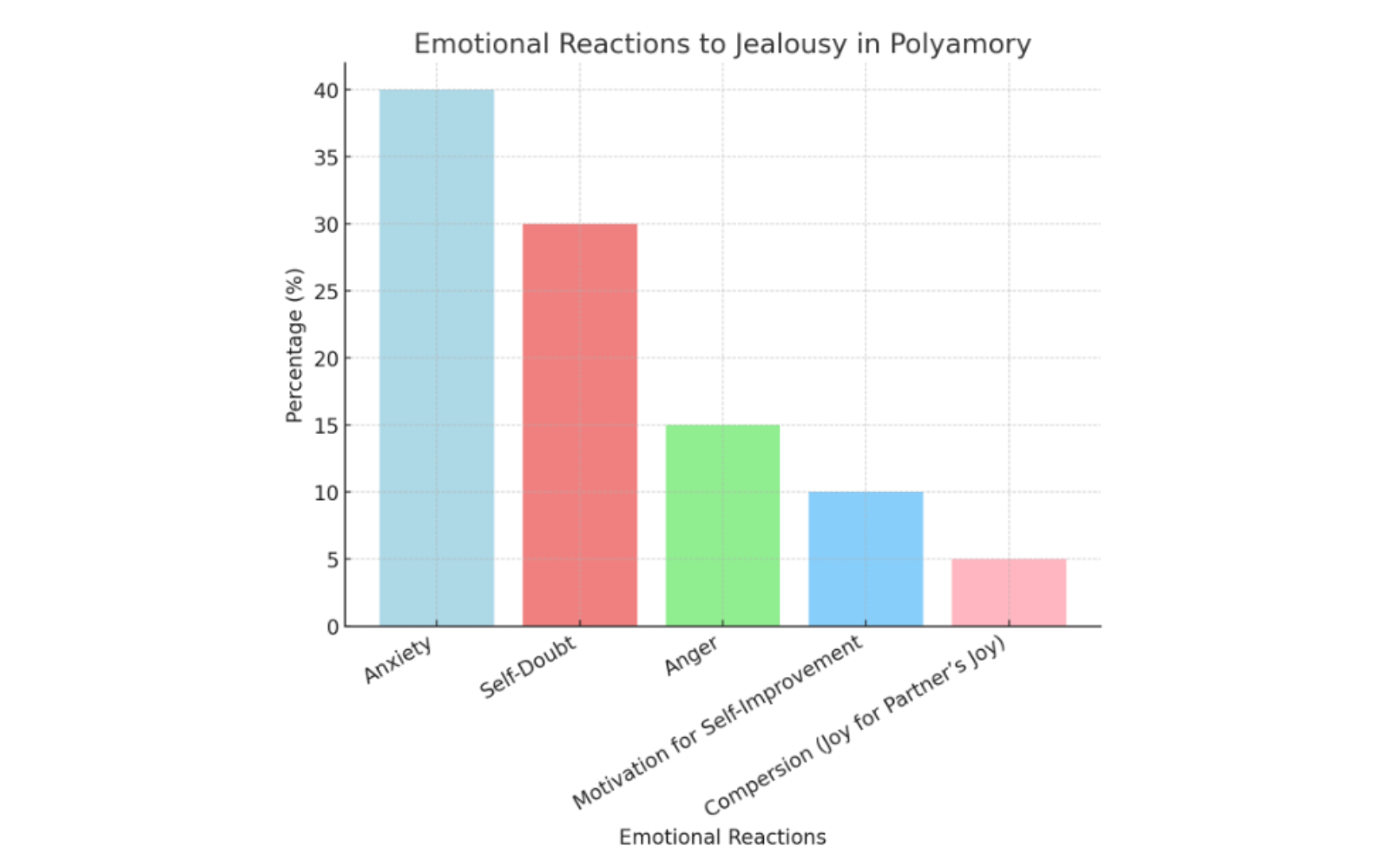
As you can see, challenging emotions like anxiety and self-doubt are common. The husband is not alone in feeling this way. The "Split-Column" exercise is a direct strategy to process this anxiety and self-doubt. By working through these feelings, he can start to shift his emotional response away from distress and toward more constructive outcomes, such as focusing on his own growth, which the chart identifies as "Motivation for Self-Improvement."
Conclusion
Today, we developed a precise cognitive tool for one of the most difficult aspects of the husband's experience: separating his admiration for the mentor from his personal feelings about the intimacy with his wife. By treating these feelings as distinct variables, he can avoid emotional contamination and maintain his psychological balance.
Key Takeaways:
- The entanglement of professional admiration and personal unease can "contaminate" both experiences.
- Cognitive Behavioral Therapy (CBT), specifically the "thought record" technique, provides a blueprint for untangling these thoughts.
- The "Split-Column" thought record is a tailored exercise to deconstruct triggers, sort thoughts into "professional" and "personal" categories, and challenge distorted thinking.
- The goal is not to eliminate any feeling, but to achieve clarity and respond to each aspect of the relationship from a place of conscious choice rather than automatic reaction.
Preview of the Next Lesson:
We have now built a foundational tool for cognitive reframing. In our next lesson, we will apply this skill to specific, high-pressure situations. The topic will be: "Develop coping mechanisms for moments when the mentor's professional authority triggers feelings of romantic subordination." We will explore scenarios where the power dynamic is most pronounced and create strategies for the husband to maintain his sense of self-worth and equality.