Hello! Welcome to your third lesson in our networking fundamentals module.
In our last session, we drew a clear line between TCP and UDP, establishing TCP as the "reliable, connection-oriented" protocol. You learned that before any data is exchanged, TCP sets up a formal connection. Today, we will dissect that setup process.
This lesson addresses the learning outcome: Explain the three-way handshake in TCP connections. This is the formal, three-step "conversation" that initiates every TCP session. For you as an aspiring penetration tester, mastering this concept is non-negotiable. It's the theoretical foundation for critical techniques like network scanning and for understanding network-based denial-of-service attacks.
The Handshake: A High-Level View
Before diving into the technical details, let's start with a simple analogy. Imagine two people, Alice and Bob, establishing a two-way radio communication.
- Alice to Bob: "Bob, this is Alice. Can you hear me? Over." (This is the SYN packet)
- Bob to Alice: "Yes, Alice, I can hear you. Can you hear me? Over." (This is the SYN-ACK packet)
- Alice to Bob: "Yes Bob, I can hear you loud and clear. Over and out." (This is the ACK packet)
At this point, both have confirmed that they can send and receive messages. The channel is open. The TCP three-way handshake works on this exact principle.
To see this in action, watch the first part of the following video.
TCP - Three-way handshake in details
This video from Sunny Classroom provides a clear and simple introduction to the three-way handshake, using a client-server analogy similar to our Alice and Bob example.
Please watch from the beginning to 01:54. Focus on understanding the role of each of the three steps: SYN, SYN-ACK, and ACK.
The Technical Purpose: Synchronizing Sequence Numbers
The handshake does more than just confirm that both parties are reachable. Its primary technical purpose is to synchronize the initial sequence numbers (ISNs) between the client and the server.
As we discussed previously, TCP ensures data is reassembled in the correct order. It does this by assigning a sequence number to every byte of data it sends. The three-way handshake is where the starting numbers for this sequencing are agreed upon.
To get a detailed, step-by-step breakdown of this process, please read the first few sections of the following article.
What Is the Three-Way Handshake? TCP Connection Guide
The article 'What Is the Three-Way Handshake?' from JumpCloud provides a well-structured explanation of the process and the key terms involved.
Please read the sections 'Definition and Core Concepts' and 'How It Works'. As you read, focus on how the SYN and ACK flags are used and, most importantly, how the sequence and acknowledgment numbers are exchanged and incremented.
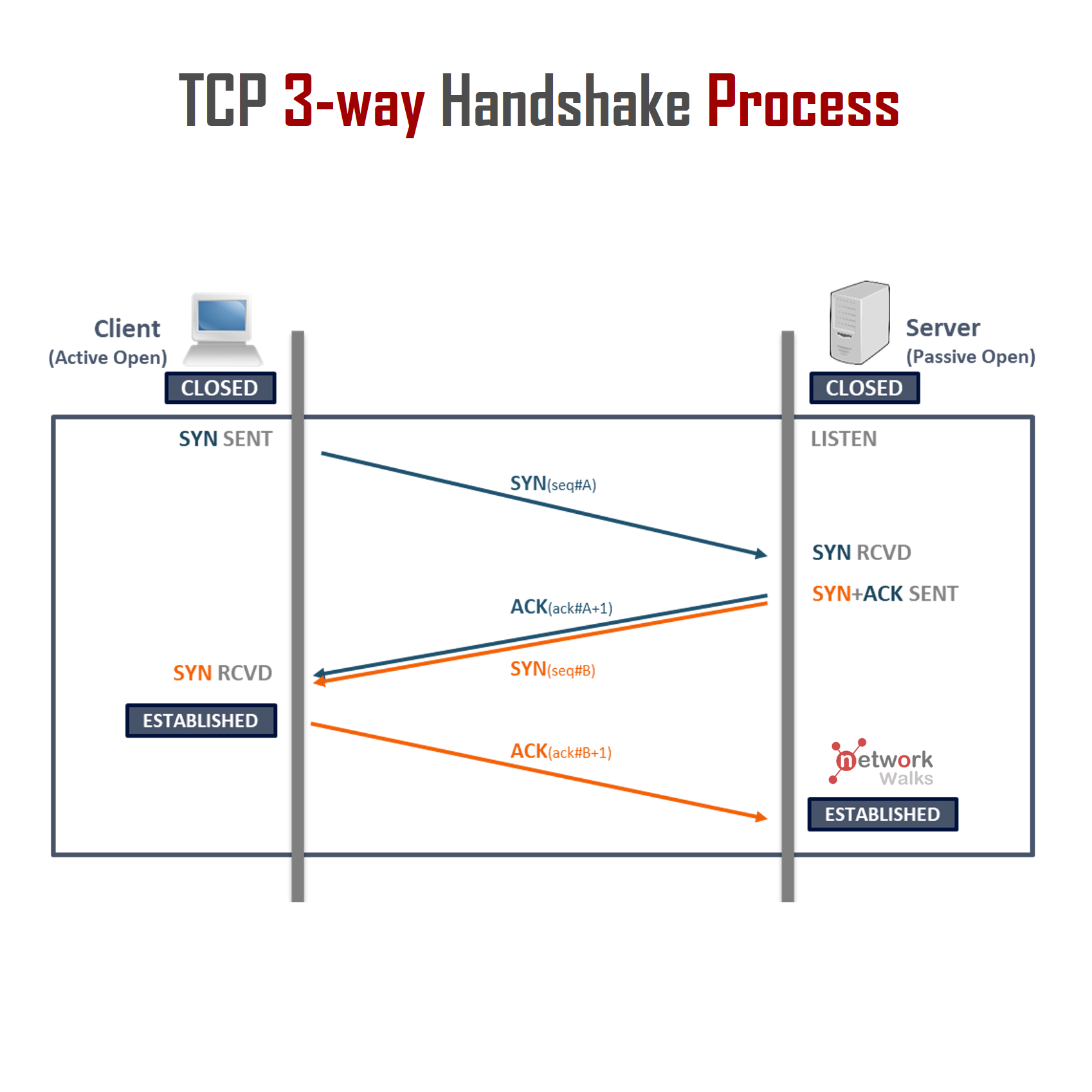
To summarize and visualize the process described in the article:
-
Client -> Server: SYN
- The client initiates the connection.
- It sends a TCP segment with the
SYN(Synchronize) flag set. - This packet contains the client's randomly generated Initial Sequence Number (ISN). Let's call it
ISN_C.
-
Server -> Client: SYN-ACK
- The server receives the client's SYN packet.
- It responds with a segment that has both the
SYNandACK(Acknowledge) flags set. - This packet contains the server's own randomly generated Initial Sequence Number,
ISN_S. - Crucially, the
Acknowledgment Numberfield is set toISN_C + 1. This confirms to the client that its SYN packet was received.
-
Client -> Server: ACK
- The client receives the server's SYN-ACK.
- It sends one final segment with the
ACKflag set. - The
Acknowledgment Numberfield in this packet is set toISN_S + 1, confirming receipt of the server's SYN packet.
At this point, the connection is ESTABLISHED. Both sides have acknowledged each other's sequence numbers, and data transfer can begin.
The image below illustrates this entire flow, including the changing states of the client and server.
A Deeper Dive: Flags and Numbers in Action
Let's reinforce this with a more detailed video walkthrough. The following video explores exactly how the flags, sequence numbers, and acknowledgment numbers appear in the TCP headers during the exchange.
TCP - 12 simple ideas to explain the Transmission Control Protocol
This segment from Practical Networking's TCP Masterclass provides an excellent visualization of the TCP headers and the values they contain during each step of the handshake.
Watch from 23:58 to 29:20. Pay close attention to how the Sequence Number, Acknowledgment Number, and the SYN/ACK flags change with each packet sent.
An interesting detail from that video is the concept of the "phantom byte". Notice that the SYN flag itself consumes one sequence number, even though no actual data was sent. This is why the acknowledgment for a packet with sequence X and the SYN flag set is X+1. This is a design feature that ensures the synchronization and acknowledgment mechanism is consistent.
Connection States and Security Implications
Understanding the handshake is not just academic; it has direct applications in security. The states that a connection moves through (LISTEN, SYN_SENT, SYN_RECEIVED, ESTABLISHED) are important for network analysis and are exploited in common attacks.
Let's explore this using another resource.
Understanding the TCP/IP 3-Way Handshake
The CloudMyLab Blog article on the handshake provides a great summary of the connection states and, in its FAQ section, directly answers how this process relates to security.
First, review the section 'How do connection states change during the TCP 3-way handshake?' and its table. Then, read the 'FAQs' section at the end of the article, specifically the questions on 'What is a SYN flood attack?' and 'How does Nmap use the handshake to detect open ports?'.
Let's expand on those two key security concepts:
1. SYN Flood (Denial of Service Attack)
This attack exploits the server's "half-open" connection state.
- An attacker sends a high volume of
SYNpackets to a server, often from spoofed (fake) IP addresses. - The server responds to each
SYNwith aSYN-ACKand allocates resources (memory, CPU time) for each new connection, placing them in theSYN_RECEIVEDstate. - Because the attacker never sends the final
ACK, these connections remain "half-open," consuming server resources. - Eventually, the server's connection table fills up, and it can no longer accept new connections from legitimate users, resulting in a denial of service.
2. Port Scanning (SYN Scan)
This is a fundamental reconnaissance technique for a penetration tester.
- To check if a port is open, a scanning tool like Nmap sends a
SYNpacket to the target port. - If the port is open: The target server responds with a
SYN-ACK. The scanner now knows the port is open. Instead of completing the handshake with anACK, it sends aRST(Reset) packet to tear down the connection. This is called a "half-open" or "stealth" scan because it avoids creating a full connection that might be logged. - If the port is closed: The target server responds with a
RSTpacket immediately. - If no response is received: The port is likely firewalled.
Conclusion
In this lesson, we deconstructed the TCP three-way handshake, moving from a simple analogy to the precise mechanics of the protocol.
Key Takeaways:
- The handshake is a three-step process: SYN, SYN-ACK, ACK.
- Its primary purpose is to establish a connection and synchronize initial sequence numbers (ISNs) between the client and server.
- The ISNs are randomized to enhance security against attacks like TCP session hijacking.
- This process is fundamental to a penetration tester's toolkit, forming the basis for SYN flood attacks and SYN-based port scanning.
Now that we've seen how a reliable connection is established at the Transport Layer (Layer 4), our next lesson will move down the OSI model to the Network Layer (Layer 3). We will examine the learning outcome: Explain the structure of an IP address and the function of a subnet mask, to understand how devices are uniquely identified and located on a network.