Welcome back! In our previous lesson, we established a clear understanding of processes, threads, and the overhead of context switching. This laid the groundwork for thinking about concurrency inside a server. Now, we'll apply that knowledge to a core problem in backend engineering: how does a server efficiently handle thousands of simultaneous client connections when I/O operations, like reading from a network socket, are notoriously slow?
Today's goal is to compare blocking I/O, non-blocking I/O, and I/O multiplexing (e.g., epoll, kqueue). This is a fundamental topic in operating systems and networking that directly explains the performance of modern backend frameworks and servers like Nginx, Node.js, and Redis. Mastering this concept is crucial for any backend interview, as it demonstrates you understand how systems achieve high concurrency.
The Two Phases of a Network I/O Operation
Before we dive into the different models, it's essential to understand what happens when your application asks to read data from a network connection (a socket). The operation happens in two distinct phases:
- Wait for data: The application must wait for data to arrive on the network. The OS network stack receives the data packets and copies them into a buffer in kernel memory.
- Copy data from kernel to user: Once the data is in the kernel's buffer, it must be copied into your application's buffer (in user space) so your code can actually process it.
The key to understanding I/O models is to see how they handle the "waiting" in phase 1.
The diagram below visualizes five different I/O models. For this lesson, we will focus on the first three: blocking, non-blocking, and I/O multiplexing. We will refer back to this diagram as we discuss each one.
Model 1: Blocking I/O
This is the simplest and most intuitive model. In a traditional "thread-per-connection" architecture, the server dedicates one thread to each connected client.
When a thread calls a function like recvfrom (a system call to receive data) on a socket, the following occurs:
- If data is already in the kernel buffer, it's copied to the application's buffer, and the function returns immediately.
- If there is no data, the thread is blocked. The operating system marks the thread as "sleeping" and performs a context switch to run another thread. The blocked thread does no work and consumes no CPU until data arrives.
As you can see in the "blocking" column of the diagram, the application thread is blocked for the entire duration of both phases.
Pros:
- Simplicity: The code is straightforward and sequential. You call
read(), and when it returns, you have the data.
Cons:
- Poor Scalability: This model fails spectacularly under high load. If you have 10,000 concurrent connections, you need 10,000 threads. As we learned in the last lesson, threads consume memory (for their stacks), and the constant context switching between thousands of threads creates immense CPU overhead. This is the classic "C10k problem".
The SystemDesignHandbook provides a good summary of this tradeoff.
C10K Problem Explained: Scalable Network Design for High-Traffic ...
This article frames the I/O model discussion in the context of the C10k problem, which is perfect for interview preparation.
Read the section under the heading "Blocking Versus Non-Blocking I/O". Focus on the description of blocking I/O and its inefficiency at scale.
Model 2: Non-Blocking I/O
To solve the issue of a thread getting stuck, we can configure the socket to be non-blocking. In this mode, an I/O call behaves differently:
- If you call
recvfromand there is no data, the call does not block. Instead, it returns immediately with an error code (likeEWOULDBLOCKorEAGAIN).
This prevents the thread from sleeping, but it introduces a new problem: how do you know when data is available? The application is now responsible for repeatedly asking, "Is there data yet?". This is called polling or busy-waiting.
// Simplified pseudo-code for polling multiple sockets
while(true) {
    for(socket in all_sockets) {
        data = recvfrom(socket); // Non-blocking call
        if (data was received) {
            process_data(data);
        }
        // If no data, the loop continues to the next socket
    }
}
Looking at the "nonblocking" column in the diagram, you can see the application repeatedly "checks" until the data is ready.
Pros:
- A single thread is not blocked waiting for one connection and can check on others.
Cons:
- Wasted CPU: The
while(true)loop is constantly spinning, consuming 100% of a CPU core just to repeatedly ask the kernel if anything has happened. This is extremely inefficient.
The following video explains how a socket is put into non-blocking mode using the fcntl system call and why this alone isn't a complete solution.
Why does node.js scale? Libuv & epoll & fcntl
This video dives into the OS-level primitives that enable non-blocking I/O, which is what frameworks like Node.js use under the hood.
Watch the segment from the start of the discussion on non-blocking operations. The speaker clearly explains why simply making a socket non-blocking leads to the problem of polling.
Model 3: I/O Multiplexing (The Event-Driven Solution)
Non-blocking I/O was a step in the right direction, but busy-waiting is not a viable solution. I/O Multiplexing provides an elegant and efficient answer.
Instead of the application polling every socket, it delegates this task to the operating system. The logic is reversed:
- The application gives the OS a list of all sockets it's interested in.
- It then makes a single blocking call (e.g.,
select(),poll(), orepoll_wait()) that says, "Wake me up when any of these sockets have an event (like incoming data)."
The OS now monitors the sockets efficiently. The application thread sleeps and consumes no CPU. When data arrives on one or more sockets, the OS wakes up the application thread and tells it which specific sockets are ready. The application can then iterate through only the ready sockets and process their data.
This is the foundation of the event loop architecture.
Look at the "I/O Multiplexing" column in the diagram. The application makes one call (select in this case) and blocks, waiting for a notification from the kernel. It's only unblocked when at least one socket is ready.
There are several OS mechanisms for I/O multiplexing, which have evolved over time:
-
select()andpoll(): These are the original, widely available system calls. They are simple but have a significant drawback: they operate in O(N) time, where N is the total number of sockets being monitored. Each time you call them, the kernel has to scan the entire list.select()also has a hard-coded limit on the number of sockets it can monitor (often 1024). -
epoll()(Linux),kqueue()(BSD/macOS), IOCP (Windows): These are the modern, high-performance replacements. Their key advantage is that they operate in O(1) or O(k) time, where k is the number of active sockets. The kernel maintains an internal data structure of interested sockets. When you wait for events, the kernel only has to return the list of sockets that have fired an event, without scanning all of them. This scales to hundreds of thousands of connections.
The video you just watched also provides a great explanation of this difference.
Why does node.js scale? Libuv & epoll & fcntl
Let's continue with the same video to see the evolution from select to epoll.
Watch the segment from the introduction of select to the end of the graph comparison. Pay close attention to the explanation of linear vs. constant time complexity. This is the key performance differentiator.
High-performance systems like Redis rely heavily on these modern primitives. The following article details how Redis uses epoll and kqueue to handle massive concurrency with a single main thread.
How Redis IO Multiplexing Works (epoll, kqueue)
This article gives a concrete example of I/O multiplexing in a real-world, high-performance system you are likely to use as a backend developer.
Read the sections titled How Redis Selects the Backend, epoll Internals, and kqueue Internals. This will solidify your understanding of the system calls involved and the O(1) advantage of epoll.
The diagram below provides a high-level visual comparison of the modern event notification systems across different operating systems.
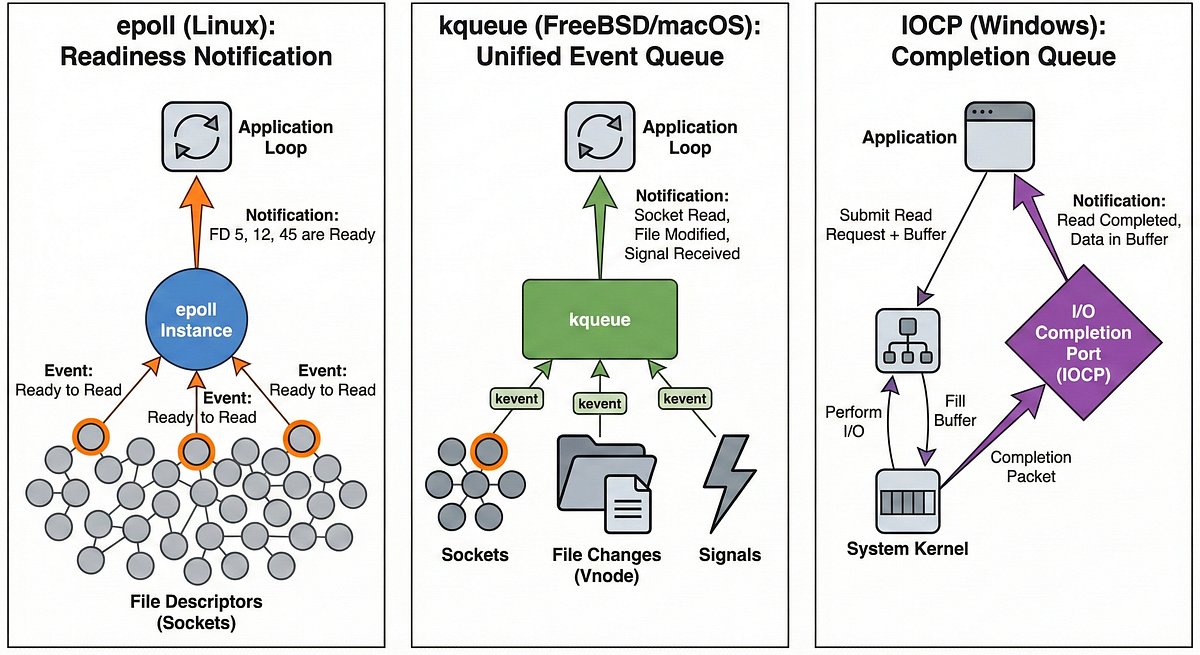
Summary and Interview Perspective
For a backend interview, you should be able to clearly articulate the tradeoffs between these three models.
| Feature | Blocking I/O | Non-Blocking I/O | I/O Multiplexing |
|---|---|---|---|
| Model | Thread-per-connection | Single thread, busy-waiting | Single/few threads, event-driven |
| CPU Usage | Low while blocked, high context switch cost | Very high (100% core usage) | Very low (thread sleeps until notified) |
| Scalability | Poor (limited by memory and context switching) | Poor (limited by CPU) | Excellent (scales to many thousands of connections) |
| Key System Call(s) | read(), write() |
fcntl(), read(), write() in a loop |
select(), poll(), or epoll()/kqueue() |
| Used By | Simple, older servers; some language runtimes for file I/O | Rarely used directly for network I/O | Nginx, Node.js, Redis, Go runtime, modern web servers |
In an interview, explaining this progression shows a deep understanding of performance engineering:
- Start with the naive blocking model and explain why it doesn't scale (threads are expensive).
- Introduce non-blocking I/O as a way to prevent threads from getting stuck, but highlight the critical flaw of busy-waiting (wasting CPU).
- Present I/O multiplexing as the efficient solution, where the OS does the waiting. Mentioning
epollorkqueuespecifically signals that you are familiar with modern, high-performance techniques.
Conclusion
Today we've deconstructed how servers handle I/O at the operating system level. This is the secret behind the ability of a single Node.js process or a Go application to juggle thousands of concurrent requests with just a few threads.
Key Takeaways:
- Blocking I/O is simple but not scalable due to the high cost of a thread-per-connection model.
- Non-Blocking I/O avoids getting threads stuck but wastes CPU cycles with constant polling (busy-waiting).
- I/O Multiplexing is the efficient solution where a single thread asks the OS to monitor many sockets and only wakes up when there is actual work to be done.
- Modern mechanisms like
epollandkqueueare what enable high-concurrency servers to scale efficiently, as they provide a constant-time method for checking event readiness.
In our next lesson, we will build directly on this foundation. We'll move up one level of abstraction to see how modern event-driven servers use I/O multiplexing to handle high concurrency. We'll discuss architectural patterns like the Reactor pattern and see how the event loop translates these low-level OS notifications into the application-level logic you write every day.