Welcome to the first lesson of our fifth module. In the previous modules, we've built a solid understanding of insurance liabilities, culminating in our discussion on reinsurance as a tool for managing large and complex risks. We now pivot from the obligations an institution faces to the assets it holds to meet them. This lesson marks our entry into the world of investments, the engine that powers the balance sheets of insurers and pension funds.
Our objective today is to evaluate the suitability of government and corporate bonds for an institutional investor's portfolio. For an actuary, this evaluation goes far beyond a simple comparison of risk and return. It involves understanding how these assets behave and how their characteristics align with the unique, long-term liabilities of institutions like pension funds and insurance companies. We will explore why these seemingly straightforward instruments are cornerstones of institutional investment strategy.
The Institutional Investor Context: Beyond Simple Returns
Before we can evaluate any asset, we must first understand the investor. In our context, this is not an individual saving for a holiday, but a large institution managing vast pools of capital to meet promises made decades into the future.

The primary goal for many of these institutions is not just to maximize returns, but to ensure they can pay their liabilities as they fall due. This has given rise to a powerful strategy known as Liability-Driven Investment (LDI). The core idea of LDI is to manage assets with explicit reference to the liabilities.
[PDF] Fixed income strategies of insurance companies and pension funds
This report from the Bank for International Settlements (BIS) provides an expert view on how institutions like insurers and pension funds manage their investments. It explains the shift from simply trying to beat a market index to focusing on liabilities.
Please read the section on Asset-liability management (ALM). Start with the paragraph introducing ALM. Then, focus on the two general approaches to LDI: duration and cash flow matching. Finally, read about the role of bonds in these strategies.
As the reading makes clear, LDI strategies treat liabilities—like future pension payments or life insurance claims—as a series of cash flows that need to be matched. Bonds, with their predictable coupon payments and principal repayment at maturity, are the natural building blocks for this approach. This liability-matching objective is the lens through which we must evaluate their suitability.
Government vs. Corporate Bonds: The Fundamental Trade-Off
At the highest level, the bond market is split into two broad categories: debt issued by governments and debt issued by corporations. The primary difference between them is the source and level of risk.
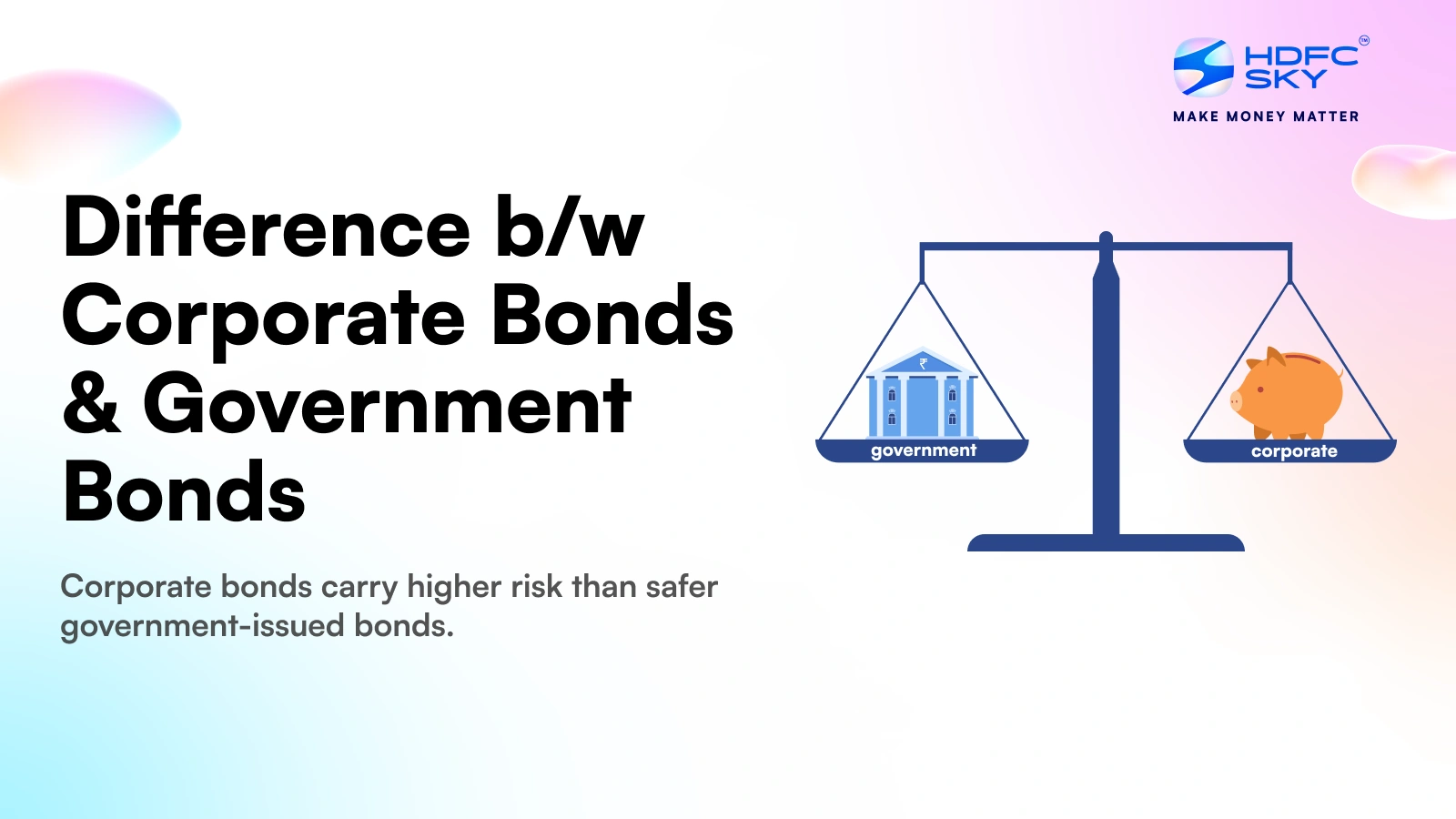
A corporate bond's value is tied to the financial health and profitability of the issuing company. A government bond's value is backed by the full faith and credit of the sovereign entity, including its power to tax its citizens. This introduces a fundamental risk that is present in corporate bonds but (largely) absent in the bonds of stable, developed-world governments: credit risk, also known as default risk.
To compensate investors for taking on this additional risk, corporate bonds must offer a higher yield than government bonds of a similar maturity. This yield difference is known as the credit spread.
Investing In Corporate Bonds : High Yield Investments
This video from PensionCraft provides a clear, practical explanation of corporate bonds and the concept of credit spread.
First, watch the brief introduction from the definition to understand the basic roles of the issuer and investor. Then, jump to the section from the overlay. This segment masterfully visualizes the credit spread by overlaying the yield curve for Apple's bonds on top of the U.S. Treasury yield curve. It clearly shows the "additional yield" you receive for taking on corporate credit risk.
A Framework for Evaluating Suitability
To conduct a rigorous evaluation for an institutional investor, we need a consistent framework. We can assess the suitability of any bond by examining it against five key criteria:
- Risk and Return Profile: The expected return versus the potential for loss, with a special focus on capital preservation.
- Correlation and Diversification: How the asset's returns move in relation to other assets (especially equities) in the portfolio.
- Cash Flow Characteristics: The predictability and timing of cash flows and their suitability for matching liabilities (LDI).
- Liquidity: The ease and speed with which the asset can be converted to cash without a significant loss in value.
- Regulatory and Accounting Treatment: How regulators view the asset and the amount of capital an institution must hold against it.
Let's now apply this framework to both government and corporate bonds.
The Case for Government Bonds
Using our framework, government bonds (specifically those from stable, developed countries like the US, UK, or Germany) present a compelling case for institutional investors.
- Risk and Return: They are considered the "risk-free" asset in many financial models. While not truly without risk (they are still subject to interest rate risk), their risk of default is negligible. They offer lower returns but provide a very high degree of capital preservation.
- Correlation and Diversification: This is perhaps their most powerful feature. High-quality government bonds typically exhibit a negative correlation with equities, especially during periods of market stress. When stock markets fall, investors execute a "flight to safety," selling risky assets and buying government bonds, which bids up the bonds' prices. This provides a crucial buffer in a diversified portfolio. Given your background in statistics, you'll appreciate the significance of this negative correlation for portfolio variance reduction.
- Cash Flow Characteristics: They provide highly predictable, fixed cash flows, making them ideal for matching fixed liabilities like annuity payments.
- Liquidity: The market for major government bonds is one of the largest and most liquid in the world, ensuring they can be sold quickly to meet unexpected cash needs.
- Regulatory Treatment: Regulatory frameworks like Solvency II for insurers explicitly recognize their safety. As the BIS report notes, government bonds often receive very favourable capital treatment, sometimes requiring zero regulatory capital to be held against them. This makes them a very capital-efficient asset for an insurer.
Corporate Bonds vs. Government Bonds (Treasury Bonds) – The Showdown
This video clearly explains the crucial diversification benefit of government bonds.
Please watch the segment from asset correlations. The speaker discusses the Pearson correlation coefficient and highlights the reliably negative correlation of Treasury bonds to stocks, especially during crises, a phenomenon known as "crisis alpha."
The Case for Corporate Bonds
If government bonds are so suitable, why would an institution hold anything else? Corporate bonds offer a different, but still valuable, set of characteristics.
- Risk and Return: Their primary attraction is higher yield. This "credit spread" provides a return enhancement over government bonds. However, this comes with credit risk. This risk is not uniform; it's measured by credit rating agencies (like S&P and Moody's).
- Investment Grade (IG): Bonds with higher credit ratings (e.g., AAA to BBB-), indicating a lower probability of default. These are the typical hunting ground for conservative institutions like insurers and pension funds.
- High-Yield (HY) or "Junk": Bonds with lower ratings (e.g., BB+ and below), indicating a higher probability of default. They offer much higher yields but carry significant risk.
- Correlation and Diversification: Corporate bonds have a higher correlation with equities than government bonds do. This is because the health of a corporation is tied to the same economic factors that drive the stock market. Therefore, they are less effective diversifiers during an economic downturn.
- Cash Flow Characteristics: Like government bonds, they provide regular coupons and a final principal payment, making them useful for LDI. However, these cash flows are less certain due to default risk.
- Liquidity: Generally liquid, but less so than government bonds. In a crisis, liquidity for lower-rated corporate bonds can evaporate as buyers disappear.
- Regulatory Treatment: Under Solvency II, corporate bonds attract a capital charge that increases with duration (longer maturity) and with lower credit quality. This makes them more "capital intensive" to hold than government bonds.
[PDF] Fixed income strategies of insurance companies and pension funds
Let's revisit the BIS report to see how regulation directly impacts the suitability of corporate bonds for an insurer.
Please read the subsection on corporate bonds within the chapter on Solvency II's impact. This section details how capital charges are calculated based on rating and duration, and why this might lead insurers to prefer shorter-dated, higher-rated corporate bonds.
Synthesis: The Portfolio Context
The choice for an institutional investor is not a binary one between government and corporate bonds. The decision is about finding the optimal blend.
- Government bonds form the safe, defensive core of the portfolio, providing diversification, liquidity, and capital efficiency.
- Corporate bonds are added to enhance yield. In a sustained low-interest-rate environment, the returns from government bonds alone may be insufficient to meet the target returns needed to fund liabilities. The credit spread from corporate bonds helps to close this gap.
The MetLife paper on long-duration bonds for public pensions summarizes these benefits well, noting that a portfolio of government and corporate bonds can provide capital preservation, predictable cash flow, liquidity, and diversification.
Long Duration Bonds in Public Pensions
This paper from MetLife Investment Management neatly summarizes the benefits of holding a mix of government and corporate bonds for a pension fund.
Please read the introductory bullet points under the main heading. Then, briefly skim the sections "Preserving Capital," "Supplying Predictable Monthly Cash Flows," and "Contributing Liquidity" to see how these points are elaborated.
An institution's final allocation will depend on its specific liability profile, regulatory regime, and risk appetite. A pension fund in a strong financial position might hold more government bonds, while one needing to earn higher returns to close a funding deficit might take on more credit risk through a larger corporate bond allocation.
Conclusion and Summary Framework
In this lesson, we have moved to the asset side of the balance sheet and established a rigorous framework for evaluating the suitability of bonds for institutional investors. We've seen that while government bonds offer unparalleled safety, liquidity, and diversification, corporate bonds play a crucial role in providing the additional yield needed to meet long-term obligations. The optimal strategy lies in blending these two asset classes to match the institution's specific needs.
Key Takeaways:
- Institutional investors like insurers and pension funds often use a Liability-Driven Investment (LDI) strategy, where assets are chosen to match the characteristics of their liabilities.
- The fundamental trade-off is between the safety of government bonds and the higher yield (credit spread) of corporate bonds.
- Government bonds are highly suitable due to their low risk, negative correlation with equities (diversification), high liquidity, and favourable regulatory treatment.
- Corporate bonds are suitable for enhancing portfolio yield but introduce credit risk, have a higher correlation with equities, and are more capital-intensive from a regulatory standpoint.
- The final allocation is a strategic balancing act between defensiveness and the search for yield, tailored to the institution's specific circumstances.
To help you consolidate this for your revision, here is the summary framework you requested, comparing the two bond types against our evaluation criteria.
Suitability Framework: Government vs. Corporate Bonds
| Criterion | Government Bonds (Developed Market) | Corporate Bonds (Investment Grade) |
|---|---|---|
| Risk & Return | Low Risk / Low Return: Considered "risk-free" in terms of default. Primary risk is from interest rate changes. Excellent capital preservation. | Medium Risk / Medium Return: Offer a yield "spread" over government bonds. Subject to credit/default risk and downgrade risk. |
| Correlation | Negative Correlation to Equities: Excellent diversifier. Prices tend to rise during stock market downturns ("flight to safety"). | Positive Correlation to Equities: Less effective as a diversifier. A company's fortunes (and bond prices) are linked to the broader economy. |
| Cash Flow (LDI) | Highly Predictable: Fixed coupons and principal repayment make them ideal for matching known liabilities. | Predictable but not guaranteed: Provide fixed cash flows, but these are contingent on the company avoiding default. |
| Liquidity | Very High: Deep and active markets ensure they can be sold quickly with minimal price impact, even in a crisis. | Good to High: Generally liquid, but liquidity can decrease significantly for lower-rated bonds during market stress. |
| Regulation | Very Favourable: Often attract very low or zero capital charges under regimes like Solvency II. Capital-efficient. | Less Favourable: Attract capital charges that increase with lower credit ratings and longer durations. More capital-intensive. |
This lesson has laid the groundwork for our analysis of asset classes. In our next session, we will use this same evaluation framework to move further along the risk-return spectrum and consider the suitability of equity and property investments for an institutional portfolio.