Introduction
In our last lesson, we explored how actuaries build prudence into their calculations by moving from best-estimate assumptions to incorporating Margins for Adverse Deviation (MADs). This process establishes a set of expectations for how a business will perform financially. But what happens once those assumptions are set and the business begins to operate in the real world? How do we know if our carefully constructed forecasts were accurate?
This lesson closes the loop on the assumption-setting process. We will delve into the critical practice of monitoring experience, which involves systematically comparing actual outcomes against the assumptions we made. More importantly, we'll examine the feedback loop that results from this analysis, exploring how actuaries use these insights to refine their models, adjust business strategy, and ensure the long-term financial health of an organization. This entire process is a cornerstone of the Actuarial Control Cycle, a fundamental framework for actuarial practice that we will anchor our discussion in today.
The Actuarial Control Cycle in Action
The Actuarial Control Cycle (ACC) provides a model for the work actuaries do. It is an iterative process of defining a problem, developing a solution, and monitoring the results. Today, we focus on the latter stages of this cycle, which are essential for managing risk and ensuring that our solutions remain effective over time.
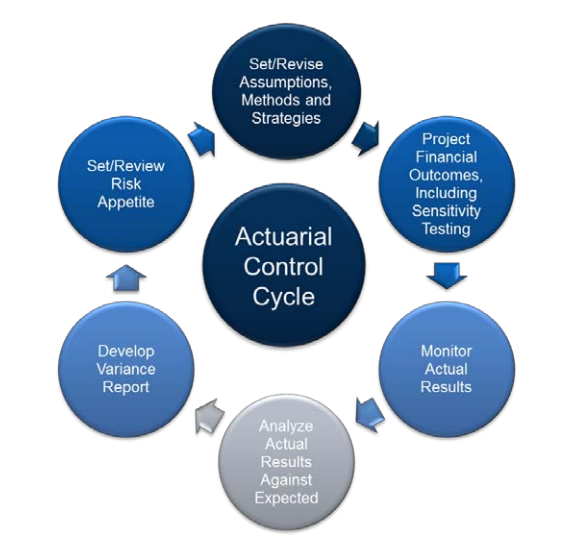
As the diagram shows, after projecting financial outcomes, the next steps are to "Monitor Actual Results" and "Analyze Actual Results Against Expected." This analysis then feeds back into revising assumptions and strategies. This is not a one-time check; it is a continuous, dynamic process.
The following flashcards provide a concise overview of what makes the ACC a 'control cycle' and why monitoring is so integral to it.
CH 0 - 2 The actuarial control cycle Flashcards by Sahil Chavan
These flashcards clearly define the Actuarial Control Cycle and its key components.
Please review the first three cards in this set: "ACC - Introduction and Definition": This card outlines the central parts of the model: defining the problem, designing the solution, and crucially, monitoring and revising. "What makes the actuarial control cycle a ‘control cycle’?": This card explains that the "cycle" refers to the interrelationship between monitoring and feedback, which requires professional judgment. "What makes the actuarial control cycle ‘actuarial’?": Note the key element listed here: "Monitoring and periodically analyzing the emerging experience".
Part 1: Why and What Do We Monitor?
The act of monitoring is a fundamental component of managing any financial enterprise. For an actuary, it serves several critical purposes, moving beyond simple validation to become a key source of business intelligence.
[PDF] Understanding Actuarial Management: - SOA.org
Chapter 17 of this book, written by David Service, is dedicated to the process of monitoring experience. It provides a comprehensive overview of the rationale and scope of this work.
Please read the introductory sections of this chapter to understand the core motivations and subjects of analysis. First, read section 17.2, "Why do we analyze experience?". As you read, notice the broad range of stakeholders who benefit from this analysis, including management, shareholders, and regulators. Next, read section 17.3, "What do we analyze?". This section lists the key areas of focus.
As you've just read, the reasons for monitoring are multifaceted. In essence, they boil down to:
- Validating Assumptions: Are our predictions about mortality, expenses, investment returns, and customer behavior holding true?
- Understanding Performance: Where are profits or losses coming from? Is performance driven by good management, or just by luck?
- Informing Management: Providing leadership with the data needed to make sound strategic decisions.
- Ensuring Compliance: Meeting the requirements of regulators and auditors who need assurance that the company is financially sound.
The "what" of monitoring covers every significant assumption that goes into an actuarial model. This includes:
- Product-specific experience: Mortality/morbidity rates, lapse/persistency rates, claim frequencies and severities.
- Economic factors: Interest rates, inflation rates, unemployment levels.
- Operational performance: Investment returns, expense levels, and sales volumes.
Part 2: The Core Process: Analysis of Variance
At its heart, monitoring experience is an exercise in analysis of variance. Given your background as a statistician, you can think of this as a structured way of examining the "residuals" between a model's predictions (the expected results based on our assumptions) and the observed data (the actual results). The goal is not just to see if there is a difference, but to understand why there is a difference.
For example, if profits are lower than expected, was it because:
- More people died than we assumed (adverse mortality experience)?
- Fewer people let their policies lapse (favorable persistency, but may strain reserves)?
- Investment returns were lower than projected (adverse investment experience)?
- Administrative costs were higher than budgeted (adverse expense experience)?
This process of breaking down the total variance into its constituent parts is often called Analysis of Surplus or Sources of Earnings analysis, a topic we will cover in more detail in a future lesson.
The following resource provides a clear, practical look at this stage.
CH 0 - 2 The actuarial control cycle Flashcards by Sahil Chavan
This flashcard provides a concise summary of the monitoring process, complete with a practical example.
Please read the card titled "Monitoring the experience". Pay close attention to the process described: compare actual vs. assumed, identify deviations, find the reasons, and revise. The health insurance example perfectly illustrates how a deviation in one area (higher claims) is investigated and linked to a specific cause (higher urban hospitalisation).
The depth of this analysis depends on the area. The Understanding Actuarial Management textbook provides a more detailed breakdown of how actuaries analyze experience for different assumption types.
[PDF] Understanding Actuarial Management: - SOA.org
This section delves into the practical methods for analyzing experience.
Please read section 17.4, "How do we analyze experience?". You do not need to memorise all the details, but focus on the approach. For instance, notice how investment performance is broken down by asset class and compared against benchmarks, and how expense analysis involves allocating costs to different business activities. This demonstrates the level of granularity required.
Part 3: Closing the Loop: Responding to Experience
Gathering and analyzing data is pointless without a mechanism to act on the findings. This is the feedback loop: using the results of experience monitoring to make informed changes. The response can be anything from a minor tweak to a fundamental shift in strategy.
This is the most crucial part of the "control" in the Actuarial Control Cycle. Ignoring the feedback is akin to driving a car by looking only at the map and not through the windshield.
CH 0 - 2 The actuarial control cycle Flashcards by Sahil Chavan
This flashcard explains why the feedback loop is essential for continuous improvement.
Read the card titled "Feedback loops". It clearly outlines that monitoring can reveal flaws in the initial problem definition, the solution, or the assumptions, and emphasizes that ignoring this feedback leads to poor outcomes.
The range of possible responses is broad. The Actuarial Control Cycle diagram (LINK) shows the primary feedback is to "Set/Revise Assumptions, Methods and Strategies." Chapter 18 of the Understanding Actuarial Management textbook explores these responses in detail.
[PDF] Understanding Actuarial Management: - SOA.org
Chapter 18, "Responding to Experience" by Bruce Edwards, discusses the practical actions an actuary might recommend based on monitoring results.
Please read sections 18.2 ("Role of the actuary"), 18.3 ("General considerations"), 18.4 ("Managing the business"), and 18.7 ("Review of insurance pricing"). Focus on the types of actions taken. Notice how the response can range from internal process changes like expense and claims controls to external strategic decisions like initiating a pricing review.
The key takeaway is that the feedback loop connects the past to the future. The actions taken can be grouped into several categories:
- Refine Assumptions: If experience consistently deviates from an assumption (e.g., mortality rates are consistently improving faster than expected), that assumption must be updated for all future actuarial work, including pricing new products and valuing existing liabilities.
- Adjust Business Operations: If expenses are overrunning, management can implement stricter cost controls. If claims are unexpectedly high, underwriting standards may need to be tightened.
- Change Product Design and Pricing: If a product is proving to be unprofitable, the company may increase its price, change its features (e.g., reduce guarantees), or even withdraw it from the market.
- Manage Capital and Investments: If monitoring reveals higher-than-expected volatility, the company may need to hold more capital or de-risk its investment portfolio.
Conclusion
Today, we have seen how monitoring and feedback form the engine of the Actuarial Control Cycle. This is where theory meets reality. We moved from setting assumptions in the previous lesson to testing them against real-world data. This process is not a passive accounting exercise; it is an active, forward-looking risk management function.
By systematically analyzing variances between actual and expected results, actuaries identify the drivers of business performance. This analysis then powers a crucial feedback loop, enabling the organization to refine its assumptions, improve its operations, and adapt its strategy. Without this continuous cycle of monitoring and response, an organization's models would become outdated, and its financial position would be exposed to unmanaged risks.
In our upcoming lessons, we will explore one of the primary beneficiaries of this feedback loop: the design and pricing of financial products. The insights gained from monitoring existing business are invaluable when creating the next generation of products.
Key Takeaways & Cheatsheet
Here is a framework summarizing the monitoring and feedback process, designed to help with your revision.
| Stage | Key Question(s) | Example Actions / Outputs |
|---|---|---|
| 1. Monitoring | What are the actual outcomes for claims, lapses, expenses, investments, etc.? | Collect and validate data on actual experience (e.g., number of deaths, claims paid, investment returns earned). |
| 2. Analysis | How do the actual outcomes compare to our assumptions (best-estimate and prudent)? Why are there differences? | Perform an Analysis of Variance (or Surplus) to quantify the financial impact of each deviation (e.g., "+$2M from favorable mortality, -$3M from adverse expenses"). |
| 3. Feedback | What do these deviations tell us about our assumptions, our products, and our business environment? | A report to management concluding that expense assumptions are too low and underwriting on a specific product line is too loose. |
| 4. Response | What changes do we need to make to our assumptions, processes, or strategy? | Revise the expense assumption upwards for future pricing. Tighten underwriting criteria for the problematic product. Launch a cost-control initiative in the claims department. |