Welcome back. In our previous lesson, we examined how providers manage the risks of investment-linked and participating products, where investment performance is either transferred to or shared with the policyholder. We saw that this shift creates complex guarantee and business risks for the insurer.
Today, we change our perspective from individual policies to group insurance. This is a fundamentally different business model where the insurer covers a collection of individuals—typically employees of a single company—under one master contract. This lesson will analyze the key risks to the provider for these products, fulfilling the final learning outcome for this module. You will discover how underwriting a group, rather than an individual, reshapes traditional insurance risks like adverse selection and introduces new challenges related to pricing, concentration, and data.
The Group Insurance Paradigm
The core distinction between individual and group insurance lies in the underwriting process. Instead of assessing the risk of each person, the insurer assesses the risk of the group as a whole. This has profound implications for the product's structure and the distribution of risk.
The infographic below offers a high-level contrast between individual and group life insurance.
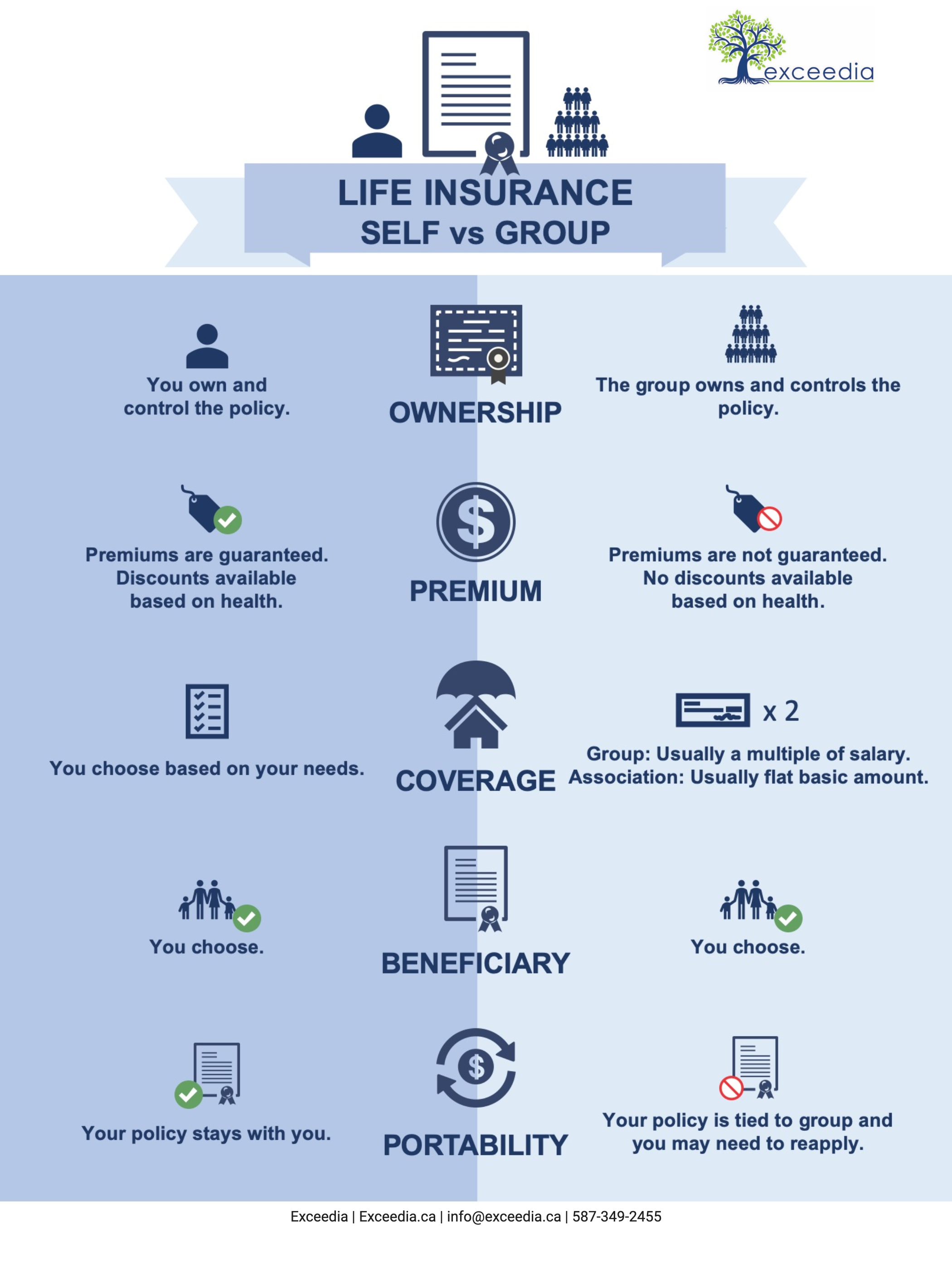
A crucial concept in employer-sponsored benefits is the funding model, which determines who ultimately bears the financial risk of claims. The most common models are "fully insured" and "self-insured." Understanding this distinction is key to analyzing the provider's risk exposure.
Health Insurance Industry Explained--Health Insurance from Job (Employer-Sponsored)
The video "Health Insurance Industry Explained" from AHealthcareZ provides an excellent breakdown of how employer-sponsored plans are structured.
Please watch the first two segments to understand the fundamental models: The introduction explains the four main parties involved: the employer, employees, insurance carrier, and healthcare provider. The explanation of fully insured vs. self-insured plans is the most critical part. Focus on understanding where the financial risk for claims resides in each model.
As the video explains:
- In a fully insured plan, the employer pays a fixed premium to an insurance company. The insurer absorbs all the claims risk. If claims are higher than expected, the insurer makes a loss (for that year).
- In a self-insured (or self-funded) plan, the employer pays claims directly from its own funds. The insurer acts more like a third-party administrator, processing claims and providing access to its network, but does not bear the primary claims risk.
For the remainder of this lesson, when we discuss the "provider's risk," we will primarily focus on the insurer's perspective in a fully insured arrangement, as this is where they carry the full spectrum of insurance risks. We will also touch upon the risks involved in providing services, like reinsurance, to self-insured plans.
The Double-Edged Sword of Adverse Selection
Adverse selection arises from asymmetric information: prospective customers know more about their own risk than the insurer does. This can lead to a "death spiral," where only high-risk individuals buy insurance, driving up premiums and pushing healthier individuals out of the market.
Group insurance is often presented as the classic solution to this problem. Because the group is formed for a reason other than seeking insurance (i.e., employment), the pool of insureds should, in theory, be a representative cross-section of risks, diluting the impact of any high-risk individuals.
The following video provides a concise explanation of this dynamic.
Asymmetric Information and Health Insurance
The video "Asymmetric Information and Health Insurance" from Marginal Revolution University clearly illustrates the theory of adverse selection and why group insurance helps.
Please watch these two clips: First, watch from the beginning to the explanation of the death spiral. This sets up the core problem. Then, watch the segment on how group insurance weakens adverse selection.
However, the reality is more nuanced. While basic group coverage provided automatically to all employees largely mitigates adverse selection, problems reappear with supplemental or voluntary group insurance, where employees can choose to buy additional coverage.
A detailed study of a university's employee life insurance scheme reveals why these plans are still vulnerable.
[PDF] Adverse Selection in the Group Life Insurance Market
This academic paper provides an excellent deep dive into the specific mechanisms that allow adverse selection to persist in employer-sponsored life insurance (ESLI).
Please read the following sections: Begin with the section titled "Viable Outside Option". This part lays out four key reasons why supplemental group plans are susceptible to adverse selection: Guaranteed issue & community-rated premiums: Unhealthy and healthy people in the same age band pay the same price. Ability to increase coverage: Employees can often increase their coverage after a negative health diagnosis without medical screening. Different benefit levels: The choice of coverage multiples (e.g., 1x to 5x salary) allows for adverse selection on the intensive margin (how much to buy), not just the extensive margin (whether to buy). Viable outside option: The existence of a separate individual insurance market can draw healthy individuals away from the group plan, leaving a riskier pool behind.
Given these vulnerabilities, why don't all supplemental group insurance markets collapse into a death spiral? The same paper offers several mitigating factors. Inertia plays a huge role; many employees make a choice upon joining and never revisit it. Furthermore, coverage is often tied to employment. An employee who becomes seriously ill may leave their job and lose their coverage, meaning the insurer never has to pay the claim. This conditionality is a powerful, if grim, risk mitigator for the insurer.
Pricing and Underwriting Risks for Groups
Since insurers cannot underwrite individuals in a group plan, they must underwrite the group itself. This process, known as experience rating, is central to managing risk and is where your statistical background in credibility theory becomes highly relevant.
Health Insurance Industry Explained--Health Insurance from Job (Employer-Sponsored)
Let's return to the "Health Insurance Industry Explained" video to see how insurers set premiums for groups of different sizes.
Please watch the section on how premiums are determined. Pay close attention to the concepts of "community rated," "partially credible," and "fully credible" groups.
This spectrum illustrates a core pricing risk:
- Small Groups (Community Rated): For small groups (e.g., <50 employees), their own claims experience is too volatile to be a reliable predictor of future costs. The insurer prices their coverage based on the experience of the broader community of similar small groups. The risk here is that the insurer has unwittingly taken on a small group that is far riskier than the community average.
- Large Groups (Fully Credible): For very large groups (e.g., >500 employees), their past experience is statistically credible. The premium for next year is based almost entirely on their own claims from the previous year. The risk is lower, but the insurer is still exposed to fluctuations and trends.
- Medium Groups (Partially Credible): These are priced using a blend of their own experience and the community rate, applying credibility weighting. The pricing risk is that the insurer gets this blend wrong.
Decomposing Mortality and Morbidity Risk
Beyond the pricing method, the insurer faces the risk that the group's health experience will be worse than assumed. Given your background in probability theory, it's useful to decompose this risk into its constituent parts, as actuaries do for capital modeling.
A technical report from the American Academy of Actuaries on life insurance mortality risk provides a formal framework. While we won't delve into the calculations, the conceptual breakdown is invaluable.
[PDF] November 9, 2021 - American Academy of Actuaries
This report outlines the components of mortality risk used for setting regulatory capital requirements.
First, please read the section "Mortality Risk Drivers" on page 10. This defines the four key drivers of mortality risk. Then, read the section "Attribution Analysis" on page 17, which shows how their importance varies with group size.
The four key mortality risk drivers are:
- Volatility Risk: The risk of natural, random statistical fluctuations in claims from year to year. As you know from the law of large numbers, this risk is highest for small groups and decreases as the group size increases.
- Level Risk (Pricing Risk): The risk of misstating the underlying baseline mortality or morbidity rate for the group due to flawed assumptions or insufficient data.
- Trend Risk: The risk of incorrectly projecting future changes in mortality or morbidity. For example, assuming historical improvements will continue when they are in fact slowing down.
- Catastrophe Risk: The risk of a short-term, large-scale event causing a spike in claims, such as a pandemic or a major accident affecting many members of the group.
The attribution analysis shows that for small groups, volatility and level risk are the main concerns. For large groups, the law of large numbers dampens volatility risk, and catastrophe and trend risk become the dominant drivers.
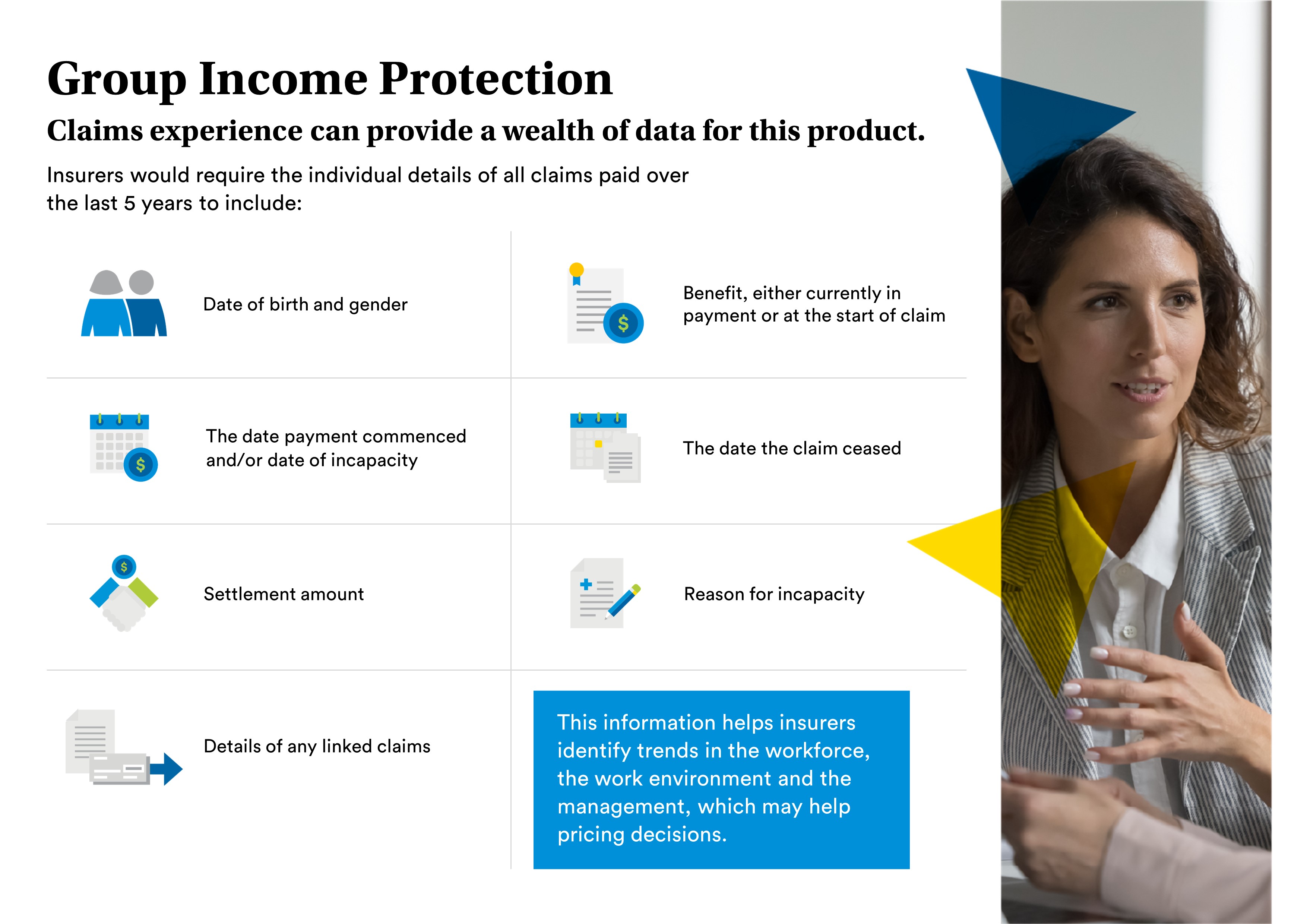
Data Risk
The ability to price a group accurately depends entirely on the data provided by the employer. Incomplete or inaccurate data on employee demographics (age, gender, salary) and past claims history significantly increases pricing risk.
Other Significant Risks
Beyond selection and pricing, several other risks are characteristic of the group insurance market:
- Concentration Risk: An insurer might have a few very large corporate clients that constitute a significant portion of its group insurance portfolio. If one of these clients switches to a competitor at renewal, it can have a material impact on the insurer's revenue and profitability. There is also physical concentration risk if most members are in a single location.
- Discontinuance Risk: This is the group-level equivalent of lapse risk. The entire contract may be terminated if the employer goes out of business or decides to stop offering the benefit. This results in the loss of all future profits and can prevent the insurer from recovering high initial setup costs.
- Expense Risk: The costs of administering a group plan—handling enrollments, answering employee queries, processing claims—can be higher than anticipated, eroding the profitability of the contract.
Risk Mitigation for Providers
Insurers are not passive in the face of these risks. Key mitigation strategies include:
- For Fully Insured Plans:
- Careful underwriting of the group's characteristics (industry, location, demographics).
- Experience rating for credible groups.
- The right to re-price the contract at annual renewal based on emerging experience.
- Contractual clauses limiting coverage for catastrophic events.
- For Self-Insured Employers:
Employers can't bear unlimited risk. They manage their exposure by purchasing stop-loss insurance from an insurer, which is a form of reinsurance.
Health Insurance Industry Explained--Health Insurance from Job (Employer-Sponsored)
The "Health Insurance Industry Explained" video details this crucial risk mitigation tool for self-insured employers.
Please watch the final recommended segment on stop-loss insurance. Note the difference between "specific" stop-loss (protecting against a single large claim) and "aggregate" stop-loss (protecting against total claims for the group exceeding a certain level).
When an insurer sells a stop-loss policy, it is taking on a different kind of risk—a high-severity, low-frequency reinsurance risk, rather than the primary claims risk.
Conclusion
We have established that providing group insurance involves a unique risk profile, driven by the shift from individual to group underwriting. While the pooling of lives helps to mitigate adverse selection, it doesn't eliminate it, especially for voluntary benefits. The primary challenges for the insurer revolve around accurately pricing the group's risk with limited data and managing the potential for large-scale losses from discontinuance or catastrophic events.
Key Takeaways:
- Adverse Selection: A major risk in voluntary group schemes, driven by guaranteed issue and community rating. It is mitigated by factors like employee inertia and the fact that coverage is conditional on employment.
- Pricing & Underwriting Risk: Insurers use experience rating (community, partially credible, fully credible) to price groups. This exposes them to volatility, level, trend, and catastrophe risks, with their relative importance depending on group size.
- Data Risk: The quality of employer-provided data is paramount for accurate pricing. Poor data leads to higher pricing risk.
- Concentration & Discontinuance Risk: Unlike individual insurance, the loss of a single large group contract can have a material impact on the insurer's finances.
To consolidate these concepts, here is a "cheatsheet" comparing the risk profiles of individual and group insurance.
| Risk Category | Individual Insurance | Group Insurance |
|---|---|---|
| Primary Unit of Risk | The individual life/health | The group as a whole |
| Underwriting | Detailed medical and financial assessment of each individual. | Assessment of the group's characteristics (demographics, industry, experience). |
| Adverse Selection | The primary risk; managed by underwriting. | Mitigated for basic coverage, but a key risk for voluntary/supplemental benefits. |
| Pricing Risk | Risk of mis-estimating mortality/morbidity for an individual risk class. | Risk of mis-pricing the group via experience/community rating (credibility risk). |
| Lapse / Discontinuance | Individual policy lapses. Risk is loss of future profit on one policy. | Entire group contract discontinues. Risk is a large, sudden loss of a block of business. |
| Concentration Risk | Low (unless concentrated in one underwriting class or region). | High. A few large clients can represent a significant portion of the book. |
| Catastrophe Risk | Present (e.g., pandemic), but losses are on an individual basis. | Amplified. A single event (e.g., industrial accident) can affect many members at once. |
In our next lesson, we will begin a new module and venture into the world of general insurance. We will explore how actuaries analyze risks for products that cover property, such as homes and cars, and liabilities, such as legal responsibility for causing injury or damage.