Introduction
Hello! In our last lesson, we focused on reducing the operational costs of AI by avoiding redundant work through semantic caching and prompt caching. We established that a core principle of efficient AI architecture is to ensure that only truly unique requests incur the full cost of LLM inference.
Today, we shift our focus from avoiding redundant work to making the necessary work more efficient. This lesson addresses the learning outcome: Describe batch inference and when it is preferable to real-time processing for cost-performance trade-offs.
We will explore the fundamental difference between processing requests as they come (real-time) versus grouping them to be processed together (batch). For you, as a designer and aspiring architect, understanding this distinction is crucial. It's a foundational decision that directly impacts not only the cost and scalability of a product but also the user experience you design. The choice between an instant response and a delayed, but much cheaper, result is a classic architectural trade-off.
1. Batch vs. Real-Time Processing: The Core Concepts
At its heart, the difference between batch and real-time processing is about timing and grouping. Do you process one item now, or do you wait and process many items later?
Let's start with a clear, product-focused definition.
System Design for AI Product Managers | by Archita Roy - Medium
The article 'System Design for AI Product Managers' provides a concise, high-level distinction between these two processing patterns from a product perspective. This is a perfect starting point.
Please read the short section titled 'Batch vs. Real-Time Processing'. It clearly defines each pattern and gives simple examples.
As the article states, the choice between these two affects your entire architecture. Real-time is more complex and expensive, while batch is suited for non-urgent tasks.
This diagram provides a simple visual of the data flow for each approach:
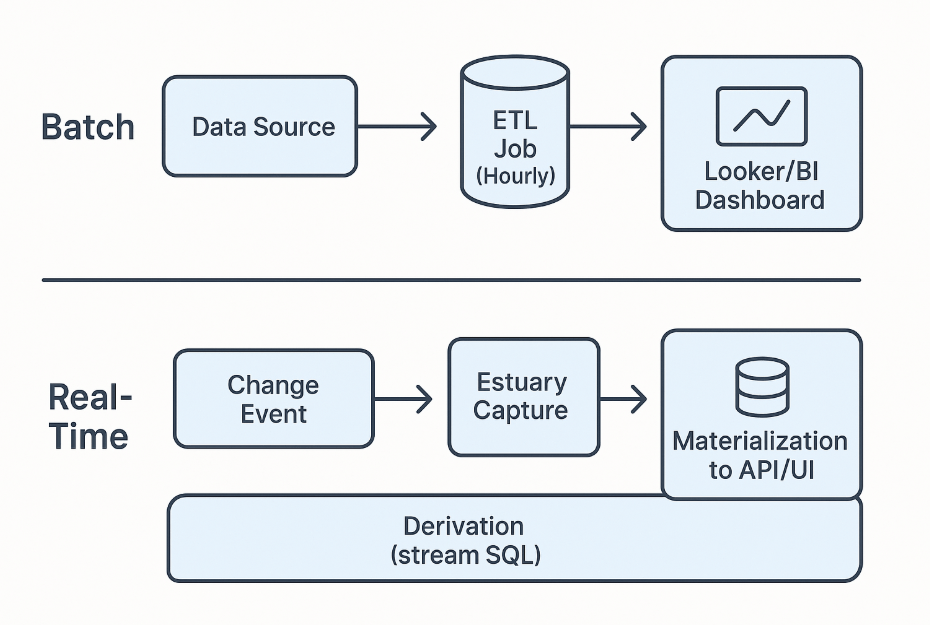
To add a bit more technical depth, let's watch a video that breaks down the concepts of batch processing, stream (real-time) processing, and a hybrid approach called micro-batching.
Batch Processing vs Stream Processing | System Design Primer | Tech Primers
The video 'Batch Processing vs Stream Processing' by Tech Primers provides a clear explanation of the fundamental differences and the types of use cases each is suited for.
Please watch the video from 01:00 to 06:17. Focus on: The definitions of batch, stream, and micro-batching (01:00 - 02:13). The examples of when to use batch processing (e.g., end-of-day files for historical analysis) (02:13 - 03:40). The examples of when to use stream processing (e.g., real-time security monitoring) (03:40 - 06:17).
To summarize the key distinctions:
| Characteristic | Batch Processing | Real-Time (Stream) Processing |
|---|---|---|
| Data Scope | Processes a large, finite collection of data. | Processes a continuous flow of individual data points. |
| Trigger | Scheduled (e.g., every hour, at midnight). | Event-driven (e.g., a user clicks a button). |
| Latency | High (minutes to hours). | Low (milliseconds to seconds). |
| Optimization | Optimized for throughput and cost-efficiency. | Optimized for responsiveness and low latency. |
2. Applying Batching to LLM Inference
Now, how does this apply specifically to calling Large Language Models?
Running a single LLM inference task on a GPU can be inefficient; the hardware is often underutilized while processing just one request. Batch inference is the practice of grouping multiple user requests (or "prompts") together and sending them to the model in a single "batch." This allows the GPU to process many tasks in parallel, maximizing its utilization and dramatically improving overall throughput.
The following article makes a strong case for batching and uses a powerful analogy that should connect well with your systems-oriented thinking.
Why Batch LLM Inference is Often the Smarter Choice - Sutro
The article 'Why Batch LLM Inference is Often the Smarter Choice' from Sutro is an excellent resource that explains the what, why, and when of batch inference for LLMs.
Please read the following sections: 'Synchronous vs. Batch APIs: How To Choose': Pay close attention to the OLTP vs. OLAP analogy and the excellent comparison table. This is the core of the trade-off. 'What Can I Actually Do with Batch Inference?': This provides a practical list of use cases that are not latency-sensitive, which is crucial for identifying opportunities for batching. 'Behind The Scenes: Why Batch Inference Saves Costs And Time': This section explains the underlying reason for the cost savings—efficient GPU utilization.
The article drives home the key architectural question: "If your user needs an answer now, use a real-time API. For almost everything else, a Batch API is the simpler, more economical choice."
This is not just a theoretical cost-saving. The efficiency gain is substantial. By packing the GPU with work, batch processing providers can offer discounts of 50-90% compared to real-time APIs.
An advanced optimization on this concept, used by high-performance inference servers like vLLM, is continuous batching. Instead of waiting for a full batch to assemble, the system dynamically bundles requests as they arrive, filling GPU slots as soon as they become free. This further maximizes throughput, blending some of the responsiveness of real-time processing with the efficiency of batching. For your role, it's enough to know that batching is a key optimization area with ongoing innovation.
3. The Architect's Decision: Cost vs. Latency Trade-offs
You now have the components to make an informed architectural decision. The choice between batch and real-time inference is a direct trade-off, primarily between cost and latency.
This graph visualizes the trade-offs across several system attributes:

Let's break it down into a decision framework:
When to choose Real-Time Inference:
Your primary goal is low latency. The user is actively waiting for the response, and a delay would degrade the experience.
- System Type: Interactive, synchronous, user-facing.
- Use Cases:
- Conversational AI and chatbots.
- Real-time content moderation or fraud detection.
- AI-powered search or autocomplete.
- Generating UI text on-the-fly based on user input.
- Cost: High. You are paying a premium for "always-on" compute resources to ensure an immediate response.
When to choose Batch Inference:
Your primary goal is low cost and high throughput. Latency is not a critical user-facing concern.
- System Type: Asynchronous, non-interactive, background processing.
- Use Cases:
- Data Processing: Classifying large datasets of user reviews, extracting information from documents, or generating embeddings for a RAG system.
- Reporting: Creating daily or weekly summaries of business activity.
- Content Generation: Translating a website's content into multiple languages, personalizing marketing emails for a campaign, or generating product descriptions for an entire catalog.
- Cost: Low. You benefit from economies of scale and more efficient hardware utilization.
As an architect and designer, you might even design a system that uses both. For example, a customer service application could use a real-time chatbot for immediate queries, while also using batch inference overnight to analyze all of the day's conversations for sentiment and emerging topics.
Conclusion
In this lesson, we dissected the difference between batch and real-time inference, establishing it as a fundamental cost-performance trade-off in AI system design.
Key Takeaways:
- Batch inference groups multiple requests to be processed together, optimizing for high throughput and low cost. It is ideal for non-urgent, asynchronous tasks.
- Real-time (or stream) processing handles requests individually as they arrive, optimizing for low latency. It is essential for interactive, user-facing applications.
- The core trade-off is cost vs. latency. Batching can reduce inference costs by 50-90% or more by maximizing hardware efficiency, but it introduces delays.
- The critical question for an architect is: "Does the user need an answer right now?" The answer to this question dictates which processing model is appropriate for the feature you are designing.
Next Steps
We've now covered two major cost optimization strategies: caching (to avoid redundant work) and batching (to make necessary work more efficient). In our next lesson, we will apply these concepts in a practical exercise: recalculating AI feature costs after applying a caching or batching strategy to quantify savings. This will allow you to see the direct financial impact of these architectural decisions on a feature's break-even timeline.