Hello! Welcome to the fifth module of our course, "Architecting Agentic Systems."
In the previous phase, we focused on analysis—modeling product economics and using Causal Loop Diagrams to map the hidden conflicts between short-term gains and long-term system health. You learned to visualize how a seemingly good decision, like an aggressive "dark pattern" for a free trial, could create a destructive feedback loop over time.
Now, we shift from analyzing existing systems to proactively designing new ones. Specifically, we're diving into the architecture of AI agents—systems that don't just process information but can take action in the world. As a UX designer, this is where you can have a huge impact, shaping how these agents interact with both users and other systems.
Our first step is to understand how we give an AI the ability to act. This lesson addresses a fundamental concept: explaining the purpose of a capability manifest in enabling AI agents to discover and use tools.
From Language Model to Action-Taker
At its core, a Large Language Model (LLM) like the one powering ChatGPT is a sophisticated text-generation engine. It takes text in and produces text out. It can write a story about booking a flight, but it can't actually book the flight. It has no hands, no senses, and no connection to the outside world.
To bridge this gap, we create an AI Agent. An agent combines the LLM's "brain" with a set of "tools" that allow it to perceive and act upon its environment.
This video from KodeKloud offers a clear, beginner-friendly explanation of this crucial distinction. It will help you understand why we need to augment LLMs to create true agents.
Model Context Protocol (MCP) Explained for Beginners: AI Flight Booking Demo!
This video, titled 'Model Context Protocol (MCP) Explained for Beginners', clearly separates what an LLM can do (generate text) from what an AI agent can do (take action).
Watch the following two segments: LLM vs. Agent (1:18 - 3:44): Pay close attention to the example of the flight booking app. It perfectly illustrates an LLM's inability to take action on its own and introduces the concept of an AI agent. How Agents Use Tools & APIs (5:42 - 8:48): This part explains that agents use 'tools' to interact with external platforms, and that these tools are essentially wrappers around APIs. Don't worry if the API explanation is new; the core idea is that tools provide a bridge to the outside world.
The Agent's Toolkit: Perception and Action
As the video showed, an agent's ability to act depends on its tools. These tools can be anything from a simple calculator to a complex flight-booking API or a connection to your company's internal database. The LLM acts as the reasoning engine, deciding which tool to use and when, based on the user's goal.
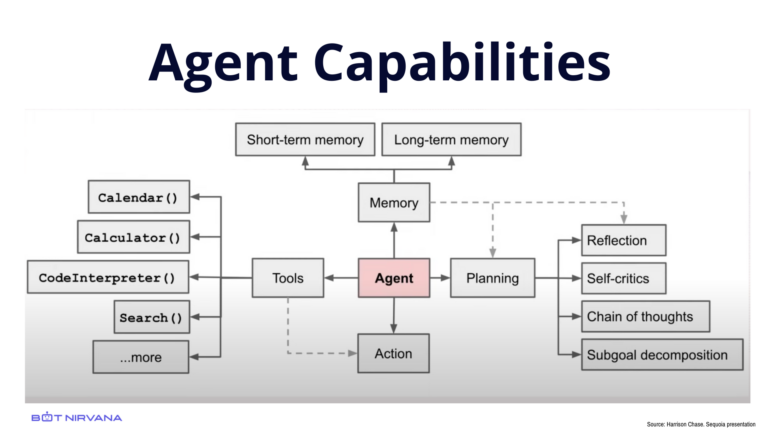
This leads to a critical architectural question: How does the LLM know which tools are available and how to use them?
The agent can't just guess. It needs a clear, structured list of its capabilities. This is where the concept of a "manifest" comes in.
To understand this better, let's read a short section from a guide on engineering AI agents. It frames tool use as the agent's "hands and senses."
AI Agents: The Definitive Guide to Engineering for Production Scale
This section from the article 'AI Agents: The Definitive Guide' by Comet explains the practical process of tool calling.
Read the section titled 'Perception and Action: Tool Calling as Hands and Senses.' Focus on the description of how the agent is provided with a 'manifest of available tools' and how it uses the tool descriptions to make decisions.
The Core Purpose: Discovery and Usage
The reading you just did highlights the central problem that a capability manifest solves. Imagine you're designing a customer service agent. It might have access to dozens of tools: lookup_order_status, process_refund, check_inventory, escalate_to_human, and so on.
The LLM, in the middle of a conversation, needs to answer two fundamental questions:
- Discovery: What can I do? What tools are in my toolkit?
- Usage: I've decided to
process_refund. How do I actually do that? What information do I need (e.g.,order_id,amount) and in what format?
The capability manifest is the answer. It is a structured, machine-readable document that describes an agent's identity, skills, and the technical specifications of its tools.
Its purpose is to enable an AI agent to dynamically discover what actions it can perform and to correctly use the tools required to perform them.
Think of it like a design specification for an AI's abilities. Just as you create UI components with defined properties in Figma, an engineer creates tools with a defined manifest so that the AI can understand and use them predictably.
Standardizing Discovery: The "USB-C Moment" for AI
If every developer created their own unique format for a manifest, it would lead to chaos. Building applications with agents that use tools from different providers (e.g., Google, Stripe, Salesforce) would require writing tons of custom "glue code."
To solve this, protocols like the Model Context Protocol (MCP) and Agent Communication Protocol (ACP) were created. They standardize how agents describe and discover capabilities.
This next video uses a brilliant analogy—the move to the USB-C standard—to explain why a standardized protocol for tool discovery is so important.
Model Context Protocol Clearly Explained | MCP Beyond the Hype
This video from codebasics, 'Model Context Protocol Clearly Explained', provides a high-level, non-technical analogy for why standardized manifests are a game-changer for AI development.
Please watch these two clips: The USB-C Analogy (0:00 - 4:21): This section explains the evolution of AI applications and introduces MCP as the 'USB-C moment' for AI, standardizing how LLMs interact with tools. The Importance of Description (6:29 - 7:54): This part is crucial. It shows how a tool's detailed description within the manifest is what guides the LLM to select the right tool and extract the right parameters from a user's natural language request. This directly relates to your work in designing clear and intuitive systems.
The video makes a key point that's highly relevant to your UX background: the quality of the tool's description in the manifest is paramount. A well-written description allows the LLM to make intelligent decisions, just as a clear label or instruction helps a human user navigate an interface.

Finally, let's look at the formal definition from the Agent Communication Protocol's documentation.
This is the official definition of an Agent Manifest from the Agent Communication Protocol documentation.
Read the introductory paragraphs under the main heading 'Agent Manifest'. This will give you the formal definition and purpose of the manifest in the context of a standardized protocol.
The manifest formally describes the agent's identity, capabilities, and how it can be found and used by other clients or agents. It's the agent's public-facing profile.
Conclusion
In this lesson, we explored the fundamental "why" behind capability manifests. You've moved from understanding system dynamics to the first principles of architecting systems that can act.
Key Takeaways:
- An LLM is a reasoning engine, but it needs tools to become an AI agent that can interact with the world.
- A capability manifest is a structured document that describes an agent's tools and how to use them.
- The primary purpose of the manifest is to enable tool discovery (What can you do?) and guide correct tool usage (How do you do it?).
- Standardized protocols like MCP and ACP create a "common language" for manifests, making it much easier to build complex, multi-tool agentic systems.
- From a design perspective, the clarity of the descriptions within a manifest is critical for the agent's performance.
Next Lesson Preview
Now that you understand why we need capability manifests, our next lesson will dive into what's inside them. We will move on to the next learning outcome: Describe the key components of a capability manifest (e.g., agent identity, functions, constraints). We'll break down the structure of a manifest and look at the essential fields that bring it to life.