Introduction
Welcome to your next lesson. In our previous session, we explored the theoretical underpinnings of Mauryan governance as laid out in Kautilya's Arthashastra. We examined its core principles of state-regulated economics, strategic taxation, and the pervasive use of espionage—all designed to build and sustain a powerful, centralized state.
Today, we transition from theory to practice. Our goal is to describe the Mauryan administrative hierarchy, from central bureaucracy to provincial, district, and village-level governance. We will see how the abstract principles of the Arthashastra were translated into a concrete, multi-layered organizational structure that was unprecedented in ancient India for its scale and complexity.
Think of it as moving from a company's strategic plan (the Arthashastra) to its organizational chart. We will map out the 'corporate headquarters' in Pataliputra, the 'regional divisions' across the subcontinent, the 'district offices,' and finally, the 'local branch' management at the village level. This lesson will give you a clear picture of the machinery that ran one of history's great empires.
1. The Central Administration: The Imperial Core
At the apex of this vast structure was the emperor (Swami), possessing supreme executive, legislative, and judicial authority. However, no single ruler could manage such a vast empire alone. The real strength of the Mauryan system lay in its highly organized central bureaucracy, which was built around the king.
This central government consisted of two main components:
- The Mantriparishad (Council of Ministers), an advisory body of senior ministers (Amatyas) who assisted the king in policy-making. This was akin to a modern cabinet or a corporate board of directors.
- A vast network of specialized departments, each headed by a superintendent (Adhyaksha). These individuals were the expert managers running the day-to-day functions of the state.
To understand this complex central machinery, let's turn to a detailed overview.
L13: Mauryan Administration | Ancient History | UPSC CSE | Vishal Chauhan
This segment from the lecture by Vishal Chauhan details the composition of the central administration. It explains the supreme role of the king, the function of the Mantriparishad, and the departmental structure based on the Arthashastra's categories of 'Tirthas' and 'Adhyakshas'.
Watch from 13:03 to 29:26. As you watch, pay close attention to: The absolute authority of the king, even over religious laws (Dharmashastra). The composition of the king's inner circle: the Yuvaraj (crown prince), Purohita (chief priest), Senapati (commander-in-chief), and other ministers (Amatyas). The distinction between the 18 Tirthas (high-ranking departments or ministries) and the numerous Adhyakshas (superintendents) who managed specific economic and administrative functions.
As you saw, the Adhyakshas formed the backbone of the economic and civil administration. Here are some of the most critical roles, which directly reflect the regulatory principles we discussed in the last lesson:
- Samaharta: The Collector-General of Revenue, responsible for the entire assessment and collection process across the empire. This role is analogous to a Chief Financial Officer.
- Sannidhata: The Treasurer or Head of the Royal Treasury, responsible for storing all state income, both in cash and kind.
- Sitadhyaksha: Superintendent of Crown Lands, managing the vast agricultural estates owned directly by the state.
- Panyadhyaksha: Superintendent of Commerce, who regulated markets, controlled prices, and managed supply and demand.
- Sulkadhyaksha: Superintendent of Tolls/Customs, responsible for levying taxes on goods.
- Akaradhyaksha: Superintendent of Mines, overseeing the state's monopoly on vital mineral resources.
This departmental specialization allowed for efficient management and control over the empire's vast economic resources, which Kautilya identified as the foundation of state power.
2. The Provincial Administration: Governing the Regions
The Mauryan Empire was far too large to be ruled directly from the capital. It was therefore divided into several large provinces, each serving as a major administrative hub. Ashokan inscriptions confirm at least four major provinces, with a fifth (the central province) being ruled directly by the emperor from Pataliputra.
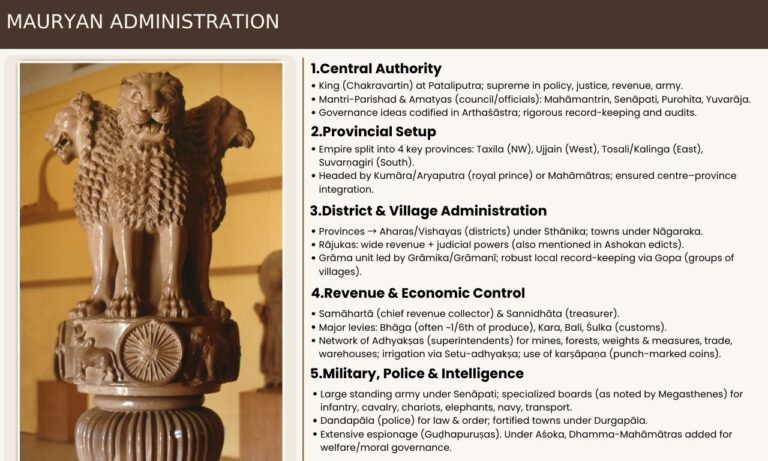
These provinces were:
- Uttarapatha (Northern Province), with its capital at Taxila.
- Avantirashtra (Western Province), with its capital at Ujjain.
- Prachyapatha (Eastern Province), with its capital at Tosali.
- Dakshinapatha (Southern Province), with its capital at Suvarnagiri.
The governance of these provinces mirrored the central administration on a smaller scale.
L13: Mauryan Administration | Ancient History | UPSC CSE | Vishal Chauhan
This next video segment explains the structure of provincial and district-level administration. It clarifies who was appointed to govern these regions and the key officials who assisted them.
Watch from 58:04 to 1:03:00. Focus on understanding the roles of the following: Kumara / Aryaputra: Royal princes who served as viceroys or governors, ensuring loyalty to the imperial center. Mahamatyas: Senior officials who assisted the provincial governor, forming a provincial council of ministers. Rajukas, Pradeshtas, and Yuktas: The key officials at the district level, who reported up to the provincial government.
The appointment of royal princes as governors (Kumaras) was a strategic move to maintain firm control over the far-flung territories. These provincial capitals—Taxila, Ujjain, Tosali, and Suvarnagiri—were not just administrative centers but also major hubs for trade, military deployment, and the projection of imperial authority.
3. District and Urban Administration
Below the provinces, the administration was further decentralized into districts. This is where the policies decided at the central and provincial levels were actually implemented and where the state had its most direct contact with the populace through revenue collection and law enforcement.
The key officials at the district level were:
- Rajukas: These were powerful officials responsible for a district's overall welfare. Their duties included land measurement, revenue assessment and collection, and judicial functions. Their role is often compared to that of a modern District Collector or Magistrate.
- Pradeshtas: These were another set of senior officials, likely in charge of groups of districts. Their primary function seems to have been touring their jurisdictions to audit the work of lower officials and ensure the proper collection of taxes and maintenance of order.
- Yuktas: These were subordinate officers, likely serving as secretaries or accountants, responsible for managing the accounts and records related to state revenue.
Urban Administration: The Pataliputra Model
Megasthenes, the Greek ambassador to Chandragupta's court, left a detailed account of the administration of the capital city, Pataliputra. This sophisticated model was likely replicated in other major cities. He describes a city council of 30 members, divided into six committees of five members each. These committees were responsible for:
- Industrial Arts: Supervising artisans and wages.
- Foreigners: Looking after the welfare of foreign merchants and envoys.
- Registration of Births and Deaths: For census and taxation purposes.
- Trade and Commerce: Regulating markets, weights, and measures.
- Manufactured Goods: Ensuring quality control and preventing adulteration.
- Collection of Sales Tax: A 10% tax levied on goods sold.
The head of the city administration was known as the Nagarika. This structure shows a remarkable level of specialized management for urban centers.
4. Village Administration: The Foundational Unit
The base of the entire administrative pyramid was the village (Gram). The Mauryan system cleverly integrated existing local bodies into its hierarchy, allowing for a degree of local autonomy while ensuring imperial control.
The structure at this level was also hierarchical, designed for efficient record-keeping and revenue collection.
Complete Ancient History | The Mauryan Empire | Lec-6 | UPSC CSE 2025 | Indian History | Alok Ojha
The video by Alok Ojha provides a very clear and concise explanation of the nested hierarchy at the village level.
Watch from 51:30 to 54:00. Note the clear three-tiered structure: Gramika: The head of a single village. Gopa: The official in charge of a group of 10-15 villages, responsible for maintaining records of land, population, and livestock. Sthanika: A higher official who supervised the Gopas, often managing a quarter of a district.
This nested structure, from the Gramika to the Gopa and then to the Sthanika, created a clear chain of command for collecting revenue and information, which then flowed upwards to the district, provincial, and finally, the central government.
To consolidate your understanding of this complex terminology, please review the following glossary of key officers.
Mauryan Administration and Governance in Ancient India
The webpage 'Mauryan Administration and Governance in Ancient India' provides a very useful quick-reference glossary. Please study this table to solidify your knowledge of the key administrative roles.
Read the table under the heading 'Quick reference — consolidated officer glossary'. This table provides concise definitions for the most important officials we have discussed, such as the Samaharta, Sannidhata, Rajuka, and Gramika.
Conclusion
In this lesson, we have mapped the intricate administrative structure of the Mauryan Empire. We saw how it functioned as a cohesive, hierarchical system, translating the statecraft of the Arthashastra into a formidable governing machine.
Key Takeaways:
- The Mauryan administration was a multi-tiered hierarchy with four main levels: Central, Provincial, District, and Village.
- The Central Administration was led by the King, advised by a Mantriparishad and supported by a highly specialized bureaucracy of departments headed by Adhyakshas.
- The empire was divided into large Provinces, governed by royal princes (Kumaras) who replicated the central structure on a regional scale.
- Districts were managed by powerful officials like the Rajukas (for revenue and justice) and Pradeshtas (for auditing), with cities having their own specialized councils.
- The Village, led by a Gramika, was the basic unit, organized into larger groups under officials named Gopa and Sthanika to ensure efficient control and revenue collection.
This elaborate structure demonstrates an advanced understanding of public administration, designed for control, efficiency, and resource extraction across a vast and diverse subcontinent.
Preview of the Next Lesson:
Having built this unparalleled administrative framework, Emperor Ashoka, Chandragupta's grandson, would attempt to use it for a purpose beyond mere political control and economic extraction. In our next lesson, we will analyze Ashoka's policy of Dhamma, exploring its content, its purpose, and how he used this very administrative machine to propagate a new moral and ethical vision for his empire.