Introduction
In our last lesson, we contrasted the religious policies of Akbar and Aurangzeb, analyzing how their ideological approaches to governance shaped the empire's political trajectory. We saw how Akbar's policy of Sulh-i-Kul ("universal peace") created a syncretic and inclusive political environment.
Today, we will see that vision rendered in stone, pigment, and marble. This lesson explores the magnificent artistic and architectural achievements of the Mughal Empire, focusing on the period of its greatest cultural output. Our learning outcome is to describe the major achievements of Mughal architecture (Fatehpur Sikri, Taj Mahal) and painting (miniature tradition). You will see how these art forms were not mere decoration but powerful statements of imperial ideology, wealth, and cultural synthesis, reflecting the very policies and systems we have been discussing.
The Mughal Miniature Tradition: A Visual Chronicle
Mughal painting represents a unique synthesis of the delicate, formal style of Persian manuscript illustration and the vibrant, naturalistic traditions of Indian art. This fusion began in the imperial workshops, or karkhanas, established by the emperors.
The Foundational Era of Akbar (1556-1605)
Under Akbar, the primary function of painting was narrative. Great literary epics, historical chronicles, and fables were transcribed and illustrated on an unprecedented scale. These were collaborative projects, often involving a master artist who would lay out the composition, a junior artist who would fill in the colours, and a specialist for portraits. The style is characterized by its dynamism, vibrant colour palette, and crowded compositions that teem with life and action. The artists began to incorporate elements of realism and perspective, influenced by European prints brought to the court by Jesuit missionaries.
The Connoisseurship of Jahangir (1605-1627)
Jahangir was a passionate connoisseur and naturalist. Under his patronage, the focus shifted from large-scale narrative manuscripts to individual paintings and portraits compiled in lavish albums (muraqqas). The style evolved towards greater refinement, subtlety, and a remarkable naturalism. Jahangir commissioned his artists, whom he valued highly and whose individual styles he could recognize, to create scientifically accurate studies of birds, animals, and flowers. Portraiture also reached a new height of psychological depth and realism.
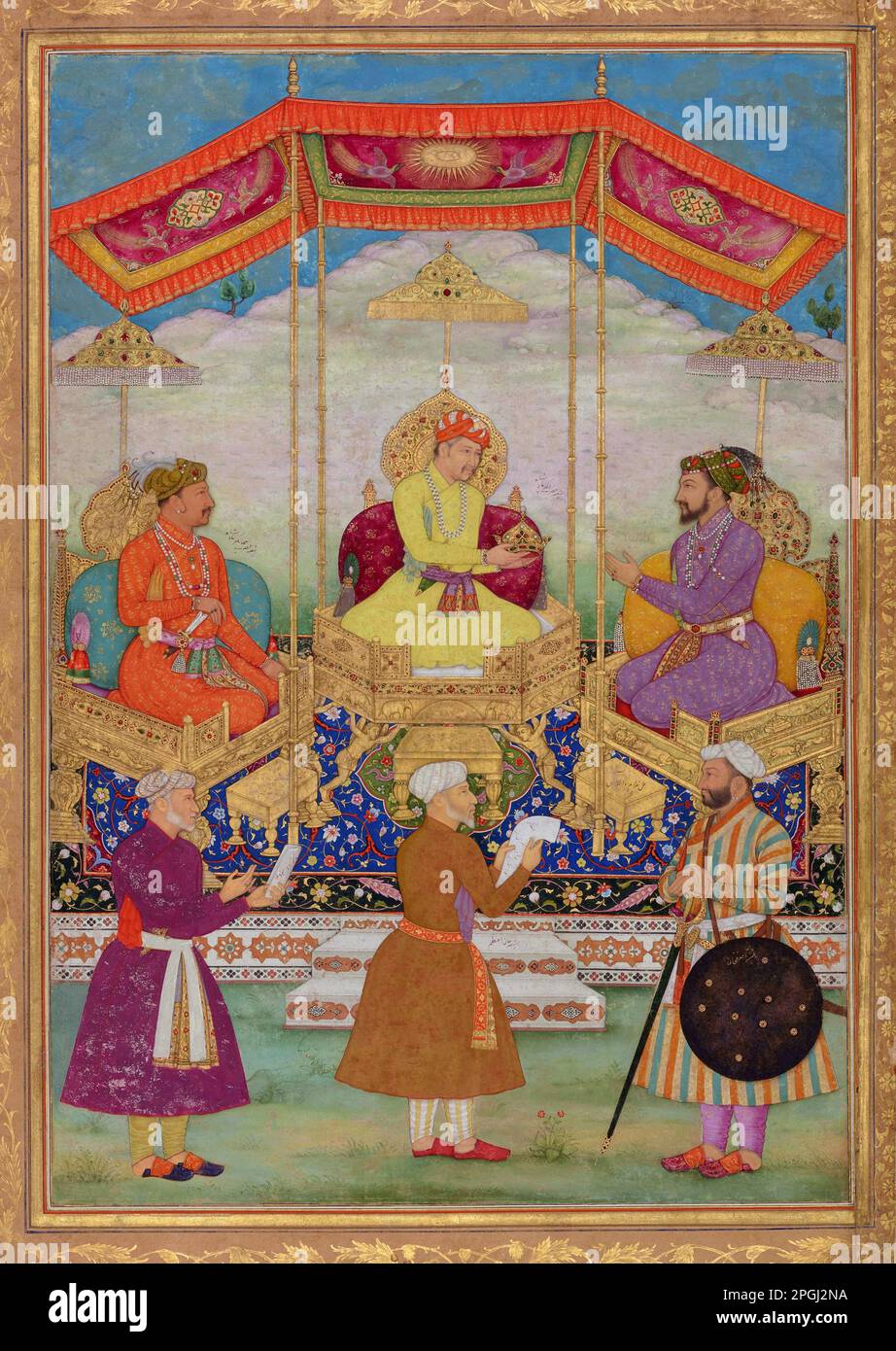
The Formal Splendor of Shah Jahan (1628-1658)
While Jahangir's art was intimate and naturalistic, Shah Jahan's was formal, opulent, and grand. Paintings from his reign often depict rigid, stately court scenes, with the emperor as the central, immobile figure. The focus is on capturing the immense wealth, power, and perfectly ordered hierarchy of the court. The style is colder and more static than in previous reigns, but the technical perfection, jewel-like colours, and intricate detail are breathtaking. The prime example from this era is the Padshahnama ("Chronicle of the King of the World"), the official history of Shah Jahan's reign.
To truly appreciate the richness of this tradition, let's explore the world of the Padshahnama.
"Wonder of the Age": Master Painters of India, 1100--1900
The video '"Wonder of the Age": Master Painters of India, 1100--1900' from The Met features a lecture by Oliver Everett, former librarian of Windsor Castle, home to the finest surviving copy of the Padshahnama. It offers a fascinating deep dive into the art, artists, and court life of Shah Jahan's reign.
Please watch the following two segments: 07:26 – 08:53: This section sets the context by discussing the 'Six Great Mughals' and highlighting Akbar's liberal patronage, which laid the foundation for the artistic developments to come. 09:59 – 21:30: This is the core segment. It provides a detailed analysis of several paintings from the 'Padshahnama', showcasing court scenes, battles, and ceremonies. Pay close attention to the incredible detail, the discussion of artistic techniques, the depiction of key political figures, and the fascinating story of the English miniature painting challenge. This provides a vivid window into the world these artists were chronicling.
As the video demonstrates, these miniatures are not just beautiful objects; they are invaluable historical documents, rich with information about the politics, culture, and material life of the Mughal court.
Mughal Architecture: Building an Imperial Vision
Mughal architecture is the most enduring legacy of the dynasty, a physical manifestation of its power and aesthetic vision. It blends Persian, Timurid, and Indian architectural traditions to create a unique style. We will focus on two of its most iconic achievements.
1. Fatehpur Sikri: A Capital of Syncretic Ideals
Built by Akbar in the 1570s, Fatehpur Sikri served as the Mughal capital for just over a decade before being abandoned, likely due to water scarcity. It stands as a remarkable architectural testament to Akbar's policy of Sulh-i-Kul. The entire city is built from red sandstone and showcases a brilliant fusion of Islamic and Hindu architectural forms.
Forts Of India - Fatehpur Sikri, Uttar Pradesh - Ep # 7
The documentary 'Forts Of India - Fatehpur Sikri' by Doordarshan National provides an excellent visual tour of the city and explains the symbolism behind its key structures. It directly connects the architecture to Akbar's political philosophy.
Please watch these three segments: 00:11 – 03:52: This introduces Fatehpur Sikri and Akbar's core purpose: binding the empire through cultural fusion, which is reflected in the architecture. 05:46 – 09:32: This segment focuses on the Jama Masjid and highlights how Hindu motifs like the lotus and bells are integrated into the Islamic architectural framework, demonstrating Akbar's respect for different faiths. 11:20 – 14:10: This part covers the Khwabgah (Akbar's residence) and the famous Diwan-i-Khas. Note the discussion of the central pillar, which symbolizes Akbar's role at the heart of the diverse belief systems of his empire.
The key buildings at Fatehpur Sikri each tell a part of this story of synthesis:
- Buland Darwaza ("Gate of Magnificence"): A massive triumphal arch built to commemorate Akbar's conquest of Gujarat, symbolizing the power and reach of the empire.
- Jama Masjid: A grand mosque that blends Persian design with Indian decorative elements.
- Diwan-i-Khas ("Hall of Private Audience"): Famous for its central pillar, a masterpiece of Hindu-inspired carving, which supports a circular platform for the emperor. Four stone walkways connect this central platform to the corners of the hall, where ministers would have sat. The structure is a powerful architectural metaphor for the emperor as the central axis around which the diverse realms and religions of the empire revolved.
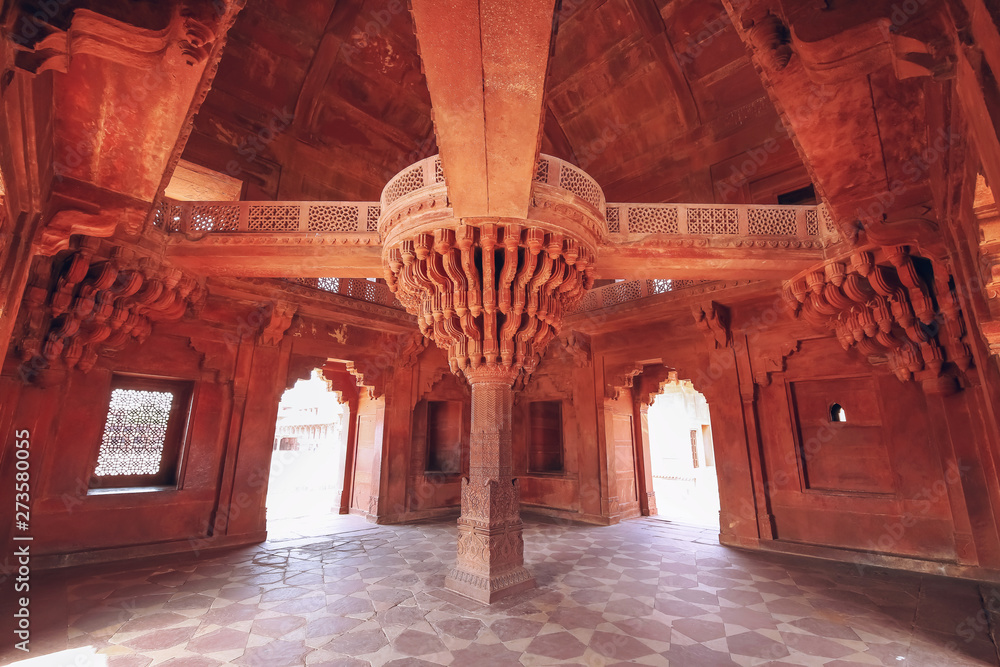
- Panch Mahal: A five-storied columnar pavilion, its design is reminiscent of a Buddhist vihara.
- Jodha Bai's Palace: Believed to be the residence of Akbar's chief Rajput queen, this palace heavily incorporates architectural elements from Gujarat and Rajasthan, such as carved brackets, pillars, and sloping eaves.
Fatehpur Sikri is, in essence, Akbar's political ideology made manifest—an experimental, dynamic, and powerful fusion of the diverse cultural threads of his empire.
2. The Taj Mahal: A Climax in Marble
If Fatehpur Sikri represents Akbar's syncretic vision, the Taj Mahal represents the aesthetic and technical perfection achieved under his grandson, Shah Jahan. Built between 1632 and 1648, it is a mausoleum for his beloved wife, Mumtaz Mahal.
Shah Jahan's reign marked a shift in architectural preference from red sandstone to gleaming white marble, often inlaid with semi-precious stones. This technique, known as pietra dura (or parchin kari), was of Florentine origin but was perfected by Mughal artisans to create exquisite floral motifs.
Let's delve into the architectural principles of Shah Jahan's era and the specifics of the Taj Mahal.
The academic text 'Mughal Architecture' provides a scholarly analysis of this classical phase. This reading will give you a deeper understanding of the design principles, materials, and symbolic meaning of the Taj Mahal.
Please read the section on 'Shah Jahan (1037—1068/1628—1658)', starting on page 87. You don't need to read the entire section in detail. Focus your attention on the pages discussing: The new architectural ideals of symmetry and uniformity. The use of white marble and new decorative forms like the baluster column and flowering plants. The detailed description of the Taj Mahal complex, its layout as a riverside garden, its symmetrical plan, and its materials (pietra dura). This will provide the deep, systemic analysis that you appreciate.
The Taj Mahal is more than just a single building; it is a perfectly integrated complex. Key features include:
- Symmetry and Hierarchy: The entire complex is organized along a central axis with perfect bilateral symmetry. The main tomb is flanked by two identical red sandstone buildings—a mosque to the west and a mihman khana (guest house) to the east—that provide architectural balance.
- The Dome: The massive, bulbous onion dome is a defining feature, giving the structure its sense of grandeur and perfect proportion.
- Layout: Unlike earlier Mughal tombs placed in the center of a charbagh (four-part garden), the Taj Mahal is set at the far end of the garden, against the backdrop of the Yamuna river. This creates a dramatic perspective and reinforces the idea of the garden as an earthly paradise leading to the celestial tomb.
- Decoration: The exterior is decorated with exquisite calligraphy of Qur'anic verses and delicate floral motifs created using the pietra dura technique. The intricacy and artistry of this inlay work are unparalleled.
The Taj Mahal is the culmination of Mughal architectural evolution. It is less about fusion and more about perfection—a singular, harmonious vision of paradise on Earth, executed with mathematical precision and sublime artistry.
Conclusion
Today we have journeyed through the artistic heights of the Mughal Empire, seeing how its imperial power and ideology were expressed in painting and architecture.
Key Takeaways:
- Mughal Miniature Painting evolved from the dynamic, narrative-driven style of Akbar's workshops to the refined naturalism of Jahangir's court and the formal, opulent grandeur of Shah Jahan's era.
- Fatehpur Sikri, built by Akbar, is an architectural embodiment of his policy of Sulh-i-Kul, showcasing a powerful and experimental fusion of Hindu and Islamic building traditions in red sandstone.
- The Taj Mahal, the zenith of Shah Jahan's patronage, represents the climax of Mughal architecture. It is a masterpiece of symmetry, proportion, and refined decoration in white marble, symbolizing a heavenly abode on Earth.
- Art and architecture under the Mughals were integral to statecraft, used to project power, legitimize rule, and express the prevailing imperial ideology.
Preview of the Next Lesson:
The unparalleled splendor of Shah Jahan's reign, as seen in the Taj Mahal, also came at an immense cost. In our next lesson, "Explain the primary factors contributing to Mughal decline after Aurangzeb", we will examine how fiscal stress, partly driven by such monumental projects, combined with administrative overextension and regional assertions to precipitate the decline of the empire.