Introduction
Welcome to our next lesson. In our previous discussion, we analyzed the bustling economic life of the Delhi Sultanate, seeing how it presided over an "Urban Revolution" and became a central hub in the vast Indian Ocean trade network. This economic dynamism, however, was coupled with immense political and administrative challenges. A sprawling, wealthy empire is difficult to control from a single center, and ambitious regional governors often eye the possibility of independence.
This sets the stage for today's topic. We will explore the consequences of this imperial overreach. Our learning outcome is to explain the political fragmentation of the late Sultanate and the rise of regional kingdoms like the Bahmani Sultanate. We will dissect the causes of the Delhi Sultanate's decline, focusing on the reign of Muhammad bin Tughlaq, and then trace the emergence and subsequent splintering of the Bahmani kingdom in the Deccan. This process reshaped the political map of India, creating the very landscape that the Mughals would encounter a century and a half later.
Let's begin by visualizing this fragmentation.
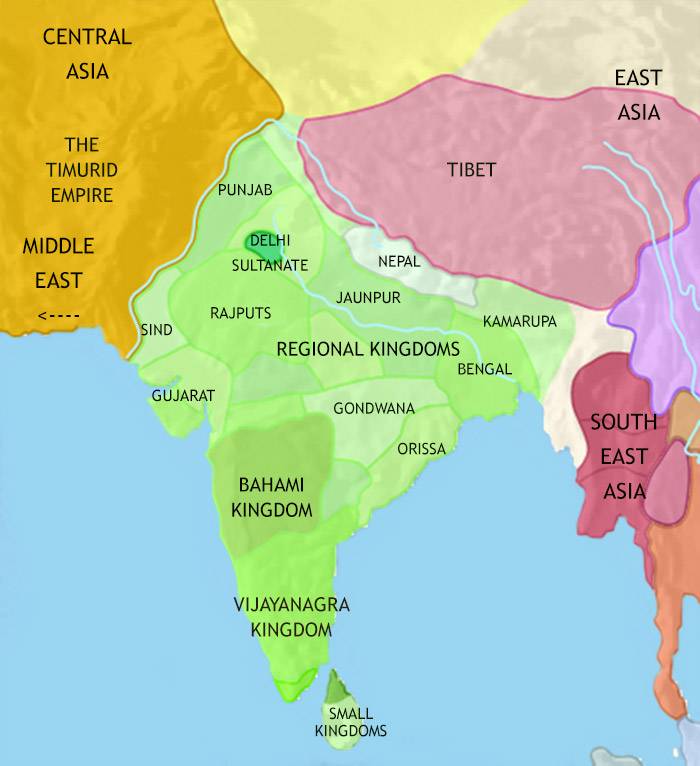
The Center Cannot Hold: Overextension and Tughlaq's Experiments
The seeds of fragmentation were sown at the height of the Sultanate's power. By the early 14th century, under the Khaljis and then the Tughlaqs, the empire stretched across nearly the entire subcontinent. While this was a remarkable military achievement, governing such a vast and diverse territory with medieval technology was a monumental task. The Deccan, in particular—wealthy from its mines and trade but geographically distant and rugged—proved to be the empire's Achilles' heel.
The reign of Muhammad bin Tughlaq (1325–1351) marks the critical turning point. His ambitious, often radical, administrative experiments, though perhaps well-intentioned, were implemented with such force and poor planning that they backfired spectacularly, accelerating the very disintegration he sought to prevent.
To understand the disastrous impact of his policies, please watch the following video. It provides a compelling narrative of his brutal annexationist policies and the chaos that followed.
How the Brutal Delhi Sultanate Gave Birth to the Vijayanagara Empire
The video 'How the Brutal Delhi Sultanate Gave Birth to the Vijayanagara Empire' from the Odd Compass channel vividly explains how Muhammad bin Tughlaq's actions in the Deccan directly led to rebellion and the birth of new kingdoms.
Watch from 05:35 to 11:18. Focus on Tughlaq's methods of conquest, his deeply unpopular rule, and the catastrophic consequences of his decision to shift the capital from Delhi to Daulatabad.
As the video explains, two policies were particularly devastating:
- Brutal Annexation: Unlike earlier sultans who were often content with extracting tribute from Deccan kingdoms, Muhammad bin Tughlaq pursued a policy of complete annexation and ruthless suppression. This destroyed existing political structures and created widespread resentment.
- The Capital Shift (1327): His decision to move the entire imperial capital, including the administrative elite and a large part of Delhi's population, to Daulatabad (formerly Deogiri) in the Deccan was a logistical and human catastrophe. The forced march resulted in immense suffering and death. When he reversed the decision a few years later, it left the Sultanate's authority in the Deccan fatally weakened and created a power vacuum.
These blunders triggered a wave of rebellions across the empire. The military and administrative elite (Amiran-i-sada or chiefs of a hundred villages), who had been posted to the Deccan, were the first to revolt against the Sultan's tyrannical and erratic rule.
To place these events in a broader context and understand how they led to new state formations not just in the Deccan, but also in Bengal and the far south, please read the following excerpt from a scholarly paper.
Indo-Persian Identities in Medieval Muslim Deccan
The paper 'Indo-Persian Identities in Medieval Muslim Deccan' offers a concise academic analysis of this period of political turmoil.
Please read the section titled 'The Making of Muslim India.' Start from the paragraph beginning 'In the traditional manner of the culture of violence...' and read until the end of the section. This part details the Tughlaq dynasty's rule, the Daulatabad experiment, and the resulting emergence of the Vijayanagar, Madurai, Bengal, and Bahmani states.
The Rise of the Bahmani Sultanate (1347 CE)
Out of the chaos of Muhammad bin Tughlaq's reign, two major powers emerged in the Deccan: the Hindu kingdom of Vijayanagara in the south, and the Muslim Bahmani Sultanate to its north. Our focus now turns to the latter.
The Bahmani Sultanate was a direct result of the rebellion of the amirs in the Deccan. In 1347, they proclaimed their independence and chose one of their own, an Afghan adventurer named Hasan Gangu, as their new sultan. He took the title Alauddin Hasan Bahman Shah.
The video we watched earlier also details this specific event.
How the Brutal Delhi Sultanate Gave Birth to the Vijayanagara Empire
Let's return to the Odd Compass video, which now explains the immediate consequences of Tughlaq's retreat from the Deccan.
Watch from 11:18 to 13:48. This segment covers the rebellions that broke out as soon as Tughlaq's authority weakened, leading to the formal establishment of the Bahmani Sultanate under Hasan Gangu and his initial policies.
The new Sultanate established its capital at Ahsanabad (Gulbarga) and consolidated its rule over a vast territory covering parts of modern-day Karnataka, Maharashtra, and Andhra Pradesh. For the next two centuries, the politics of the Deccan would be defined by the intense and near-constant rivalry between the Bahmani Sultanate and the Vijayanagara Empire for control of fertile river valleys (like the Raichur Doab) and strategic ports.
Internal Rifts and the Fragmentation of the Bahmanis
Just as the Delhi Sultanate fragmented, the Bahmani Sultanate itself contained the seeds of its own dissolution. The key cause was a bitter and irreconcilable conflict within its nobility, which was divided into two hostile factions:
- The Deccanis (or Dakhnis): These were the established nobles, descendants of the original Turkic settlers from the Delhi Sultanate, along with local Hindu converts to Islam. They considered themselves the original stakeholders of the kingdom.
- The Afaqis (or Pardesis / Gharbians): Meaning "foreigners" or "westerners," this group consisted of recent immigrants from Persia, Central Asia, and the Arab world. They were often highly skilled administrators, merchants, and soldiers, and many adhered to the Shia sect of Islam, unlike the largely Sunni Deccanis. Their rapid rise to positions of power and influence created intense jealousy.
This factional struggle came to a head during the time of Mahmud Gawan, an brilliant Afaqi merchant who rose to become the Peshwa (Prime Minister) of the kingdom from 1466 to 1481. He was a military genius and a superb administrator who expanded the kingdom to its greatest extent and introduced key reforms. However, his success and dominance were intolerable to the Deccani party. They forged a treasonous letter in his name and presented it to the Sultan, who, in a drunken rage, ordered Gawan's execution in 1481.
Gawan's death was the death knell for the Bahmani Sultanate. With its most capable administrator gone, the central authority collapsed, and the factionalism spiraled out of control. Provincial governors, who had already been growing in power, began to declare their independence.
The following resource clearly lists the causes of the decline and the five states that emerged from it.
Bahmani Kingdom & 5 Deccan Sultanates [UPSC Notes]
The article 'Bahmani Kingdom & 5 Deccan Sultanates' provides a structured summary of the kingdom's downfall and its successors.
Please read three short sections: 'Mahmud Gawan (1466-1481)': Focus on his achievements and his execution. 'The decline of the Bahmani Sultanate': Note the list of causes. 'The 5 Deccan Sultanates': Familiarize yourself with the five successor states using the table provided.
Within a few decades of Mahmud Gawan's execution, the once-mighty Bahmani Sultanate had disintegrated into five independent sultanates, collectively known as the Deccan Sultanates:
- Nizam Shahis of Ahmadnagar (1490)
- Adil Shahis of Bijapur (1490)
- Imad Shahis of Berar (1490)
- Qutb Shahis of Golconda (1518)
- Barid Shahis of Bidar (1528)
These successor states inherited the Bahmani legacy of Indo-Persian culture and its rivalry with Vijayanagara, shaping the political and cultural life of the Deccan until they were eventually absorbed by the Mughal Empire in the 17th century.
Conclusion
In this lesson, we have traced a crucial arc of political change in medieval India: the process of imperial fragmentation. We saw how a combination of factors led to the decline of the central authority of the Delhi Sultanate and the rise of powerful regional states.
Key Takeaways:
- The decline of the Delhi Sultanate was triggered by imperial overextension and the disastrously executed policies of Muhammad bin Tughlaq, particularly the shift of the capital to Daulatabad.
- This created a power vacuum in the Deccan, leading to the establishment of the Bahmani Sultanate in 1347 by nobles rebelling against Delhi's rule.
- The Bahmani Sultanate itself was plagued by a deep internal conflict between the Deccani and Afaqi (foreign) nobility.
- The execution of the brilliant Afaqi minister Mahmud Gawan in 1481 fatally weakened the central authority, leading to the Bahmani Sultanate's fragmentation into the five Deccan Sultanates (Ahmadnagar, Bijapur, Golconda, Berar, and Bidar).
Preview of the Next Lesson:
This landscape of fragmentation was not confined to the Deccan. By the early 16th century, northern India was also a patchwork of competing, weakened sultanates. This political disunity created an opportunity for a new wave of invaders from Central Asia. In our next lesson, we will describe the establishment of the Mughal dynasty by Babur, a Timurid prince who would exploit this power vacuum to lay the foundations of India's last great pre-colonial empire.