Introduction
In our last lesson, we examined how the Pala dynasty created a thriving ecosystem for Mahayana Buddhism in Eastern India, culminating in great universities like Nalanda and Vikramashila. We concluded with the violent destruction of these centers around 1200 CE by Turkic forces, an event that marked the end of institutional Buddhism in its heartland. That event was part of a much larger, transformative process of incursions from the northwest that began centuries earlier.
Today, we will analyze the start of this process by focusing on two distinct, early waves of incursions from the Islamic world. This lesson addresses the learning outcome: Explain the political and economic impact of the Arab conquest of Sindh and Mahmud of Ghazni's raids on northern India.
It is crucial to distinguish between these two episodes. The first was a limited Arab conquest in the early 8th century, largely focused on a single region, Sindh. The second, occurring about 300 years later, involved a series of devastating but transient raids by a Turkic ruler, Mahmud of Ghazni, across a vast swathe of northern India. By analyzing their very different motivations and consequences, we can understand how the relationship between the Indian subcontinent and the powers to its west evolved from contained interaction to full-scale conflict.
Part 1: The Arab Conquest of Sindh (Early 8th Century)
The first significant military encounter between an Islamic power and an Indian kingdom occurred in 712 CE. Before we dive into the invasion itself, it's important to understand the context. Arab merchants had been active along India's western coast for centuries, making this a story of evolving commercial relationships turning into a political one.
Arab, Ghaznavid and Ghorid Invasions of India
This introductory clip from a CEC-UGC lecture explains the broader context, highlighting the pre-existing commercial contacts between the Arab world and India before the military invasion.
Please watch from 02:33 to 04:00. Note the distinction made between the initial commercial contacts and the later military engagement.
The invasion itself, led by the young Umayyad general Muhammad bin Qasim, resulted in the defeat of Raja Dahir and the conquest of Sindh, a region corresponding roughly to the modern-day Pakistani province.
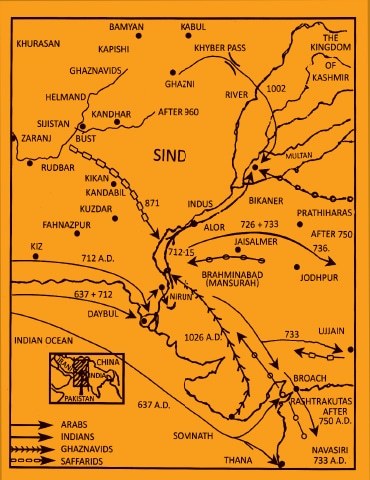
The Motives: A Reassessment
Traditional accounts often attribute the invasion to a punitive expedition to free Arab women and children captured by pirates near the port of Debal. While this may have been the immediate pretext, a deeper analysis reveals more compelling economic and political drivers. Given your background in M&A and strategic analysis, you'll find this re-evaluation of state motives particularly interesting.
Reinterpretation of Arab Conquest of Sindh
The essay 'Reinterpretation of Arab Conquest of Sindh' from Dr. Mubarak Ali's 'Essays On The History of Sindh' offers a sharp, critical analysis that moves beyond the simplistic narrative.
Please read the first five paragraphs of this essay, starting from 'Generally in the history books...' and ending with '...interests of the conquest of Sindh.' Focus on identifying the primary economic and political reasons that the author argues were the true drivers of the invasion.
As the reading argues, the key motives were:
- Economic: The primary driver was to secure the lucrative maritime trade routes. The pirate incident threatened the commercial interests of Arab merchants, creating pressure for a permanent solution. For the Umayyad governor Hajjaj, this was an investment in securing critical supply chains. The fact that the expedition's loot reportedly paid back the state treasury three times over highlights the powerful economic calculus involved.
- Political: The conquest was part of the broader expansionist policy of the Umayyad Caliphate, which at the time was conquering territories from Spain to Central Asia. Securing a foothold in Sindh fit into this larger geopolitical strategy.
Political and Economic Impact
The consequences of the Arab conquest were significant but geographically contained.
Political Impact:
- Limited Territorial Gain: Arab rule was largely confined to Sindh and Multan. It did not lead to a domino effect of conquests across India. Powerful contemporary Indian kingdoms, especially the Gurjara-Pratiharas, effectively checked further Arab expansion eastward.
- New Administrative Model: The Arabs introduced a new framework for governing a non-Muslim majority. They extended the status of Zimmi (protected people), previously reserved for Christians and Jews, to Hindus and Buddhists. In exchange for religious freedom and protection, the non-Muslim population was required to pay a poll tax known as the jizya. This administrative model would be adopted and adapted by subsequent Muslim rulers in India, including the Delhi Sultans and the Mughals, making it one of the most enduring political legacies of the conquest.
Economic Impact:
- Integration into a Global Trade Network: While initial plunder was part of the conquest, the long-term economic impact was the formal integration of Sindh into the vast trade network of the Islamic world. This increased the volume of trade flowing through the region's ports.
- Intellectual and Cultural Exchange: Sindh became a conduit for the transmission of Indian knowledge in mathematics, astronomy, and philosophy to the Arab world, which then transmitted it further to Europe. This 'soft' impact, while not strictly political or economic, was a profound consequence of this new connection.
In summary, the Arab conquest of Sindh established a limited but stable political presence. Its main impact was the introduction of a new administrative approach to governance and the strengthening of economic ties, rather than initiating a large-scale military transformation of the subcontinent.
Part 2: Mahmud of Ghazni's Raids (Early 11th Century)
Three centuries later, a new and far more destructive series of invasions began from the northwest. These were led by Mahmud, the ruler of the Turkic Ghaznavid dynasty based in Ghazni (modern Afghanistan). His campaigns were fundamentally different from the Arab conquest of Sindh in their motive, scale, and strategy.

To understand the nature and impact of these raids, let's begin with a comprehensive reading that outlines Mahmud's strategy and its consequences.
The Ghaznavid Raids: Setting the Stage for Islamic Invasions in India
The article 'The Ghaznavid Raids' provides a clear and structured analysis of this period. It details the motivations, key targets, and the ultimate political and economic consequences of Mahmud's campaigns.
Please read the following sections to get a full picture: 'Who were the Ghaznavids and what drove them to India?' (on motivation) 'The fall of the Hindu Shahi kingdom' (on the key political impact at the frontier) 'Mahmud’s systematic campaigns into India' (on strategy) 'Indian resistance and the problem of disunity' (on the internal Indian context) 'Economic and social impact of the raids' (on the economic impact) 'Setting the stage for the Ghurid invasions' (on the long-term political impact)
Based on this reading and other sources, we can break down the impact of Mahmud's raids as follows.
Political Impact
Mahmud's campaigns were not aimed at building an empire in India. They were a series of violent, large-scale asset-stripping operations designed to finance his empire in Central Asia. However, they had a devastating and lasting political impact on India.
- Annihilation of the Frontier Defense: The single most important political consequence was the destruction of the Hindu Shahi kingdom. This kingdom, which controlled the Kabul valley and Punjab, had acted as a formidable gatekeeper, guarding the northwestern passes. Mahmud’s systematic destruction of this buffer state threw the gates of India wide open to future invasions.
- Exposure of Indian Political Disunity: Mahmud’s repeated successes exposed the fatal weakness of the fragmented political landscape of northern India. While individual Rajput kingdoms were strong, their inability to form a lasting, coordinated defense against a common threat made them vulnerable to a determined and mobile invader.
- Setting the Stage for Conquest: This is Mahmud's most significant long-term legacy. His raids served as a large-scale "reconnaissance-in-force." They proved that India was incredibly wealthy and militarily vulnerable. This knowledge directly inspired the next wave of invaders, the Ghurids, who, unlike Mahmud, came with the ambition of permanent conquest, ultimately leading to the establishment of the Delhi Sultanate.
Economic Impact
The economic motive and impact were direct and unambiguous.
- Systematic Plunder and Wealth Drain: The primary goal was to plunder the immense wealth of Indian cities and temples. These temples were not just religious centers; they were the economic hubs of their time, functioning as treasuries and banks. The accumulated wealth—gold, jewels, and other treasures—was hauled back to Ghazni to fund Mahmud's army and adorn his capital.
- Debate over Motivation: Plunder vs. Piety: While Mahmud was portrayed in Persian chronicles as an iconoclast and a "champion of Islam," modern historians largely agree that his primary motivation was economic. His targeting of temples was strategic, aimed at maximizing financial returns.
To explore this debate on Mahmud's motivations further, let's watch a short video segment.
How Muslims Conquered India | History Documentary
This segment from Hikma History critically examines the motivations behind Mahmud's invasions, weighing the narrative of religious zeal against the evidence for economic and political opportunism.
Please watch from 06:48 to 08:40. Focus on the arguments presented for why financial gain was the primary goal, such as the lack of effort in mass conversion and the need to fund a complex state.
The video reinforces the scholarly consensus: the raids were primarily an economic enterprise. The destruction of idols served a dual purpose—it provided religious justification for the chronicles back home while demoralizing the enemy, but the core objective was the acquisition of wealth. The short-term impact was severe economic disruption and devastation in the raided territories.
Conclusion
Today, we have analyzed two very different episodes of military incursion that had profound, yet distinct, impacts on the Indian subcontinent.
Key Takeaways:
- Arab Conquest of Sindh (8th Century): This was a limited conquest driven by the need to secure trade routes. Its political impact was contained to Sindh, but it introduced the long-lasting administrative concepts of jizya and Zimmi status. Its main economic legacy was the formal integration of the region into the wider Indian Ocean and Islamic trade networks.
- Mahmud of Ghazni's Raids (11th Century): These were systematic, large-scale plundering expeditions, not acts of conquest. Their political impact was catastrophic: they destroyed India's northwestern frontier defense (the Hindu Shahi kingdom), exposed the fatal disunity among North Indian kingdoms, and provided the strategic intelligence that paved the way for future, permanent conquests. The economic impact was a massive drain of wealth from India to Central Asia.
- From Raids to Rule: The crucial difference is that the Arabs created a province, while Mahmud created a vulnerability. Mahmud's raids demonstrated the profitability of invading India, but it was the Ghurids who, a century and a half later, would change the objective from plunder to permanent rule.
Preview of the Next Lesson:
The vulnerabilities exposed by Mahmud of Ghazni were exploited by the next major power to emerge in the region: the Ghurids. In our next module, we will begin our study of the Delhi Sultanate by examining how the Ghurid invasions, unlike Mahmud's raids, transitioned into a project of conquest and state-building. We will explore how their slave-generals, such as Qutb-ud-din Aibak and Iltutmish, laid the foundations of the first enduring Turko-Islamic state in northern India.