Introduction
In our last lesson, we explored the Chola Empire's remarkable outward focus, examining how their naval power allowed them to project influence across the Indian Ocean and dominate trade with Southeast Asia. While the Cholas were looking east, the Indian subcontinent itself was a dynamic and contested space, shaped by powerful regional kingdoms vying for supremacy.
Today, we turn our attention to one of the most defining conflicts of the early medieval period. This lesson addresses the learning outcome: Describe the political rivalry between the Chalukyas of Badami and the Pallavas of Kanchi and their contributions to temple architecture. We will dissect the century-long struggle between these two Deccan and South Indian powers, a rivalry that was not only military but also cultural. As you'll see, their intense competition for political dominance fueled an equally intense competition in artistic patronage, leading to an extraordinary period of innovation in temple architecture that laid the foundations for centuries to come.
Given your interest in strategic analysis, you will find the push-and-pull of this conflict, driven by control over resources and prestige, a compelling historical case study.
The Great Rivalry: A Century of Conflict
From the 6th to the 8th century CE, the political history of South India was dominated by the struggle for supremacy between three major powers: the Chalukyas of Badami, the Pallavas of Kanchi, and the Pandyas of Madurai. The central conflict, however, was the long, attritional war between the Chalukyas and the Pallavas.
To understand the contours of this rivalry, it's useful to consult a well-structured overview of the key players and events.
South Indian kingdoms : pallavas and chalukyas
Let's begin by reading about the political histories of both dynasties. This text from the INFLIBNET e-book, 'South Indian kingdoms : pallavas and chalukyas', sets the stage for the conflict and introduces the key rulers who drove it.
Please read the introduction, then the section on Imperial Pallavas (from Simhavishnu to Nandivarman II), and finally the Political History section for the Chalukyas (from Pulakesin I to Kirtivarman II). As you read, focus on identifying the key moments where the two dynasties clashed directly.
The reading outlines a multi-generational conflict characterized by a series of invasions and counter-invasions. Here are the pivotal moments:
-
Phase 1: Chalukyan Ascendancy (c. 630s CE)
- The conflict began in earnest during the reign of the Pallava king Mahendravarman I.
- The powerful Chalukya king Pulakesin II invaded the Pallava kingdom, defeated Mahendravarman I, and annexed the northern Pallava provinces. This was a major blow to Pallava prestige.
-
Phase 2: Pallava Revenge (c. 642 CE)
- Mahendravarman I's son, Narasimhavarman I, was determined to avenge his father's defeat. A formidable general, he launched a counter-offensive against the Chalukyas.
- He defeated Pulakesin II in several battles, pursued his forces back to the Chalukyan heartland, and decisively sacked their capital, Vatapi (modern Badami).
- Pulakesin II was killed in this conflict. To commemorate this monumental victory, Narasimhavarman I took the title Vatapikonda ("Conqueror of Vatapi").
-
Phase 3: Chalukyan Retaliation (c. 670s CE)
- After a period of disarray, the Chalukyas regrouped under Vikramaditya I, the son of Pulakesin II.
- Driven by a desire for revenge, he invaded the Pallava kingdom and, after a long struggle, managed to capture the Pallava capital, Kanchi. This act restored Chalukyan pride and demonstrated the cyclical nature of this bitter rivalry.
This back-and-forth sacking of each other's capitals continued for decades, with later Chalukyan kings like Vikramaditya II also invading Kanchi.
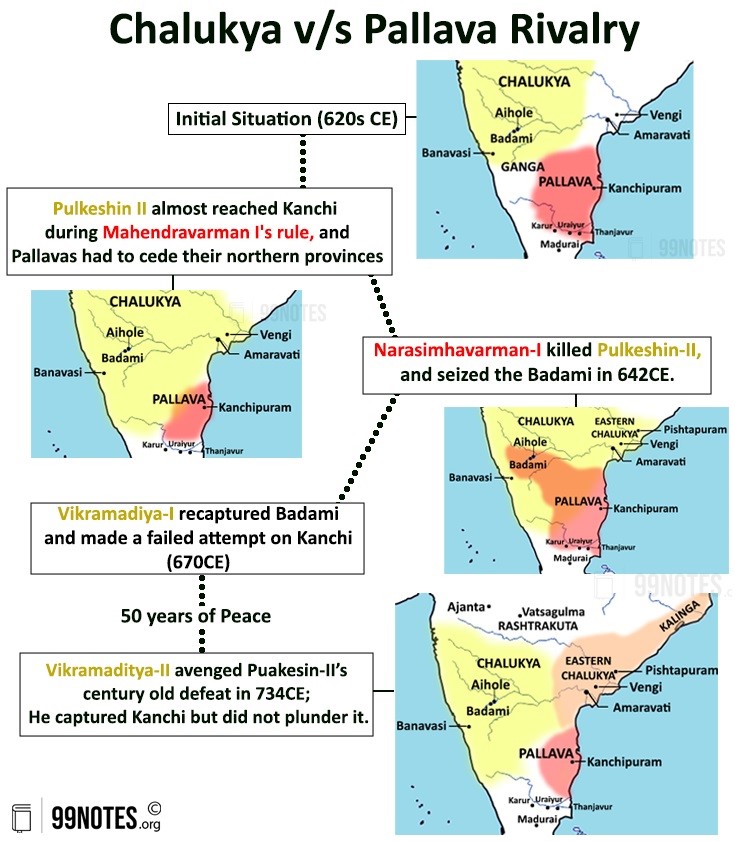
This was not merely a war for glory. As one of the provided resources, "[PDF] UNIT-V TOPIC-1 The Pallavas", astutely notes, the Chalukyas ruled over a largely rocky and less fertile terrain. The raids into the richer Pallava territories were driven by a powerful economic imperative: the need to acquire resources and plunder to sustain the state. This "mutually destructive" conflict was, at its core, a fight for regional economic and political dominance.
The Pallavas: Forging the Dravidian Style
The Pallavas' most enduring legacy lies in their contribution to architecture. They were the pioneers of the South Indian, or Dravidian, style of temple architecture, and their patronage created a clear, evolutionary path from simple rock-cut caves to vast, complex structural temples.
To understand this evolution, let's watch a detailed breakdown.
Ancient History l Pallava Dynasty | Lecture-33 | Abhishek Singh | StudyIQ IAS English
The following video from StudyIQ IAS explains the development of Pallava architecture through four distinct phases, each associated with different rulers and showcasing increasing complexity.
Please watch from 27:33 to 45:37. The video details the two major phases: the initial rock-cut phase (Mahendra and Mamalla groups) and the later structural phase (Rajsimha and Nandivarman groups). Pay close attention to the distinction between rock-cut mandapas, monolithic rathas, and structural temples.
As the video explains, the evolution can be summarized in four stages:
-
Mahendravarman Stage (7th Century): This initial phase involved excavating simple, pillared halls called mandapas directly into rock faces. These were essentially artificial caves and marked the beginning of monumental stone architecture under the Pallavas.
-
Narasimhavarman I / Mamalla Stage (7th Century): Under the great Vatapikonda, architecture became more ambitious. This stage is defined by two key forms, best seen at Mamallapuram (Mahabalipuram):
- Monolithic Rathas: These are free-standing temples, but each is carved from a single, massive block of stone (monolithic). The famous Pancha Pandava Rathas are prime examples, each showcasing a different architectural design, as if they were prototypes.
- Elaborate Mandapas: The cave temples became more complex, featuring ornate carvings and narrative panels, such as the famous 'Arjuna's Penance' or 'Descent of the Ganges' bas-relief.
-
Rajasimha Stage (8th Century): This marks the crucial transition from rock-cut to structural architecture. Instead of carving into rock, temples were now built with cut stone blocks. The two masterpieces of this era are the Shore Temple at Mamallapuram and the magnificent Kailasanatha Temple at Kanchi. These temples feature the characteristic pyramidal tower (Vimana) and enclosed courtyards that would define the Dravidian style.
-
Nandivarman Stage (Late 8th Century): The later Pallavas continued building structural temples, though generally on a smaller scale than those of the Rajasimha period. The Vaikunta Perumal temple at Kanchi is a notable example.
The Chalukyas: A Laboratory of Temple Styles
While the Pallavas forged a distinct southern style, the Chalukyas, whose territory was a cultural crossroads, presided over an eclectic and innovative architectural movement. Their capitals at Badami, Aihole, and Pattadakal became laboratories where different regional styles met and mingled.
Let's explore this unique architectural heritage with one of the world's leading experts.
George Michell on Calukyan Temple Architecture
Dr. George Michell, a renowned architectural historian, provides an expert tour of the key Chalukyan sites in this video from Sahapedia. He explains the significance of their rock-cut caves and the remarkable co-existence and fusion of northern and southern architectural styles.
Please watch from 02:48 to 21:13. This extended segment covers: Badami (02:48-07:40): The rock-cut cave temples. Mahakuta & Pattadakal (07:40-14:26): The appearance of distinct Southern (Dravida) and Northern (Nagara) style temples side-by-side. Pattadakal's Royal Temples (14:26-21:13): The culmination of the Dravida style and early signs of stylistic fusion.
The Chalukyan sites reveal a fascinating story:
-
Aihole: Often called the "Cradle of Indian Temple Architecture," Aihole features over 100 temples in various styles, representing a period of intense experimentation. Temples like the Ladh Khan have a simple, flat-roofed design, while the Durga Temple is notable for its semi-circular, apsidal shape, reminiscent of Buddhist chaitya halls.
-
Badami: Like the Pallavas, the Chalukyas began with rock-cut cave temples. The four caves at Badami, dedicated to Shiva, Vishnu, and Jain Tirthankaras, are famous for their magnificent, large-scale sculptures.
-
Pattadakal: This is the jewel in the Chalukyan crown and a UNESCO World Heritage site. Here, the experimentation of Aihole reached its climax. At this single site, you see fully mature temples built in both the Northern Nagara style (with a curvilinear tower or shikhara) and the Southern Dravida style (with a stepped pyramidal tower or vimana).

This synthesis gave rise to a hybrid style known as Vesara or the 'Chalukyan style,' which incorporates elements from both traditions. The Virupaksha temple at Pattadakal, built in the Dravida style, is particularly significant. It was constructed by Queen Lokamahadevi to commemorate her husband Vikramaditya II's victory over the Pallavas. In a fascinating instance of conflict-driven cultural exchange, sculptors were brought from the Pallava capital of Kanchi to work on this temple, directly infusing Pallava artistry into a Chalukyan royal monument.
Conclusion
The centuries-long rivalry between the Pallavas and Chalukyas was a defining feature of early medieval Deccan, a bloody struggle for resources, territory, and prestige. Yet, this very conflict acted as a powerful catalyst for cultural and artistic achievement. In their quest to outdo one another, these dynasties poured resources into building temples that were not just places of worship, but potent symbols of royal power and piety.
Key Takeaways:
- Political Rivalry: The Chalukya-Pallava conflict was a protracted, see-saw struggle for supremacy in South India, marked by the repeated sacking of each other's capitals—Vatapi and Kanchi.
- Pallava Architecture: The Pallavas were the originators of the Dravidian temple style. Their contribution is marked by a clear evolution from rock-cut mandapas (Mahendra style) and monolithic rathas (Mamalla style) to grand structural temples like the Shore Temple and Kailasanatha temple (Rajasimha style).
- Chalukyan Architecture: The Chalukyas patronized a dynamic architectural movement, particularly at Aihole and Pattadakal. Their kingdom served as a melting pot where the Northern (Nagara) and Southern (Dravida) styles flourished side-by-side, eventually blending into the hybrid Vesara style.
- Conflict and Culture: The rivalry directly fueled architectural development. The desire to commemorate victories and display grandeur spurred immense investment in temple construction, and military campaigns sometimes led to the direct transfer of artistic talent, as seen with the Kanchi sculptors at Pattadakal.
Preview of the Next Lesson:
While kings and empires battled for supremacy, a deeper structural change was occurring in the political economy of India. In our next lesson, we will explore the development of the Samanta system. This complex network of feudal-like relationships between overlords and subordinates reshaped the nature of power and governance, and its rise is crucial to understanding the political landscape of the entire early medieval period.