Welcome. This first module builds a way to compare political and economic systems without relying on labels alone. We begin with the labels themselves. Socialism and communism did not acquire one fixed meaning at birth: their meanings developed among people responding to industrial capitalism, arguing about social change, and choosing names for their movements.
In this lesson, you will trace that development through nineteenth-century examples. The immediate aim is not to decide which modern party or government deserves either label. It is to understand why two writers can use the same words differently—and why neither usage necessarily tells the whole story.
A shared problem, several proposed answers
Industrial production brought factories and growing wealth, but also sharpened questions about poverty, working conditions, and who benefited from production. Early critics did not offer a single alternative. Some imagined deliberately organized communities; others sought to improve workers’ circumstances through education or changes in how society was managed. Their proposals overlapped in their criticism of existing arrangements without being identical plans for ownership or government.
SOCIALISM: An In-Depth Explanation
Watch “SOCIALISM: An In-Depth Explanation” by Ryan Chapman for a short introduction to three early thinkers associated with socialism.
Watch early proposals, from the introduction of Saint-Simon, Fourier, and Owen through the account of Owen’s approach to workers’ conditions. Notice how their proposed remedies differ; do not treat any one proposal as the definition of socialism.
The important historical point is that a family of criticisms need not imply one agreed remedy. People could share concern about the consequences of industrial capitalism while disagreeing over cooperation, reform, political action, and the future organization of production. The terms used to group them were correspondingly unsettled.
Communism also drew on ideas of common life and shared resources, but in the nineteenth century it became closely associated with movements seeking more thorough social change. That association did not make every person called a communist a follower of Marx: communist ideas and movements existed before Marx and Engels wrote their best-known work.
Why the Manifesto was called communist
The cover of the first edition of the Manifesto of the Communist Party, published in February 1848, announces a political choice of name. Its closing appeal calls on workers across countries to unite. The cover tells us what the authors chose to call their movement, but not, by itself, what every contemporary meant by communism or socialism.
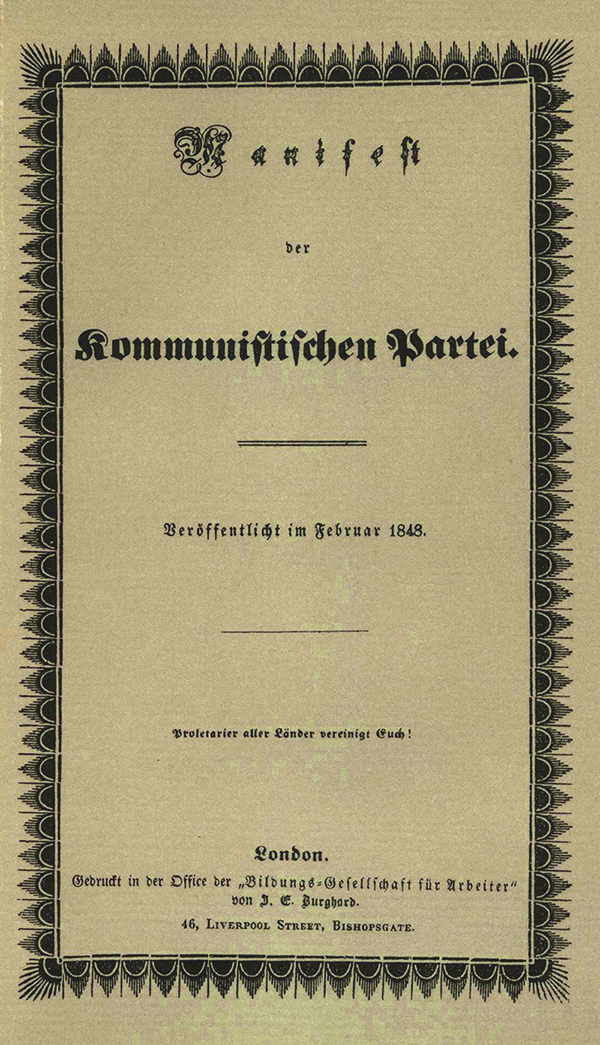
Forty years later, Friedrich Engels looked back on that choice in a preface to the Manifesto. This is a useful primary source: Engels was explaining the movement’s own choice, not writing a neutral dictionary entry. Read his recollection alongside two brief passages from the original text, where Marx and Engels themselves apply socialism to quite different tendencies.
Manifesto of the Communist Party
Read Engels’s “Preface to the 1888 English Edition” and selected passages from Chapter III of Marx and Engels’s Manifesto. They show both a reason for choosing “Communist” and the variety of positions the authors grouped under “Socialist.”
In “Preface to the 1888 English Edition,” find the description of the Manifesto as socialist literature. Read Engels’s explanation through the end of that paragraph. Pay particular attention to his contrast between who was called a socialist and who called themselves communist in 1847, including his qualification “on the Continent at least.” Then go to Chapter III, “Socialist and Communist Literature.” In subsection “2. Conservative or Bourgeois Socialism” (p. 32), read the opening critique. In subsection “3. Critical-Utopian Socialism and Communism” (p. 33), begin at the sentence naming the systems of Saint-Simon, Fourier, and Owen, and read the opening account. Focus on why the authors group these proposals together even as they criticize them.
Engels says that, in his account of 1847, socialist commonly described proponents of schemes who stood outside the working-class movement and looked to educated supporters. Those calling themselves communist, he says, included workers who believed a merely political revolution was insufficient. Marx and Engels chose Communist because they held that workers’ emancipation had to be the work of the working class itself.
That is a historically situated distinction, not an eternal rule that socialists are middle-class and communists are workers. Engels also calls the Manifesto socialist literature in the very passage where he explains why it could not, in 1847, have been titled a socialist manifesto. The contrast makes sense once the time of the label is kept in view: he is looking back from 1888 at the political associations of two names in 1847.
Chapter III adds another caution. Marx and Engels use socialism for positions they strongly oppose, including attempts to ease social grievances while preserving the existing class structure. They also discuss “Socialist and Communist” systems together. Their categories help reveal a crowded nineteenth-century debate; they should not be mistaken for an impartial classification of everyone in it. A label might be claimed by a movement, applied by an opponent, or used by a later historian—and those are not always the same act.
How a later distinction became familiar
Marx did not consistently reserve socialism for one stage and communism for another. Like many nineteenth-century writers, he could use the terms with considerable overlap. In an 1875 work, however, he distinguished a lower and a higher phase of communist society. In the lower phase, distribution still reflected how much work people performed; the higher phase was associated with distribution according to need. Notice Marx’s wording: these were phases of communist society.
The now-familiar formula that calls the earlier phase socialism and the later phase communism was reinforced by Lenin in the early twentieth century. The following short scholarly overview sets out that change and the subsequent influence of communist-party governments on the word’s public meaning.
Communism | Definition, History, Varieties, & Facts | Britannica
Read Britannica’s account of the changing relationship between “socialism” and “communism.” It provides a historical overview to compare with Engels’s first-hand explanation.
In the main article, skip the news items and begin with the opening definition. Read the opening account, ending with its discussion of Marx’s two phases. Then read the Lenin passage immediately following it. Track which distinction is attributed to Marx’s phases and which naming convention is attributed to Lenin; also note the article’s separate point about later associations with states governed by communist parties.
There are now at least three different uses to keep apart:
- A nineteenth-century movement label. In Engels’s account, Communist identified the working-class politics Marx and Engels wanted their 1848 manifesto to represent.
- A distinction between an earlier and a later society. Marx described lower and higher phases of communist society; Lenin later identified the earlier phase as socialism and the later one as communism proper.
- A label associated with governing parties and states. After communist parties took power, many people used communism to refer to those governments and their institutions, whether or not those institutions resembled the ultimate society envisioned in theory.
These uses can overlap in a sentence, but they are not interchangeable claims. “Marx envisioned communism,” “a party called itself Communist,” and “a government was ruled by that party” point respectively to an envisioned society, a political identity, and an institution exercising power. Later lessons will examine those differences in detail.
A dependable way to read the labels
The historical record does not support a single timeless equation such as “socialism means reform, communism means revolution,” or “socialism means government ownership, communism means no government.” Each captures something found in certain traditions while obscuring other uses. Nor does historical variation mean the words are meaningless. It means context is part of their meaning.
When you encounter either term, identify the period and speaker, then distinguish whether the speaker is describing an ideal, a movement’s programme, or institutions that actually governed. That small discipline explains much of the apparent contradiction between Engels’s 1847 contrast, Marx’s overlapping terminology, Lenin’s phase names, and later references to communist-party states.
The key takeaway is that socialism and communism emerged in an overlapping field of nineteenth-century responses to capitalism, while their political associations changed as movements developed. In the next lesson, you will move from names to a more stable comparison: who controls productive assets and who receives their returns under private, state, cooperative, and common ownership.