Hello! Welcome to your first lesson in the SSC English course.
I'm here to guide you on your path to mastering the English section for the SSC CGL exam. Your goal to become an Income Tax Inspector is ambitious, and building a strong foundation in English is a critical step. We'll start from the very beginning, as you requested, focusing on clear rules and a logical structure that will help you build confidence and skill.
Today, we'll tackle the most fundamental concept in English grammar: the basic structure of a sentence. By the end of this lesson, you will be able to identify the subject, verb, and object in simple sentences. This skill is the bedrock upon which all other grammar rules are built. Understanding it will make it much easier to spot errors, understand complex sentences, and correctly answer a wide variety of questions in your exam.
Let's begin.
1. The Core Components of a Sentence
At its heart, a simple English sentence communicates a basic piece of information: Who did What to Whom/What. These three parts are the Subject, the Verb, and the Object.
Think of it like a simple command in a program. For an action to occur, you need an actor (the subject), the action itself (the verb), and sometimes, something that is acted upon (the object).
The most common sentence structure in English follows this exact order: Subject - Verb - Object (SVO).
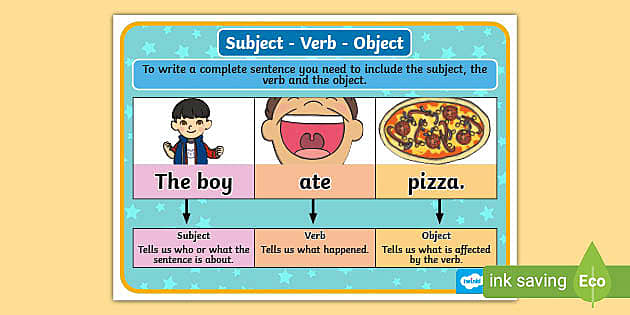
Let's define these terms more formally.
- Subject (S): The person, place, thing, or idea that is performing the action. To find the subject, ask the question: "Who or what is doing the action?"
- Verb (V): The word that expresses the action or a state of being. It's the engine of the sentence.
- Object (O): The person or thing that receives the action of the verb. To find the object, ask the question: "The subject did what?" or "The subject did [the action] to whom/what?"
To get a solid grasp of these definitions, please read the following material from a resource designed for competitive exams.
Sentence Structure - Components, Types and Examples
The article 'Sentence Structure - Components, Types and Examples' from Testbook.com clearly defines the essential parts of a sentence. This will give you a solid theoretical base.
Please read the section titled 'Basic Components and Elements of a Sentence'. Focus on the definitions and examples for 'Subject', 'Verb', and 'Object' (both Direct and Indirect). You can stop reading when you reach the 'Complement' subsection.
2. Seeing the SVO Pattern in Action
Now that you have the definitions, let's see how this pattern works in practice. The best way to internalize this is through simple, clear examples.
The following video provides a straightforward visual explanation with many examples. The color-coding used will help reinforce the S-V-O pattern.
English Sentence Structure: Subject, Verb, Object (SVO) -2025.
This video, 'English Sentence Structure: Subject, Verb, Object (SVO)', provides a very basic and clear walkthrough of the concept with lots of repetition, which is excellent for building a strong initial understanding.
Watch the video from the beginning until 05:41. Pay close attention to how the speaker defines each part and how the examples are broken down into Subject (blue), Verb (red), and Object (green).
Here is another visual to solidify the concept:

Test your understanding!
Using the S-V-O pattern, identify the Subject, Verb, and Object in the following sentence:
The company hired a new manager.
Show answer
- Subject: The company (Who hired a new manager?)
- Verb: hired (What did the company do?)
- Object: a new manager (Whom did the company hire?)
3. A Practical Method for Identifying S, V, and O
To consistently identify these parts, especially in more complex sentences you'll face in the SSC exam, you can use a simple, step-by-step method.
- First, find the Verb. Look for the action word. This is the heart of the sentence.
- Next, find the Subject. Ask, "Who or what is performing this action?" The answer is your subject.
- Finally, find the Object. Ask, "[Subject] [Verb] what or whom?" If there is an answer, that is your object.
Let's apply this to the sentence: The student passed the exam.
- Verb: The action is
passed. - Subject: Who passed?
The student. - Object: The student passed what?
the exam.
So, we have: The student (S) passed (V) the exam (O).
Sentences Without Objects
What happens if there's no answer to the "what or whom?" question? This means the sentence does not have an object.
Example: The baby cried.
- Verb:
cried - Subject: Who cried?
The baby. - Object: The baby cried what? (No answer).
This sentence only has a Subject and a Verb (S-V).
- Verbs that take an object are called transitive verbs (e.g.,
hired,passed,wrote). They transfer their action to an object. - Verbs that do not take an object are called intransitive verbs (e.g.,
cried,slept,arrived). The action is complete on its own.
Recognizing this distinction is crucial. You don't need to force an object where there isn't one.
Test your understanding!
Identify the Subject, Verb, and Object (if any) in these two sentences.
- She painted a beautiful picture.
- The train arrived.
Show answer
- Subject: She, Verb: painted, Object: a beautiful picture. (The verb
paintedis transitive here). - Subject: The train, Verb: arrived, Object: None. (The verb
arrivedis intransitive).
4. A Common Trap: Prepositional Phrases
SSC questions often include extra phrases to confuse you. One of the most common distractors is the prepositional phrase.
A prepositional phrase is a group of words that starts with a preposition (like in, on, at, of, for, with, from) and ends with a noun or pronoun.
Examples:
in the morningon the tableof the studentswith his friend
Here is the most important rule to learn today: The subject and the object of a sentence will NEVER be inside a prepositional phrase.
When you see a sentence, your first step should be to identify and mentally "cross out" all the prepositional phrases. This will make finding the true subject, verb, and object much easier.
Let's look at a tricky sentence:The keys to the car are on the kitchen counter.
- Identify prepositional phrases:
to the car,on the kitchen counter. - Mentally remove them:
The keys are. - Now, find the S and V:
- Verb:
are - Subject:
keys(What are on the counter? The keys).
- Verb:
The following resource explains this concept and provides a useful list of common prepositions.
SOME IMPORTANT NOTES ABOUT SUBJECTS AND VERBS
The document 'SOME IMPORTANT NOTES ABOUT SUBJECTS AND VERBS' offers a very practical trick for finding subjects by ignoring prepositional phrases. This is a high-value technique for your exam.
Please read section 5, titled 'It is important to distinguish SUBJECTS from PREPOSITIONAL PHRASES'. Pay close attention to the list of prepositions and the examples showing how crossing out these phrases helps locate the subject.
Let's try one more example that includes an object.
Sentence: The player with the red jersey kicked the ball into the goal.
- Prepositional Phrases:
with the red jersey,into the goal. - Sentence without them:
The player kicked the ball. - Analysis:
- Verb:
kicked - Subject:
The player(Who kicked?) - Object:
the ball(The player kicked what?)
- Verb:
This simple technique of eliminating prepositional phrases will be invaluable as you start tackling error-spotting questions.
Lesson Summary
You've taken a crucial first step today. Let's recap the key points:
- The basic structure of a simple English sentence is Subject-Verb-Object (SVO).
- The Subject is the doer of the action. You find it by asking "Who or what?".
- The Verb is the action or state of being.
- The Object is the receiver of the action. You find it by asking "[Subject] [Verb] what or whom?".
- Some verbs (intransitive) do not take an object, resulting in an S-V structure.
- A critical strategy for exams is to identify and ignore prepositional phrases, as the subject and object will never be found within them.
What's Next?
Excellent work today. You've learned to identify the "skeleton" of a sentence. In our next lesson, we will move on to the learning outcome: Identify the eight parts of speech (noun, pronoun, verb, etc.). This will help us put "flesh" on that skeleton. You'll learn what types of words can function as subjects, verbs, and objects, which will make your analysis even more accurate and prepare you for more advanced grammar topics.