Welcome to your third lesson. In our previous sessions, we explored the two major sources of distraction: the external world, which triggers your "bottom-up" attention system, and your internal world, governed by the mind-wandering Default Mode Network (DMN). You've expressed a particular interest in "annoyance focus," especially when sounds in your environment become irritating and disruptive.
This lesson dives directly into that experience. We will explore exactly how auditory stimuli, from the subtle hum of an air conditioner to a nearby conversation, compete for your brain's limited attentional resources. You will learn why noise isn't just a psychological annoyance but a physiological event, and you will discover the specific brain circuits that work to filter it out. Understanding this process is key to developing strategies for managing your sound environment, a crucial step toward mastering focus.
1. The Survival Instinct and the Stress of Sound
Why is a sudden noise so hard to ignore? The answer lies in our evolutionary history. For our ancestors, an unexpected sound—a snapping twig, a distant cry—could signal danger. Our brains are therefore wired with a powerful survival instinct to immediately orient toward new auditory stimuli.
While this instinct is rarely needed for survival today, the mechanism remains. When your brain registers persistent or jarring background noise, it doesn't just "get annoyed"; it can trigger a genuine physiological stress response.
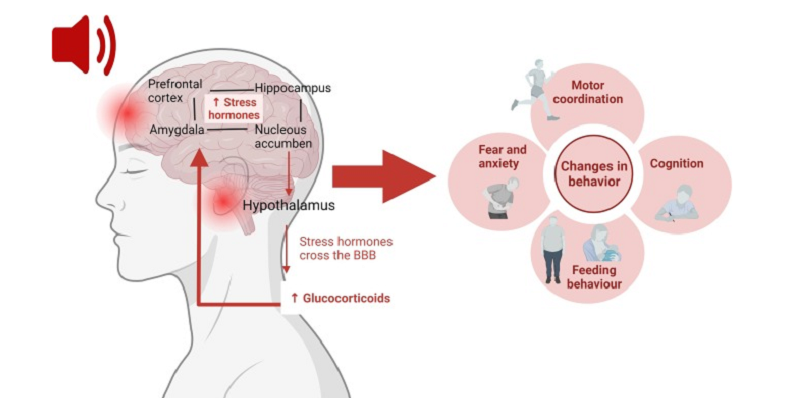
As the diagram illustrates, unwanted noise can activate the hypothalamus, part of the brain's alarm system. This initiates a cascade that results in the release of stress hormones like cortisol. Let's explore this in more detail.
How does background noise affect our concentration?
This article from Scientific American provides a concise explanation of the physiological impact of background noise on concentration.
Please read the section that begins with the question "How does background noise affect our concentration?". Pay close attention to the roles of cortisol and the prefrontal cortex (PFC).
As the article explains, excess cortisol impairs the function of the prefrontal cortex—the very brain region responsible for your "top-down," goal-directed focus. The noise isn't just competing for your attention; it's actively degrading the neural hardware you use to concentrate. The article also mentions that noise-induced stress may reduce dopamine, a neurotransmitter we will explore in our next lesson as it is crucial for motivation and sustained focus.
2. The Brain's "Dimmer Switch": Theories of Auditory Selection
Clearly, we don't give our full attention to every sound we hear. If we did, we'd be in a constant state of overwhelming distraction. Our brains have sophisticated filtering mechanisms to decide what gets through. Cognitive psychologists have developed several theories to explain this process of "selective attention."
To understand these models, please watch the following video from Khan Academy Medicine.
Theories of selective attention | Processing the Environment | MCAT | Khan Academy
This video introduces the core theories of selective attention, explaining how we filter out unimportant information. It uses the classic "cocktail party effect" to make the concepts clear and relatable.
Please watch from the beginning to the end of the main explanation. As you watch, focus on understanding the key differences between these three models: Broadbent's Early Selection Theory (a simple on/off filter) Deutsch & Deutsch's Late Selection Theory (filtering after meaning is processed) Treisman's Attenuation Theory (a 'dimmer switch' or attenuator)
Treisman's Attenuation Theory provides a particularly useful model for our purposes. It suggests that your brain doesn't completely block unattended sounds but rather weakens them. This explains why you can be focused on writing (your "attended" channel) but still have your attention captured when a colleague nearby mentions a project you're on (an "unattended" but meaningful sound). The information is getting through, just at a lower volume. This constant, low-level processing is how auditory stimuli compete for your attention.
3. The "Noise-Cancelling" Circuit in Your Brain
The theories above describe what happens, but how does the brain actually do it? How does it actively suppress distracting sounds? Recent neuroscience has identified a specific "noise-cancelling" circuit that gives us a remarkable look under the hood.
This circuit involves a top-down command from your prefrontal cortex (the CEO of your brain) to the thalamus, which acts as the main gateway for all sensory information. The PFC essentially tells the thalamus which sensory signals to turn down.
How we tune out distractions | MIT News
This MIT News article explains the discovery of the brain circuit responsible for filtering out distractions. It provides a clear, narrative-style breakdown of a complex neural process.
Start by reading the first two paragraphs for an overview. Then, skip to the section that begins, "In the new study..." and read about how the PFC uses the striatum and basal ganglia to control the thalamus. Finally, read the section "Noise sensitivity", which explicitly connects this circuit to blocking out background noise.
This research reveals a beautiful mechanism. Your focus is not just about enhancing one signal but also about actively suppressing all others. When you try to focus on your work in a noisy café, your PFC is sending instructions through the basal ganglia to the thalamus, ordering it to dampen the incoming auditory chaos.
The "annoyance focus" you experience happens when the distracting noise is too loud, unpredictable, or meaningful (like speech) for this circuit to suppress effectively. The filtering effort fails, the stress response kicks in, and your top-down focus collapses.
4. From Science to Strategy: Controlling Your Auditory Space
Understanding these mechanisms gives us the power to be strategic. Instead of simply enduring noise, we can create an auditory environment that supports our brain's natural filtering processes. The goal is to replace unpredictable, high-information noise with a predictable, low-information auditory backdrop.
How To FOCUS In ANY NOISY Environment
This video offers a practical take on managing noise, connecting the brain's instinctual reactions to actionable techniques.
Watch from this section on the brain's wiring. The video introduces the idea of "noise layering" — using sounds like white noise, brown noise, or instrumental music to mask more distracting sounds.
The "noise layering" strategy works because it gives your brain a constant, monotonous soundscape to latch onto. A steady hum of white noise or the predictable rhythm of lo-fi beats contains very little new information. This makes it far easier for your brain's attenuator and the PFC-thalamus circuit to filter out compared to the variable pitch and content of a conversation. You are essentially creating a controlled "bottom-up" signal that masks the more disruptive, unpredictable ones, freeing up attentional resources for your top-down, focused work.
Key Takeaways
- Your brain is wired to react to new sounds as a survival instinct, and persistent noise can trigger a physiological stress response, releasing cortisol that impairs the prefrontal cortex.
- Theories of selective attention, particularly Treisman's Attenuation Theory, suggest our brain uses a "dimmer switch" to weaken, not block, unattended sounds, explaining why some distractions still leak through.
- Your brain has an active "noise-cancelling" circuit where the prefrontal cortex directs the thalamus (your sensory gateway) to suppress specific sensory inputs.
- You can support this filtering process by using "noise layering" (e.g., white noise) to create a predictable auditory environment that masks more distracting, information-rich sounds.
In this first module, we've examined the core neuroscience of attention, from internal distractions (DMN) to external ones (noise). We are now ready to transition from theory to practice. In our next lesson, we will begin building your personal focus toolkit by taking the first practical step: learning how to categorize your daily tasks based on their cognitive demand.