Introduction
In the last lesson, we established the two fundamental sentence patterns in German: declarative statements and yes/no questions. You learned the critical "Verb Second" (V2) rule for statements and the "Verb First" (V1) rule for yes/no questions. This framework is the bedrock for everything that follows.
Today, we complete our initial survey of sentence types by focusing on questions that seek information. These are known as W-Fragen (W-questions) because the question words typically begin with a 'W'. This lesson will teach you how to use the essential W-words: Wer, Was, Wo, Wann, Wie, Warum, Woher, and Wohin. The most important takeaway is that these questions follow the same V2 rule you already mastered for statements, making them remarkably straightforward to construct.
1. The Structure of a W-Question
While a yes/no question begins with the verb, a W-question begins with the W-word itself. The rest of the sentence then follows a very familiar pattern: the conjugated verb takes the second position.
The Rule:
Position 1: W-Word
Position 2: Conjugated Verb
Position 3: Subject
Position 4+: Other information
Let's formalize this.
Mastering German Question Words: How to Use Them ...
This article provides a direct and clear breakdown of the word order for W-questions.
Read the section Basic Question Structure. Pay close attention to the formula presented: Question Word + Conjugated Verb + Subject + Other Elements. Notice how the examples consistently place the verb in the second slot, right after the W-word. This reinforces the V2 rule you learned previously.
As you can see, the structure is a simple variation of the inverted declarative sentence you practiced (Heute arbeite ich.). Instead of a time expression in position 1, you now have a question word.
- Statement: Heute arbeite ich. (Today I work.)
- W-Question: Wo arbeitest du? (Where do you work?)
The verb's position remains fixed. This is the key insight.
2. The Essential W-Words
Now, let's learn the core set of W-words. For each one, focus on its meaning and see how it fits into the structure we just defined.
This video from the "YourGermanTeacher" channel provides a great overview with clear pronunciation and examples. We'll go through it section by section.
Basic German Question Words | All A1 Question Words You Need to Know
This video introduces the most common German question words. Watch the specific segments as instructed below to familiarize yourself with each word.
Wer? (Who?): Watch from this segment. Wer is used to ask about a person. Wer ist das? (Who is that?) Wie? (How?): Watch from this segment. Wie is used to ask about manner or state. Wie geht es Ihnen? (How are you? - formal) Wie heißt du? (What is your name? - literally "How are you called?") Was? (What?): Watch from this segment. Was is used for things or actions. Was ist das? (What is that?) Was machst du? (What are you doing?) Wo? (Where?): Watch from this segment. Wo asks for a static location. Wo wohnst du? (Where do you live?) Woher? (Where from?): Watch from this segment. Woher asks about origin. Woher kommst du? (Where are you from?) Wohin? (Where to?): Watch from this segment. Wohin asks about a destination. Wohin gehst du? (Where are you going?) Wann? (When?): Watch from this segment. Wann asks about time. Wann beginnt das Meeting? (When does the meeting begin?) Warum? (Why?): Watch from this segment. Warum asks for a reason. Warum lernst du Deutsch? (Why are you learning German?)
3. Special Focus: Location vs. Origin vs. Destination
The distinction between Wo, Woher, and Wohin is a common challenge but can be mastered with a clear rule. It's about whether you are asking about a static position, a starting point, or a destination.
- Wo? asks about a fixed location. The answer often uses prepositions that indicate a static place, like in (in) or auf (on).
- Wohin? asks about movement towards a destination. The answer often uses prepositions indicating direction, like in die (into the) or nach (to).
- Woher? asks about movement from an origin. The answer often uses prepositions like aus (from) or von (from).
The following infographic provides a perfect summary of this concept.
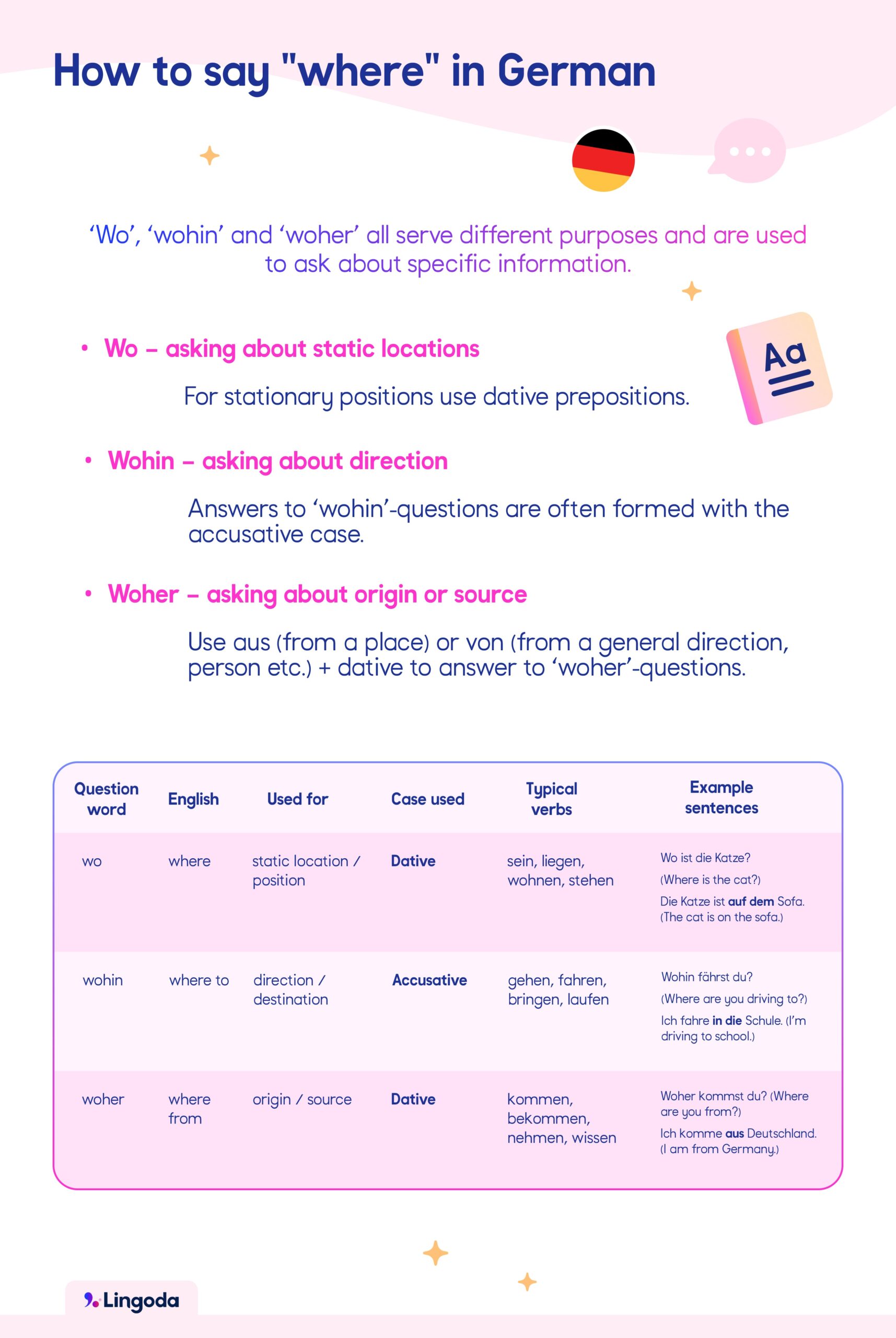
This infographic from Lingoda clearly distinguishes between 'Wo' (static location), 'Wohin' (direction/destination), and 'Woher' (origin/source), highlighting the typical verbs and case usage for each.
To see this distinction explained in a real-life context, watch this short segment.
W-Fragen in German A1 | How to ask questions in German | German Basics for Beginners
This "Five Minute German" video uses a travel scenario to make the difference between these three W-words very clear.
Watch the explanation starting from this point. Notice how the questions change depending on whether the officer is asking about the origin (Woher), destination (Wohin), or current location (Wo).
4. Practice Task: Formulating Questions
Let's put this into practice. For each task, write down your answer and say it aloud.
Part A: Form the Question
Based on the answer provided, write the correct W-question.
- Answer: Ich lerne Deutsch.
Question: ______________________? - Answer: Das Meeting ist um 14 Uhr.
Question: ______________________? - Answer: Ich komme aus Frankreich.
Question: ______________________? - Answer: Ich wohne in Paris.
Question: ______________________? - Answer: Ich gehe ins Büro. (I'm going to the office.)
Question: ______________________?
Part B: Unscramble the Sentences
Arrange the words to form a correct W-question.
du / heißt / wieSie / arbeiten / wo(formal 'you')heute / was / du / machstder Zug / ab / wann / fährt(abfahren = to depart; it's a separable verb, but the rule still applies to the conjugated part fährt)
Model Answers:
Part A:
- Was lernst du?
- Wann ist das Meeting?
- Woher kommst du?
- Wo wohnst du?
- Wohin gehst du?
Part B:
- Wie heißt du?
- Wo arbeiten Sie?
- Was machst du heute?
- Wann fährt der Zug ab?
Conclusion
You have now learned how to ask for information using the core German W-words. This skill, combined with your knowledge of statements and yes/no questions, gives you the grammatical tools to handle a wide range of basic conversational exchanges.
Key Takeaways:
- Structure: W-questions follow the V2 rule: W-word + Verb + Subject.
- Core W-Words: You learned the meaning and use of Wer (who), Was (what), Wann (when), Wie (how), and Warum (why).
- Location vs. Direction: You can now distinguish between asking about a static location (Wo?), an origin (Woher?), and a destination (Wohin?).
In our next lesson, we will cover another essential building block of communication: negation. You'll learn how to use nicht and kein to say "no" or "not," allowing you to negate any of the statements and questions you can now form.