Hello! Welcome back to our course on investing.
In our last lesson, you learned the critical skill of evaluating ETFs by analyzing their expense ratio, holdings, and assets under management. You now have a framework for selecting a quality investment. Today, we shift from selection to execution. We'll focus on a powerful strategy for building your wealth steadily over time: Dollar-Cost Averaging (DCA).
This lesson will teach you how to implement a disciplined, consistent investment strategy. For a long-term investor, mastering this method is fundamental. It's not just a technique; it's a mindset that helps you navigate the market's ups and downs with confidence, which aligns with your interest in managing the psychological aspects of investing.
What is Dollar-Cost Averaging (DCA)?
At its core, dollar-cost averaging is a simple but powerful concept: you invest a fixed amount of money at regular intervals, regardless of what the price of the investment is doing.
For example, you might decide to invest $200 into an S&P 500 ETF on the 1st of every month.
- If the ETF price is high, your $200 buys fewer shares.
- If the ETF price is low, your $200 buys more shares.
This process automatically forces you to buy more when things are "on sale" and less when they are expensive. Over time, this smooths out your average purchase price.
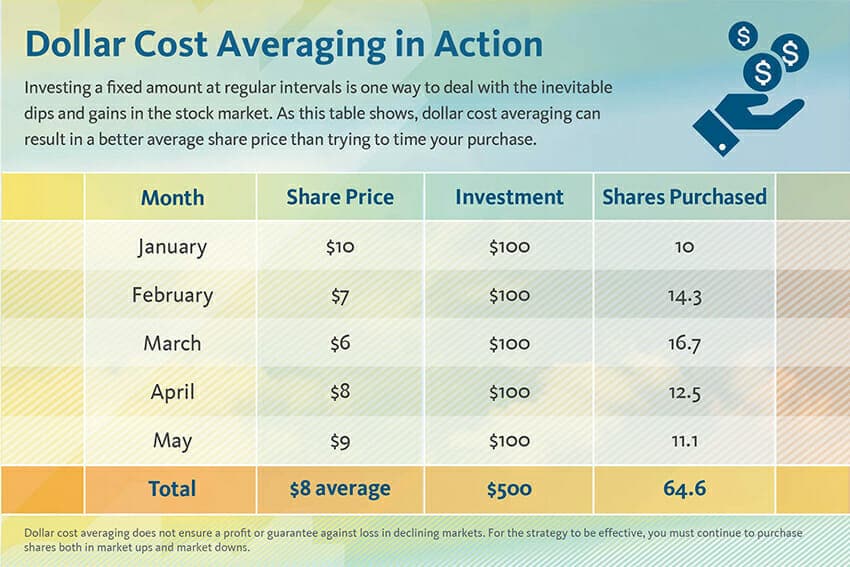
To get a formal definition and a quick example, please watch this first segment of the following video.
Best Investing Strategy for Beginners: Dollar Cost Averaging
The video 'Best Investing Strategy for Beginners: Dollar Cost Averaging' by Joyee Yang provides a crystal-clear definition of DCA.
Please watch from 01:40 to 02:45. Focus on the core definition and the simple example of buying an ETF at different prices.
The Power of DCA: A Numerical Example
Let's look at a more detailed example to see how DCA can work in practice. The following article from Bankrate provides a table showing a hypothetical $300 monthly investment over a 10-month period.
Guide To Dollar-Cost Averaging: How To Build Wealth ...
This section of the 'Guide To Dollar-Cost Averaging' from Bankrate provides an excellent table that brings the concept to life with concrete numbers.
Please read the section titled 'Example of dollar-cost averaging' and study the table carefully. Pay close attention to the final outcome at the end of 10 months.
As you saw in the example, the total value of the investment after 10 months was $3,251.85 on a total contribution of $3,000. This is an 8.4% gain, even though the fund's price only rose by 5% (from $100 to $105). The extra return came from accumulating more shares during the price dips in months 2, 4, 5, 6, and 7. This is the mathematical advantage of DCA.
Why Use DCA? The Psychology of Consistent Investing
The biggest benefit of DCA might not be mathematical, but psychological. One of the greatest challenges for any investor is managing emotions like fear and greed. DCA provides a system to bypass these emotional traps.
- It removes the need to "time the market." Trying to buy at the absolute bottom and sell at the absolute top is nearly impossible. DCA accepts this and focuses on consistency instead of prediction.
- It combats fear and hesitation. When markets fall, it's natural to be scared to invest. But with an automated DCA plan, you continue to buy, taking advantage of lower prices. As the famous investor Warren Buffett says, "Be fearful when others are greedy, and greedy when others are fearful."
- It prevents FOMO (Fear Of Missing Out). When markets are soaring, the temptation is to throw a large sum of money in at the peak. DCA keeps you disciplined, preventing you from over-investing at potentially inflated prices.
This next video clip explains these psychological benefits very well.
Best Investing Strategy for Beginners: Dollar Cost Averaging
Joyee Yang's video continues by explaining how DCA helps you avoid common emotional pitfalls that trip up many new investors.
Watch from 03:23 to 05:10. Focus on how a systematic approach helps you avoid emotional decisions related to FOMO and panic selling.
The power of continuing to invest during a downturn is shown perfectly in the chart below.
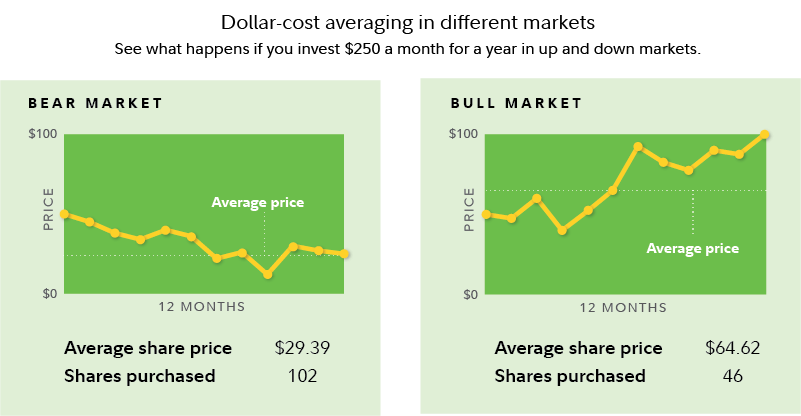
This illustrates why market downturns can be an opportunity for a long-term investor using DCA.
How to Implement DCA: Putting Your Investments on Autopilot
Now for the most important part: the "how-to." Your goal should be to make this process as automatic as possible. The general steps are:
- Decide what to invest in. (e.g., a low-cost, broad-market ETF you selected using the skills from our last lesson).
- Determine how much you can consistently invest. Start with an amount you are comfortable with and won't need for at least 3-5 years. Consistency is more important than the amount.
- Set up the automation. This usually involves two parts: automating the transfer of cash from your bank, and automating the investment of that cash.
Many modern brokerage platforms make this incredibly easy. Let's see an example of how to set up recurring investments for an ETF on a user-friendly platform.
Best Investing Strategy for Beginners: Dollar Cost Averaging
This part of Joyee Yang's video is a practical, step-by-step tutorial on setting up a recurring investment plan. While it uses a specific app, the principles apply to most modern brokers.
Watch from 05:10 to 06:39. Follow the steps to see how you can schedule a recurring purchase of a specific stock or ETF.
An Important Practical Note:
The ability to directly automate ETF purchases, as shown in the video, is common but not universal. Some brokers, especially older, more established ones, may only allow full automation for mutual funds. For stocks and ETFs, they might only allow you to automate the first step: the cash transfer from your bank to your brokerage account. You would then need to log in manually to make the purchase.
The following video discusses this exact distinction on the Charles Schwab platform.
Automate Your Investments at Charles Schwab
In his video 'Automate Your Investments at Charles Schwab', Alex Quinn explains the difference in automation capabilities between mutual funds and ETFs on that platform. This is a common real-world scenario you should be aware of.
Watch the beginning from 00:00 to 00:40 and the end from 06:41 to 07:50. This will show you how some platforms differentiate their automation features and what the two-step semi-manual process for ETFs looks like.
Your Universal Action Plan:
When you're ready to start, log into your brokerage account and look for "recurring" or "automatic" investments.
- If you can set up a recurring purchase for an ETF: Great! Set up the amount, frequency, and which ETF you want to buy.
- If you can't: Don't worry. Simply set up a recurring cash transfer from your bank to your brokerage account for a specific day (e.g., the 15th of the month). Then, set a recurring calendar reminder for yourself a day or two later to log in and manually buy your chosen ETF with the transferred cash.
Common Mistakes to Avoid
DCA is effective, but only if you stick with it. Here are some common pitfalls that can undermine the strategy.
Best Investing Strategy for Beginners: Dollar Cost Averaging
To wrap up, let's review three critical mistakes to avoid when using DCA, as explained by Joyee Yang. Learning from others' mistakes can save you a lot of trouble.
Watch from 06:58 to 09:57. Pay close attention to the three mistakes: improper budgeting, starting too late, and especially, stopping your plan during a market dip.
The third mistake—stopping DCA during a market dip—is the most destructive. It's the equivalent of stopping your grocery shopping just because everything went on sale. The whole point of DCA is to keep buying through the entire market cycle to lower your average cost.
Test your understanding!
You've set up a DCA plan to invest $200 every month into VOO, an S&P 500 ETF. After six months of consistent investing, the stock market enters a correction, and VOO's price drops by 15%. You feel nervous seeing your account value decrease.
What is the most logical action to take, according to the principles of dollar-cost averaging, and why?
Show answer
The most logical action is to continue investing your $200 as planned.
Why: The core benefit of DCA is that it allows you to buy more shares when prices are low. The 15% price drop means your fixed $200 investment will now purchase more shares of VOO than it did in previous months. By continuing to invest, you are taking advantage of the "sale" and lowering your overall average cost per share. Pausing or stopping your investments out of fear would defeat the purpose of the strategy and cause you to miss the opportunity that the market dip provides.
Conclusion
You now have a complete understanding of one of the most reliable strategies for long-term investing. Dollar-cost averaging is your tool for building wealth methodically and with discipline.
Key Takeaways:
- What it is: Investing a fixed amount of money at regular intervals.
- Why it works: It averages your purchase price, forcing you to buy more shares when prices are low, and removes emotion from your investment decisions.
- How to implement it: Automate the process through your brokerage by setting up recurring investments, or at a minimum, recurring cash transfers followed by manual purchases.
- The Golden Rule: Stick with the plan, especially during market downturns. That is when DCA is most powerful.
In our next and final lesson of this module, we will put everything together. You know how to evaluate an ETF and you have a strategy for investing in it. Next, we will discuss how to build a simple, diversified portfolio using a small number of these funds to achieve your long-term goals.