Hello! Welcome to your first lesson in Module 2: Setting Up Your Investment Hub.
In our last lesson, we wrapped up the fundamentals by learning how to calculate the value of your personal stock positions. This was the final theoretical piece of the puzzle. Now, we move from "what is the stock market?" to "how do I participate in it?"
Today's lesson addresses the very first practical step every investor must take: choosing a home for their investments. Our learning outcome is to identify key features to consider when choosing a brokerage firm (e.g., fees, tools, account types). A brokerage firm is the company that will give you access to the stock market, so making an informed choice is crucial. Since you're interested in both long-term investing and active trading, we'll look at features that are important for both styles.
What is a Brokerage Firm?
Before you can pick one, let's clarify what a brokerage firm does. In simple terms, it's a financial institution that acts as a middleman, or broker, connecting you to the stock exchanges where stocks are bought and sold. You can't just walk up to the New York Stock Exchange and buy shares of Apple; you need a licensed firm to do it for you.
To get a solid overview of their role, please read the first part of this article from Fidelity.
This article, 'What is a brokerage firm?', clearly explains the essential functions that a brokerage firm performs for investors.
Please read the section titled 'What is a brokerage firm?'. Focus on the four main functions listed: ensuring secure transactions, providing research, offering different account types, and simplifying account management.
As you've just read, brokerage firms do more than just execute trades. They:
- Safeguard your assets with security measures and SIPC insurance.
- Provide research and tools to help you make decisions.
- Offer various account types for different goals (e.g., retirement, general investing).
- Consolidate everything on a website or app for easy management.
Key Features to Consider When Choosing a Brokerage
Now for the main event. Choosing a broker isn't about finding the one "best" firm, but the one that is best for you. This involves weighing several factors against your personal needs. Let's break them down.
1. Fees and Costs
Fees are a direct drag on your investment returns, so minimizing them is critical. The era of "zero-commission" trading has made this easier, but there are still various costs to watch for.
The following video provides an excellent, practical comparison of the fees and other features at three of the largest brokerage firms: Fidelity, Charles Schwab, and Vanguard. It will give you a real-world sense of how these factors differ.
How To Choose The Best Brokerage Account For Beginners
Watch this segment from the Wealth Twins video 'How To Choose The Best Brokerage Account For Beginners' to understand the different types of fees and how they compare across major firms.
Watch the section on fees, which starts at 07:37 and ends at 11:04. Pay close attention to the different types of fees discussed: annual account fees, expense ratios on funds, and commission fees.
To summarize and expand on what you saw, here are the main fees to investigate:
- Trading Commissions: Fees for buying or selling a stock or ETF. Many brokers now offer $0 commissions for online stock and ETF trades.
- Account Maintenance/Inactivity Fees: Some firms charge an annual fee just for having an account, or if you don't trade often. As the video noted, this can be a key differentiator.
- Expense Ratios: This is a fee specific to funds (like ETFs and mutual funds), not the brokerage firm itself. It's charged by the fund manager as a percentage of your investment. Even a small difference (e.g., 0.03% vs. 0.15%) adds up significantly over time.
- Other Fees: Look out for less obvious costs like fees for wire transfers, paper statements, or closing your account.
2. Account Types
Brokerages offer different types of accounts tailored to specific financial goals. Your interest in tax-advantaged accounts like IRAs is a great starting point. The two primary categories you'll encounter are:
- Taxable Brokerage Accounts: These are general-purpose investment accounts with no special tax benefits and no limits on how much you can contribute. You have the flexibility to withdraw your money at any time.
- Tax-Advantaged Retirement Accounts: These include Traditional IRAs, Roth IRAs, and employer-sponsored plans like 401(k)s. They offer significant tax benefits (either now or in retirement) but have strict rules about contributions and withdrawals.

We will dive deep into the specifics of these accounts in a later module, but for now, the key takeaway is to ensure the brokerage firm you choose offers the account types you need. Most major firms offer both taxable and retirement accounts.
3. Investment Selection and Account Minimums
Not all brokers offer the same menu of investments or have the same requirements to get started.
How To Choose The Best Brokerage Account For Beginners
Let's return to the Wealth Twins video. This next segment discusses investment minimums and the availability of fractional shares—two features that are especially important for new investors.
First, watch from 00:48 to 04:15 to learn about investment minimums. Then, watch from 12:31 to 16:09 to understand what fractional shares are and why they are useful. Note how different firms handle these offerings.
Here's a breakdown of what to look for:
- Account Minimum: The amount of money required to open an account. Many online brokers have a $0 minimum.
- Investment Minimum: The minimum amount needed to invest in a specific product, like a mutual fund. As the video explained, this is where a firm like Vanguard can have higher barriers ($1,000-$3,000 for many of their popular mutual funds).
- Range of Investments: Does the broker offer what you want to trade? This includes stocks, ETFs, mutual funds, bonds, and for more advanced trading, options and futures.
- Fractional Shares: This feature allows you to buy a "slice" of a stock for as little as $1. It's incredibly useful for investing small, consistent amounts and for buying into high-priced stocks (like a company trading at $1,000/share) without needing to afford a full share.
4. Platform, Tools, and Research
Since you'll be managing your investments online, the quality of the broker's website and mobile app is vital. A good platform makes investing easier; a bad one can be a source of frustration.
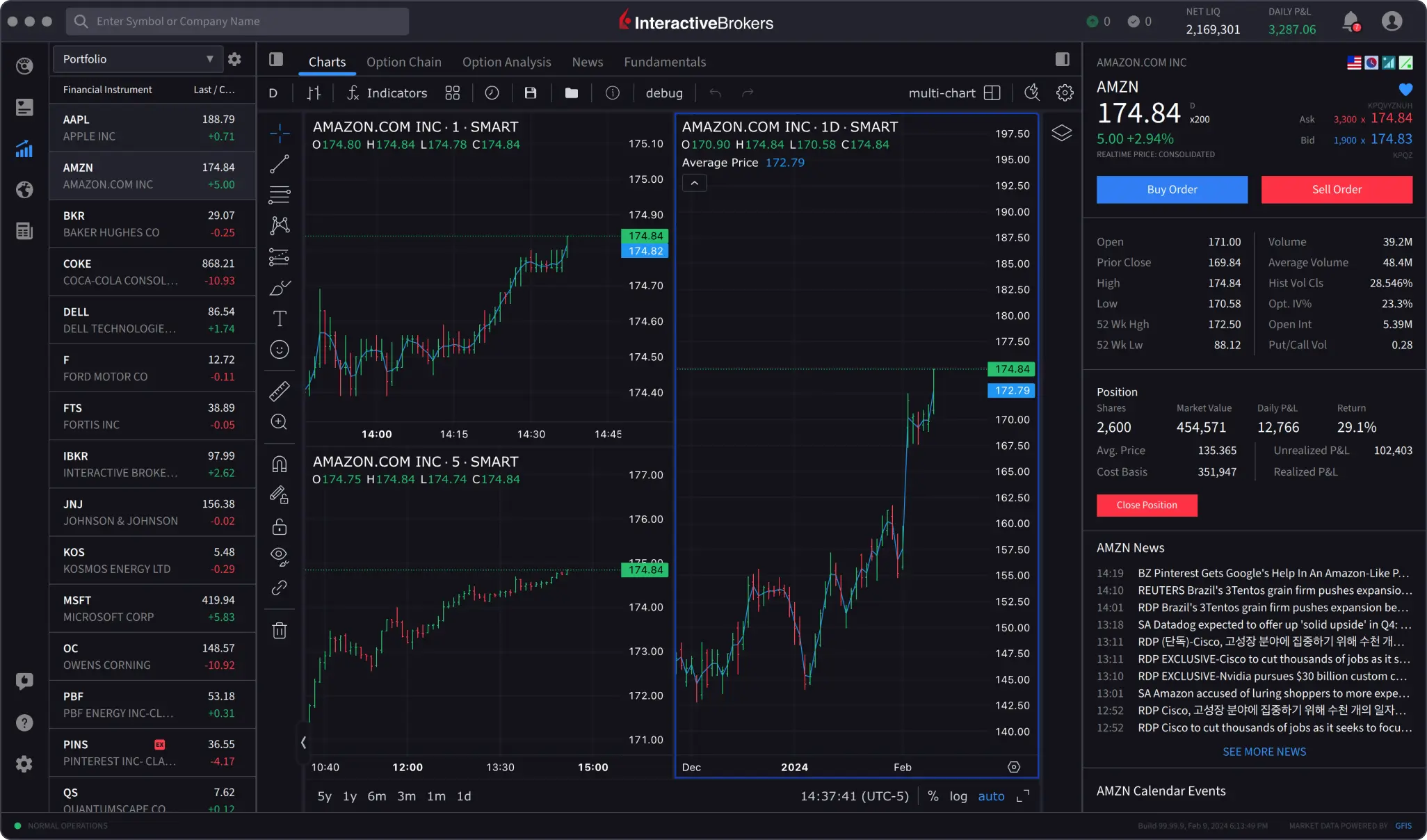
Here's what to consider:
- Ease of Use (UI/UX): Is the platform intuitive? Can you easily find your account information, search for stocks, and place trades?
- Trading Tools: For your interest in active trading, look for features like advanced charting, drawing tools, and technical indicators.
- Research: Many brokers provide access to third-party analyst reports, stock screeners (to filter stocks based on criteria like market cap or P/E ratio), and educational content.
- Customer Service: For beginners, good customer service can be a lifeline. Can you easily reach a human on the phone for help, or is it limited to email or a chatbot? The Wealth Twins video (resource LINK, section from 23:24) offered great insights into how service levels can differ.
Test your understanding!
Imagine two investors:
- Investor A (The Active Trader): Wants to day trade volatile, high-volume stocks. They plan to make dozens of trades per week.
- Investor B (The Long-Term Investor): Wants to invest $200 every month into a few broad-market ETFs and hold them for decades.
For each investor, which of the following features would be most important?
- Low-cost ETF expense ratios
- Availability of fractional shares
- Advanced charting tools and fast trade execution
- Annual account fees
Show answer
-
For Investor A (The Active Trader): Advanced charting tools and fast trade execution would be paramount. Since they are trading frequently, the quality of the trading platform and the speed at which their orders are filled are critical to their success. Low commissions (ideally $0) are also essential.
-
For Investor B (The Long-Term Investor): Low-cost ETF expense ratios and the availability of fractional shares are most important. Low expense ratios will maximize their long-term growth. Fractional shares will allow them to invest their fixed $200 amount fully across their chosen ETFs, regardless of the share prices.
5. Broker Type and Your Investing Style
Finally, it's helpful to understand that brokers can be categorized by the level of service they provide.
This article from Investopedia, 'How to Choose a Broker,' provides a great summary of the different types of brokers and how your investing style influences your choice.
Read the sections 'Full-Service Brokers vs. Discount Brokers' and 'Investment Styles'. This will help you understand the difference between service models and connect them to your dual goals of trading and long-term investing.
As the article explained, the main types are:
- Full-Service Brokers: Offer a wide range of services, including personalized financial advice, retirement planning, and estate planning. They typically charge higher fees for this hands-on guidance. (e.g., Morgan Stanley, Merrill Lynch).
- Discount Brokers: Focus on providing a platform for you to execute your own trades at a low cost. They offer research tools and education but generally don't provide personalized advice. Most well-known online brokers fall into this category (e.g., Fidelity, Charles Schwab, E*TRADE).
- Robo-Advisors: A newer, automated alternative. They use algorithms to build and manage a diversified portfolio for you based on your goals and risk tolerance, typically for a very low fee (e.g., Betterment, Wealthfront).
For your goals, a major discount broker is likely the best fit. They provide the low costs and powerful tools needed for active trading while also offering the excellent selection of low-cost ETFs and retirement accounts needed for long-term investing.
Conclusion
You are now equipped with a comprehensive checklist to evaluate and choose a brokerage firm. There's no single right answer, only the right fit for your specific needs.
Here are the key takeaways from today's lesson:
- A brokerage firm is your gateway to the stock market, providing the platform to buy, sell, and manage investments.
- Fees are paramount: Look for $0 commissions, no account fees, and low expense ratios on the funds you plan to buy.
- Account types matter: Ensure the broker offers both the taxable and retirement accounts (like a Roth IRA) that align with your goals.
- Tools and usability are key: A good platform makes investing easier. For active trading, advanced tools are essential. For beginners, fractional shares are a game-changer.
- Your style dictates your choice: As someone interested in both active trading and long-term investing, you need a versatile platform that excels at both.
In our next lesson, we will continue setting up your investment hub by taking a closer look at two fundamental account settings you'll encounter when opening your account: cash accounts and margin accounts, and we'll explain the significant risks associated with using margin.