Hello! Welcome to the final lesson in our module on Active Trading Strategies.
In our last session, we built a solid foundation in swing trading by learning to identify key continuation and reversal patterns on multi-day charts. This taught us to read the "story" of a stock over several days or weeks.
Today, we will focus on a very specific, powerful, and fast-moving event that active traders love: the price gap. Your goal for this lesson is to learn how to apply basic gap trading strategies, specifically the "Gap and Go" and "Gap Fill." These strategies are staples in the world of day trading and can offer high-probability setups if you know what to look for.
Let's dive into these exciting, event-driven opportunities.
What is a Price Gap?
A price gap is an area on a chart where no trading occurred. It happens when a stock's opening price is significantly higher or lower than the previous day's closing price. These jumps are usually triggered by significant overnight news, like an earnings report, a new product announcement, or a major industry development. This creates a sudden, intense imbalance between buyers and sellers.
To see what this looks like in practice, let's watch a clear explanation of a "gap up."
The Simplest Day Trading Strategy: Gap and Go ↗️📈 #stockmarket #daytrading
In the video 'The Simplest Day Trading Strategy: Gap and Go', Ross Cameron from Warrior Trading explains what a gap is using a real-world example. This will give you a concrete visual of the phenomenon.
Watch from 03:42 to 05:49. Pay close attention to how he defines a 'gap up' and highlights the role of news as the catalyst for such a dramatic price move.
As you saw, a gap represents a powerful shift in market sentiment. Traders classify gaps to better understand their potential implications. While there are several types, the most important distinction for a trader is whether the gap signals the start of a new move or the end of an old one.

Now that we know what a gap is, let's explore the two primary ways traders try to profit from them.
Strategy 1: The "Gap and Go" (A Momentum Strategy)
The "Gap and Go" is a pure momentum strategy. The core idea is that the strong buying (or selling) pressure that caused the gap will continue after the market opens, pushing the price even further in the same direction.
This strategy is especially effective with stocks that have a low float. As a quick reminder, "float" is the number of shares available for public trading. A low float means a smaller supply of shares. When a low-float stock has good news and high demand, the price can move explosively because there simply aren't enough shares to meet the buying interest. This supply-demand imbalance is a concept straight from economics that you'll see play out daily in the market.
Let's see how a professional trader identifies and executes this strategy.
The Simplest Day Trading Strategy: Gap and Go ↗️📈 #stockmarket #daytrading
Let's return to the same Ross Cameron video. He will now walk through the 'Gap and Go' strategy itself, including how to find candidates and what to look for as an entry signal.
Watch the following segments carefully: Finding Gappers (06:14 - 09:04): Notice how he uses a 'gap scanner' to find stocks that are gapping up significantly (e.g., >20%). He filters by criteria like price and float. The Importance of Float (10:34 - 13:12): This is a key concept. Understand why a low float creates the potential for a 'parabolic' move due to the supply/demand equation. The 'Gap and Go' Setup (13:12 - 18:44): Focus on the specific entry points discussed, especially the break of the pre-market high. This is a classic, actionable entry trigger for this strategy.
The "Gap and Go" Playbook:
- Identify: Before the market opens, use a scanner to find stocks gapping up significantly (e.g., >10-20%) on high pre-market volume. Check for a news catalyst and a relatively low float.
- Plan: Mark the pre-market high on your chart. This is the key resistance level that needs to break.
- Execute: When the market opens, if the stock breaks out above the pre-market high with strong volume, it triggers a long entry. The momentum is confirmed.
- Manage: This is a fast-moving trade. Traders often take profits quickly as the initial momentum surge fades.
Strategy 2: The "Gap Fill" (A Reversal Strategy)
What if the initial momentum of the gap fails? Sometimes, a stock gaps up, but the buying pressure isn't strong enough to sustain the move. Early buyers take profits, and sellers step in, pushing the price back down.
This creates an opportunity for a "Gap Fill" trade. The idea is that the price will reverse and fall all the way back down to "fill" the empty space on the chart, returning to the previous day's closing price.
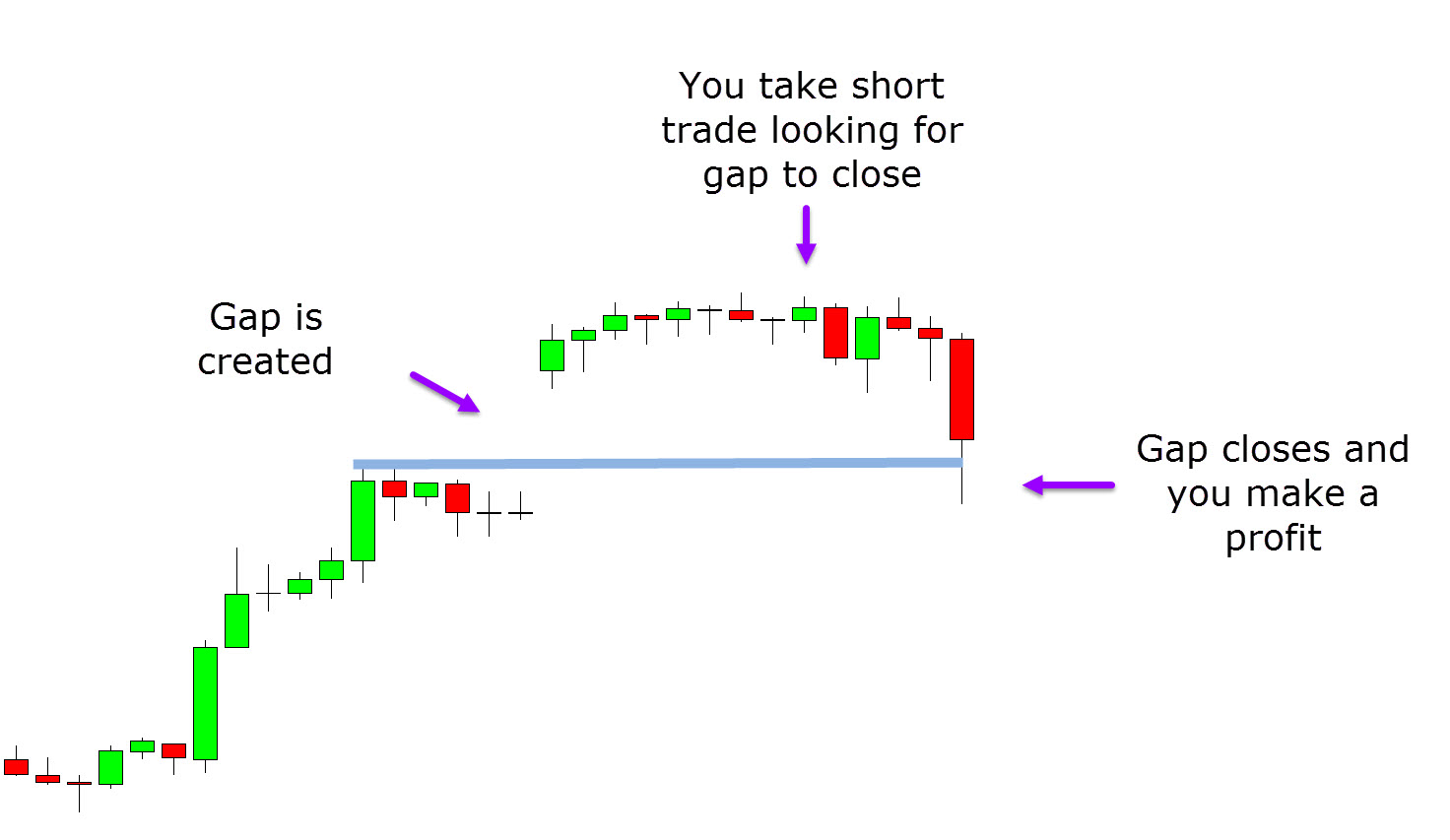
Let's watch a video that explains this concept in more detail.
In 'Day Trading Gaps and Windows', Ross Cameron explains the psychology behind the gap fill strategy and what it looks like on a chart.
Watch two key sections: Defining the Gap Fill (00:45 - 02:53): Focus on how a gap creates an area with no support or resistance, allowing the price to move quickly to 'fill' it once it starts reversing. Context is Key (04:18 - 09:32): This part is crucial. He explains that gap fill strategies are most reliable on stocks with high relative volume. A stock with low volume and no catalyst is unlikely to have the momentum to complete the fill. He also discusses how 'bag holders' (traders stuck in a losing position) can create resistance.
The "Gap Fill" Playbook:
- Identify: A stock gaps up significantly but shows signs of weakness at the open. It fails to break the pre-market high and starts trading downwards.
- Plan: The target for the trade is the price level where the gap began (the previous day's high or close).
- Execute: A trader would enter a short position as the stock shows clear downward momentum, with the expectation that it will continue to fall until the gap is filled.
- Manage: The target is well-defined, providing a clear exit point for the trade.
Test your understanding!
It's 9:00 AM, and you see a stock, XYZ, that closed at $50 yesterday. This morning, it's trading at $60 in the pre-market due to great earnings news. It has a low float and very high pre-market volume. The highest price it reached in pre-market trading was $62.
At the market open (9:30 AM), the stock's price immediately pushes past $62.
- Based on this information, which strategy seems more appropriate: "Gap and Go" or "Gap Fill"?
- What was the specific event that would trigger an entry?
Show answer
- The "Gap and Go" strategy is more appropriate. The stock has all the classic signs: a strong catalyst (earnings), high volume, a low float, and it's showing immediate strength at the open.
- The trigger was the price breaking above the pre-market high of $62. This confirms the initial momentum is continuing, which is the core of the "Gap and Go" thesis.
From Theory to a Practical Framework
You now know the two main approaches to trading gaps. To bring this all together, let's look at a structured guide that outlines the different types of gaps and the strategies associated with them.
Gap Trading Strategies: How to Trade the Gap (Beginner's ...
The article 'Gap Trading Strategies' from tastylive provides an excellent written summary of everything we've discussed. It clearly defines the strategies and the types of gaps you might encounter.
Read the following three sections: 'Gap types in trading': This reinforces the different classifications like Breakaway and Exhaustion gaps. 'What does it mean “a gap is filled?”': A concise definition of the concept we just covered. 'Trading the gap strategies': This is the most important part. Review the descriptions for the Gap Filling Strategy and the Gap and Go Strategy. Notice how they align perfectly with what we saw in the videos.
For an even more rule-based approach, which can be helpful as you start, some traders use time-based rules. For example, the article "Gap Trading Strategies" from ChartSchool suggests waiting for the first hour of trading to complete (from 9:30 AM to 10:30 AM ET) to see where the stock settles. Then, you could place a buy order above the high of that first hour or a short-sell order below the low of that first hour. This is a more patient method that waits for the initial chaotic open to resolve.
Conclusion
Congratulations on completing the Active Trading Strategies module! Today, you've added a powerful, event-driven setup to your toolkit. Trading gaps requires quick thinking and a solid understanding of momentum, but the logic is rooted in the fundamental principles of supply and demand that you're becoming familiar with.
Key Takeaways:
- Price Gaps are significant price jumps between trading sessions, usually driven by news.
- The "Gap and Go" strategy is a momentum play, betting that a strong stock will continue in the direction of the gap, often triggered by a break of the pre-market high.
- The "Gap Fill" strategy is a reversal play, betting that a weak gap will fail and the price will return to the previous day's close.
- Key factors for successful gap trading include a strong catalyst, high relative volume, and understanding the stock's float.
A Look Ahead: The Most Important Module
You've learned how to find stocks, read charts, and identify compelling trade setups like breakouts and gaps. But none of this matters if you don't protect your capital. Identifying a good entry is only one small part of trading.
In our next module, Risk Management and Portfolio Maintenance, we will cover the single most important topic for your long-term survival as a trader. We'll start with the foundational rule of professionals: applying the 1-2% risk rule per trade to preserve trading capital. This is where successful trading truly begins.