Hello again. In the previous lesson, you mapped planned course work to AZ-900 and DP-900 objectives using Direct, Supporting, and Gap labels. That tracker is useful not only for certification study: it is the raw material for a credible entry-level résumé and for interview answers.
This lesson turns course artifacts into career evidence. You will learn to distinguish a learning exercise from portfolio evidence, select the strongest artifacts as the course progresses, write honest résumé statements, and prepare interview examples that explain your decisions—not merely the Azure tools you encountered. This is especially important during a career transition: projects can demonstrate applied capability, but only when their business purpose, scope, and your individual contribution are clear.
From course activity to employment evidence
Completing a worksheet, watching a tutorial, or earning a badge is useful learning. It is not automatically portfolio evidence.
A hiring manager reviewing an entry-level candidate is usually trying to answer a few practical questions:
- Can this person understand a business problem?
- Can they turn it into an organized technical or information-management approach?
- Can they explain their choices and limitations clearly?
- Can they use relevant tools carefully?
- Can they show what they actually did?
A portfolio project does not have to be a production system used by a real company. In this course, many scenarios will be fictional or guided. That is acceptable, provided you describe them accurately. A well-documented fictional customer-service architecture is stronger than a vague claim to have “implemented enterprise cloud governance.”
A useful distinction is:
| Type of work | Main purpose | Usually public portfolio evidence? |
|---|---|---|
| Learning exercise | Build familiarity with one concept or tool | Usually no; retain it privately as working evidence |
| Supporting artifact | Demonstrate a discrete skill, such as a SQL query set or an entity-relationship diagram | Sometimes; include if it supports a larger case study |
| Portfolio case study | Show how you addressed a realistic business problem through connected decisions and artifacts | Yes; this is the main item to feature |
| Certification | Validate foundational knowledge against an exam blueprint | Yes, after it is earned; it complements rather than replaces project evidence |
For example, a single query that filters customer records is a useful learning exercise. A small case study that starts with poorly defined customer data, models the entities, writes quality checks, explains the business consequences of duplicate records, and recommends a governed target state is portfolio evidence. The SQL matters, but it is not the whole story.
Christine Jiang’s Hiring Manager Explains: Data Portfolio Do’s and Don’ts makes the same central distinction: projects intended for practice are different from projects that demonstrate how technical work supports a business question.
Hiring Manager Explains: Data Portfolio Do’s and Don’ts
Watch “Hiring Manager Explains: Data Portfolio Do’s and Don’ts” from Christine Jiang for a practical view of what makes a project readable and business-focused rather than a collection of tool exercises.
Watch a strong portfolio to see why a clear business question, findings, and recommendations should lead the project narrative. Then watch the resume example for the components of an achievement-oriented project bullet: work performed, meaningful scope, tools, and the audience or decision supported. Notice that the point is not to copy the example’s metrics, but to report only the scope you can substantiate.
The evidence test
As you complete future course work, assess each artifact against six questions:
- Problem: What business or operational problem does it address?
- Artifact: What can another person inspect—a diagram, decision matrix, query, configuration screenshot, glossary, policy, or README?
- Reasoning: What decision did you make, and why was it appropriate?
- Validation: How did you check the design, data, rule, or workflow?
- Scope: What did you personally create, and what was simulated, guided, assumed, or unfinished?
- Explanation: Could you explain it clearly in two minutes to a non-technical manager?
An artifact that answers at least four or five of these questions is a good candidate for retention. The best capstone artifacts will answer all six.
One important rule follows: do not invent business impact. If a project was not deployed, do not claim that it “reduced costs by 30%” or “improved customer satisfaction.” You can still state meaningful results:
- “Produced a decision-ready design with documented assumptions and controls.”
- “Identified three duplicate-data risks and defined quality checks for each.”
- “Created and tested a workflow that routes invalid submissions to an exception notification.”
- “Compared four Azure data-storage options against latency, structure, governance, and cost criteria.”
Those are real outcomes of a project.
Which course artifacts will be strongest?
You are still at the beginning of the course, so the purpose now is to identify what to preserve as you build it. Do not try to publish every exercise. Aim eventually for two or three coherent case studies, supported by selected smaller artifacts.
The table below identifies likely evidence from this course and the type of entry-level role it can support.
| Planned evidence | What it can demonstrate | Strongest relevance |
|---|---|---|
| Information-requirements brief with KPIs, source data, quality, access, and timeliness needs | Requirements analysis; translating a vague business issue into measurable needs | Business analyst, data analyst, information-management coordinator |
| Context diagram and information-flow diagram | Understanding systems, users, boundaries, sources, and destinations | Junior architecture, data operations, cloud support |
| Entity-relationship diagram, normalized model, and SQL query set | Relational thinking, data structure, basic SQL, data validation | Data analyst, junior data engineer, database support |
| Subject-area map and target-state conceptual architecture | Ability to connect business capabilities, applications, information domains, and principles | Information architecture, business analysis, data governance |
| Microsoft Purview glossary, metadata, classifications, and RACI | Governance roles, discoverability, ownership, and accountable decision-making | Data governance analyst, information-management analyst |
| Azure storage decision matrix and data-lake zone design | Evaluating cloud data services against requirements rather than choosing tools by name | Cloud data support, junior data engineer, architecture support |
| Data Factory pipeline and workflow automation | Integration concepts, operational controls, guided Azure implementation | Data operations, automation support, junior data engineer |
| Data-quality scorecard and remediation workflow | Quality measurement, threshold-based controls, ownership, issue resolution | Data-quality analyst, governance analyst |
| Grounded AI architecture and AI risk-control matrix | Modern information architecture, responsible AI, access and governance thinking | Information-management or governance roles with AI exposure |
| Final Azure target-state architecture and governance pack | Connected thinking across business requirements, cloud services, governance, privacy, cost, integration, and AI | Your flagship portfolio case study |
A portfolio does not need to prove that you are already a senior cloud architect. At entry level, its job is to show that you can analyze a problem, follow disciplined methods, make reasonable choices, and learn from constraints.
Select evidence according to the role, not just the tool
The same project can be framed differently depending on the job description.
| If the role emphasizes… | Lead with evidence such as… | Do not lead only with… |
|---|---|---|
| Data governance | Purview glossary, ownership model, classifications, retention rule, quality escalation | “I used Microsoft Purview” |
| Cloud data operations | Storage-service decision, redundancy choice, pipeline controls, cost tags | A list of Azure service names |
| Data analysis | Information requirements, SQL, data-quality checks, findings and recommendations | Screenshots of query output without interpretation |
| Architecture support | Current-state issue map, target-state diagram, assumptions, trade-offs, principles | A visually attractive diagram with no narrative |
| Automation support | Workflow trigger, validation rule, approval or exception path, test evidence | “Built a Power Automate/Logic Apps flow” |
This is why a generic project name such as “SQL Project 1” is weak. A title should reveal the business context and the question addressed. Compare:
- Generic: “Azure Data Factory Pipeline”
- Better: “Customer-Data Intake Pipeline with Validation and Exception Routing”
- Generic: “Purview Assignment”
- Better: “Governance Pack for a Customer Information Domain”
- Generic: “Cloud Architecture Diagram”
- Better: “Target-State Architecture for Secure Customer-Service Reporting”
If a case uses invented data or a fictional organization, label it clearly: “Simulated case study using synthetic customer-service data.” Transparency increases credibility.
Turn evidence into résumé statements
A résumé has little space. Its purpose is to make a reviewer want to inspect your portfolio or speak with you. It should not attempt to explain every technical decision.
The University of Maryland Global Campus Career Services article emphasizes the difference between listing duties and describing accomplishments. It also notes that technical projects can serve as practical experience for entry-level candidates and career changers.
Why These Essential Elements Create a Strong Technology Resume | UMGC Career Services Connection
Read this UMGC Career Services article to see how a résumé moves from vague responsibilities toward concrete project evidence and outcomes.
In the “A Clear and Targeted Professional Summary” section, read the summary rationale, then continue through the “Technical Skills,” “Work/Professional Experience,” and “Technical Projects” sections. In “Technical Projects,” focus on the project guidance. As you read, notice the recurring pattern: specific action, relevant scope, and an outcome rather than a list of duties.
A practical bullet structure
For a project artifact, use this structure:
Action verb + what you created or analyzed + scope/context + important method or technology + decision, control, or result.
The order can vary, but the reader should quickly find each element.
| Weak or risky statement | Why it is weak or risky | More credible version once completed |
|---|---|---|
| “Learned Azure, SQL, and Purview.” | Shows study, not evidence of application | “Built a simulated customer-information case study using SQL data-quality checks, a governance glossary, and an Azure target-state design.” |
| “Implemented enterprise data governance.” | Overstates a course project as organizational implementation | “Created a governance pack for a simulated customer domain, including ownership roles, glossary terms, classification decisions, and an escalation path.” |
| “Created an Azure architecture.” | Does not reveal the problem, decisions, or scope | “Designed a target-state Azure information architecture for a customer-service reporting scenario, documenting data flows, access assumptions, service trade-offs, and retention controls.” |
| “Used Data Factory to copy data.” | Describes a tool action without a reason or control | “Built and tested a guided Azure Data Factory copy pipeline for a small dataset, documenting source, destination, validation steps, trigger choice, and exception handling.” |
Use numbers only when they are meaningful and verifiable. Good project metrics might include:
- number of entities, data-quality rules, source systems, glossary terms, or architecture alternatives analyzed;
- size of a synthetic or public dataset;
- number of test cases passed;
- defined recovery, completeness, or timeliness thresholds.
For example, if it is true of your finished work:
“Modeled six customer-service entities, assigned primary and foreign keys, and wrote validation queries to identify null, duplicate, and invalid records in a simulated dataset.”
That is stronger than “Practiced database design,” but it does not claim an unproven business impact.
Keep skills and evidence separate
Your skills section should be short, grouped, and aligned to the target role. It is an index, not proof.
For example, after you have genuinely used these items, a skills section might be organized as:
- Data and modeling: SQL, relational modeling, data quality, metadata
- Azure and integration: Azure Storage, Azure Data Factory, Microsoft Purview, Microsoft Entra fundamentals
- Architecture and governance: information flows, data classification, RACI, retention, access-control concepts
- Documentation: architecture diagrams, decision matrices, technical README files
Then let your projects demonstrate the claims. Do not list a service merely because you watched a video about it or saw it in a certification guide.
Similarly, list AZ-900 or DP-900 under certifications only after passing the exam. Before then, your projects and coursework are better evidence of active preparation.
Prepare interview examples with STAR
A project gets attention on a résumé; your explanation determines whether it becomes convincing interview evidence.
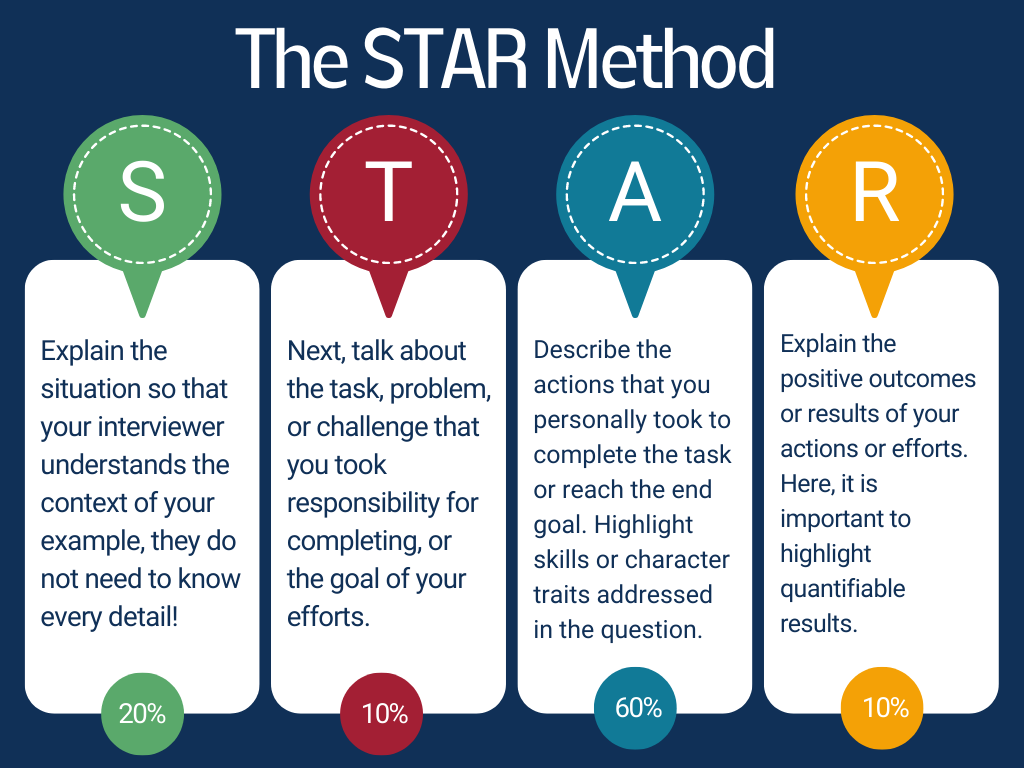
The University Career Center’s STAR guidance is particularly useful because it stresses both specificity and individual contribution: even when work occurs in a group, describe your actions.
Interviewing Resources | University Career Center
Read the University Career Center’s STAR Technique guidance to structure project stories for behavioral interview questions.
In the “The STAR Technique” section, read from the four STAR components. Focus especially on the distinction between a general claim (“I handle data problems well”) and one specific project event, as well as the instruction to keep the Action portion centered on your own work.
A portfolio-based STAR example
Imagine you have completed a later course case study involving duplicate customer records. This is a model for structure, not a script to memorize.
| STAR element | Example content |
|---|---|
| Situation | “In a simulated customer-service reporting case, customer data came from a CRM export and a support spreadsheet. The records used inconsistent identifiers, which made reporting unreliable.” |
| Task | “I needed to identify the data-quality risks and propose a governed approach for creating a trusted customer view.” |
| Action | “I profiled the data for missing and duplicate values, mapped the information flow, defined a customer glossary term, assigned owner and steward roles, and documented matching and survivorship assumptions. I then created a target-state diagram and a remediation workflow for unresolved duplicates.” |
| Result and reflection | “The result was a documented, reviewable design containing quality rules, ownership, and an escalation path. Because the case was simulated, I did not claim production improvement; instead, I identified the controls that would need validation before deployment. I learned that matching logic without accountable ownership would not resolve the business problem.” |
This answer is credible because it names the scenario, your contribution, the artifacts produced, and a limitation. A thoughtful limitation is not a weakness. It shows that you understand the difference between a design proposal and a deployed service.
STAR is not the answer to every question
Use STAR primarily for behavioral questions:
- “Tell me about a time you solved a problem.”
- “Describe a project where requirements were unclear.”
- “Tell me about a difficult trade-off.”
- “Give an example of how you handled data quality.”
For a technical project question—“Walk me through your Azure data architecture”—start with a concise problem-and-outcome summary, then move into the architecture:
- Business problem: Who needed what decision or capability?
- Design: What did you propose or build?
- Key trade-off: What alternatives did you consider, and why did you select this approach?
- Controls: How did governance, security, quality, cost, or reliability affect the design?
- Scope: What was tested, simulated, or left for a later implementation phase?
This sequence prevents a common mistake: beginning with a long list of Azure services before the interviewer knows why the architecture exists.
Cloudtechexec’s Azure-project video illustrates this distinction well: it contrasts a tool-first description with a business-outcome-first explanation.
5 Azure Projects That Will Get You Hired (Build These Before You Apply)
Watch the closing portion of Cloudtechexec’s “5 Azure Projects That Will Get You Hired” for a cloud-focused example of how to describe a project as problem-solving rather than as a list of services.
Watch framing the project and focus on the contrast between naming Azure components and explaining the business problem the components address. Then watch public evidence for the suggestion to document one design decision and its rationale. Apply that idea only to work you can safely share; never publish credentials, connection strings, personal information, proprietary material, or sensitive screenshots.
Build an evidence record as you go
Waiting until the end of the course to reconstruct your work will make résumé writing much harder. After each substantial artifact, create a short evidence record in a private notes file or in the project README.
Use these headings:
| Evidence-record field | What to capture |
|---|---|
| Project title | A business-oriented title, not a course-unit name |
| Context | The fictional, public, synthetic, or guided nature of the scenario |
| Business question | The decision, risk, or operational problem addressed |
| My contribution | The diagrams, rules, queries, configurations, or documentation you personally created |
| Key choices | One to three decisions and their rationale |
| Validation | Tests, review criteria, data checks, or assumptions used |
| Result | Deliverables produced; only measured outcomes you can substantiate |
| Limitations and next step | What would need testing, approval, or implementation in a real organization |
| Résumé bullet | One evidence-based line tailored to a target job family |
| Interview story | A brief STAR outline with an emphasis on your actions |
This habit produces a useful compounding effect. By the capstone, you will not merely have a folder full of diagrams and screenshots. You will have a defensible explanation of how each artifact relates to a business need, a role, and a technical or governance decision.
For public case studies, a clear README should normally let a reviewer understand the following in less than a minute:
- The problem and intended audience.
- The architecture or information-management approach.
- The key artifacts or diagrams.
- The major choices and trade-offs.
- The controls, assumptions, and limitations.
- The most important recommendation or next implementation step.
Keep the public presentation simple. One readable diagram and a concise narrative are more valuable than a large collection of disconnected screenshots.
Key takeaways
Portfolio evidence is not a list of tools studied. It is inspectable proof that you can address a realistic information or cloud-data problem through sound reasoning and clearly documented work.
- Preserve artifacts that show a business problem, your decisions, validation, scope, and a clear explanation.
- Build toward two or three connected case studies rather than publishing every learning exercise.
- Write résumé bullets around action, scope, method, and real result—without inventing production impact.
- Tailor which artifacts you emphasize to the role: governance, data operations, analysis, automation, or architecture support.
- Use STAR for behavioral interview stories, with most detail on your actions and an honest result or reflection.
- Capture an evidence record after each major project so the final portfolio, résumé, and interview preparation draw from the same accurate source.
This completes the first module’s foundation and career-landscape work. Next, you will move into how enterprise information systems function: applications, databases, file stores, APIs, compute, networks, and the paths information takes between them.