Hello, and welcome to the first lesson in Enterprise Information Management and Cloud Information Architecture. This opening module builds the vocabulary needed to discuss enterprise information clearly before moving into systems, data models, cloud services, governance, and Azure.
The words data, information, metadata, and knowledge are often used casually as if they mean the same thing. In an enterprise, the distinction matters: it affects what is stored, how assets are cataloged, who can trust them, and how decision-makers act on them. By the end of this lesson, you should be able to classify each term using a realistic business example—and explain why metadata is essential rather than merely administrative detail.
From recorded facts to decisions
A useful starting point is the DIKW model: data, information, knowledge, and wisdom. It describes how meaning and usefulness can grow as recorded facts are organized, interpreted, and used in judgment.

The pyramid is a helpful mental model, but do not treat it as an automatic assembly line. An organization can have enormous quantities of data and still make poor decisions if the data is inaccurate, poorly understood, or used without appropriate business context.
Data-Information-Knowledge in 3 minutes or less
Watch Data-Information-Knowledge in 3 minutes or less from KnowledgeMT for a compact first explanation of the distinction between raw facts, organized information, and contextual know-how.
Watch data and information to see the movement from unorganized facts to data that answers a meaningful question. Then watch knowledge, focusing on the idea that knowledge includes context, experience, and practical understanding rather than simply a larger report.
Here is the core vocabulary:
| Term | Working definition | Typical question it helps answer |
|---|---|---|
| Data | Recorded facts, observations, events, or measurements. On their own, they may have limited meaning. | “What was recorded?” |
| Information | Data organized and placed in context for a particular purpose. | “Who, what, where, or when?” |
| Knowledge | A reusable, evidence-based understanding of patterns, relationships, causes, or effective practices. | “How or why does this happen?” |
| Wisdom | Sound judgment about what action to take, including trade-offs and consequences. | “What should we do?” |
| Metadata | Data that describes, structures, manages, or governs another data or information asset. | “What is this asset, where did it come from, and can I use it?” |
The important distinction is purpose and context, not whether something happens to be a number, a spreadsheet, or a paragraph of text.
Consider a retailer’s order-management system:
Order A-1042,SKU LAMP-18, quantity2, order date, shipping address, and delivery status are data: facts recorded as an order is placed and fulfilled.- A weekly operations report stating, “14% of West-region orders were delivered late last week” is information. It organizes order data around a business question: what happened, where, and when?
- After reviewing several months of data, the fulfillment team finds that orders containing a particular product, shipped from a particular warehouse, are frequently late because replenishment arrives after the daily dispatch cutoff. That tested explanation is knowledge.
- Choosing to reposition stock, change the replenishment schedule, or alert customers earlier is an act of wisdom. It requires the knowledge above, but also budget, customer impact, contractual obligations, and management judgment.
Notice that the weekly report does not automatically become knowledge. It becomes knowledge only when analysis and experience produce a reliable understanding that can guide future action.
The Data-Information-Knowledge-Wisdom Pyramid
Read DataCamp’s concise introduction to the DIKW model. It provides definitions first, then shows how the same progression appears in business functions such as sales, marketing, product development, and finance.
Begin with the four definitions near the top of the page. Focus on the differences between “organized and contextualized” information and interpreted knowledge. Then move to the “Sales Example: Customer Relationship Management” section and read the CRM example. As you read, trace one path: individual interactions, performance metrics, a sales pattern, and then a decision about lead prioritization.
A crucial qualification: categories depend on the question
The same item can serve different roles in different situations.
For example, the number 14% could be:
- information for an operations manager reading a late-delivery dashboard;
- data for an analyst combining it with other measures in a forecasting model;
- a value accompanied by metadata when a catalog records that the metric is named “Late Delivery Rate,” is calculated weekly, and excludes customer-caused delays.
So, instead of asking “Is this number data or information forever?”, ask:
For whom, in what context, and for what decision is this being used?
This habit is foundational in information architecture. Architects make the context explicit: which systems create facts, which processes transform them into usable information, which people rely on them, and which definitions make their meaning consistent.
Metadata: the context that makes assets usable
Metadata is sometimes introduced as simply “data about data.” That definition is correct, but incomplete in practice. Metadata is the context that enables people and systems to find, interpret, trust, protect, and manage an asset.
Suppose a team finds a file called orders_final_v3.csv in cloud storage. The rows in the file may contain useful order data, but several critical questions remain:
- Is this the current approved version?
- Who is accountable for it?
- What does
delivery_statusmean? - Is it safe to share outside the operations team?
- Where did the file originate?
- How often is it refreshed?
- Does it include personal data?
- How long must it be retained?
The answers are metadata. Without them, a technically accessible file may be operationally unsafe or analytically misleading.
Read IBM’s explanation of metadata to connect the basic definition to the kinds of details enterprises need to manage data assets.
In the opening “What is metadata?” section, read the definition and customer-orders example. Distinguish the dataset itself from facts about its owner, file type, tables, and relationships. Then, in “Types of metadata,” read the five metadata types. Pay particular attention to administrative metadata—ownership, permissions, and retention—and technical metadata—formats, structures, and storage details.
A practical enterprise catalog entry for the retailer’s Order Fulfillment Dataset might contain the following metadata:
| Metadata category | Example for the dataset | Why it matters |
|---|---|---|
| Descriptive | Name: “Order Fulfillment Dataset”; description: “Daily order and shipment status records” | Helps people discover and understand the asset. |
| Business | Definition of “late delivery”; business owner: Head of Fulfillment | Ensures that teams interpret key terms consistently. |
| Technical | Source: order-management database; format: Parquet; fields and data types; storage location | Helps engineers and analysts process the asset correctly. |
| Operational | Refresh frequency: daily at 06:00; last successful load; data-quality status | Helps users judge freshness and reliability. |
| Governance and security | Classification: Internal; contains delivery addresses; retention period; permitted access groups | Supports appropriate handling, privacy, and compliance. |
| Lineage | Created from order, shipment, and warehouse-management sources | Lets users trace where results came from. |
Some organizations use slightly different labels for these categories, but the underlying purpose is consistent: an information asset needs enough context to be safely understood and used.
Metadata is not merely an IT concern
Metadata connects business work to technical systems. A business manager may care about the definition and owner of “on-time delivery.” A data engineer may need table names, data types, and pipeline schedules. A governance specialist may need classification, access rules, and retention obligations. An information architect needs to see how these elements fit together.
Later in the course, Microsoft Purview will provide a practical setting for this work. It is a data-governance service that can catalog assets and connect them to business terms, classifications, owners, and lineage.
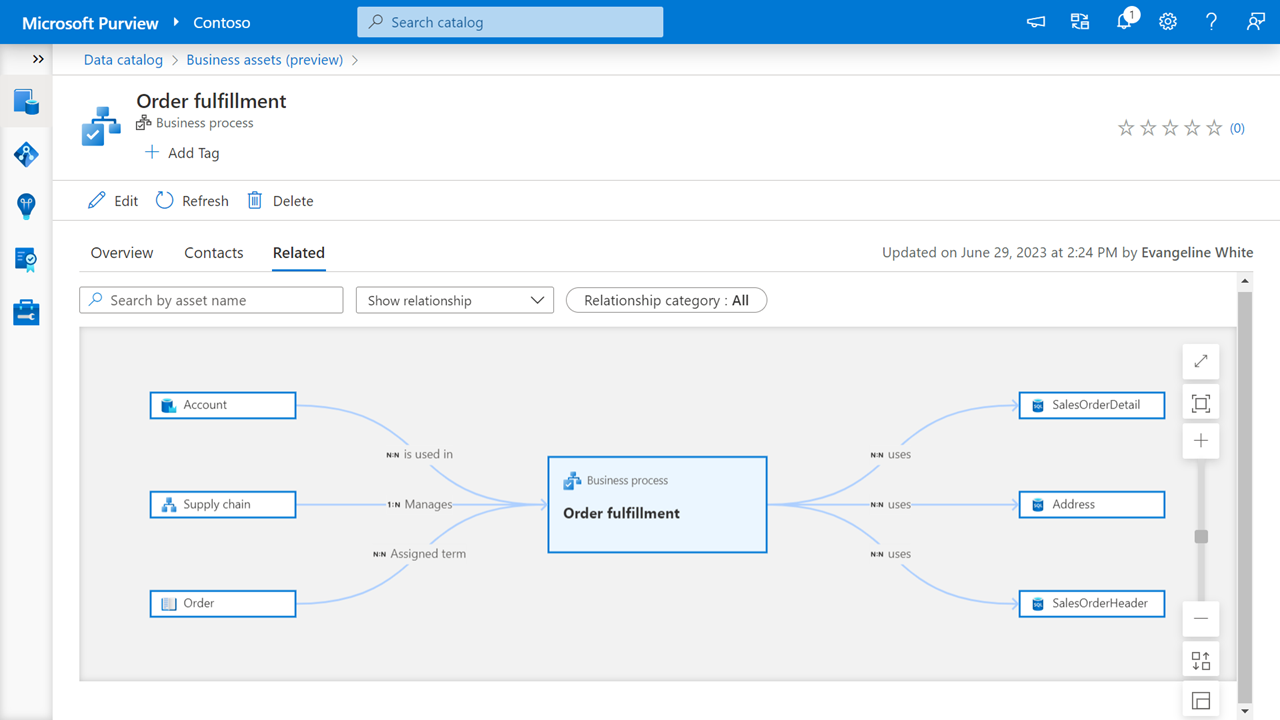
The Purview view is not a diagram of the order records themselves. It is a view of relationships around information assets: which business process uses them, what other assets connect to them, and how a person might navigate from a business concept to technical data.
Applying all four concepts to one enterprise scenario
Let’s keep the retailer example together and classify its assets carefully.
| Enterprise artifact | Primary classification | Reason |
|---|---|---|
A record that shipment S-8801 left Warehouse East at 14:32 |
Data | It records a specific event. |
| A dashboard showing shipment volume and late-delivery rate by warehouse for the current week | Information | It aggregates and presents data for a defined operational purpose. |
| An analysis showing that a recurring cutoff-time mismatch causes most late deliveries for a product category | Knowledge | It identifies and explains a repeatable pattern that can guide future work. |
| A decision to move inventory closer to demand, after weighing cost, risk, and service levels | Wisdom | It applies knowledge and judgment to choose action. |
| The approved definition of “late delivery” | Metadata | It describes how a key metric should be understood. |
| The dataset’s owner, source system, refresh schedule, sensitivity label, and retention rule | Metadata | These facts describe and govern the dataset rather than describe an individual order. |
Two details are especially important.
First, knowledge may live in people as well as systems. A long-serving fulfillment manager may know that a weekly delay spike usually follows a supplier’s month-end shipping pattern. That expertise is knowledge. A well-managed enterprise tries to capture important knowledge in documented procedures, definitions, decision records, training, and analytical models so it is not lost when an individual changes roles.
Second, metadata is itself data. A field such as owner = Fulfillment Operations is stored as data somewhere. It is called metadata because its role is to describe or govern another asset—the Order Fulfillment Dataset. This “relative to what?” test resolves much of the apparent confusion.
A reliable way to classify a new artifact is to apply this short diagnostic:
- Is it a recorded observation, transaction, or measurement? Start by treating it as data.
- Has it been organized to answer a defined business question? It is information.
- Does it explain a pattern, cause, or effective action that can be reused? It is knowledge.
- Does it describe the meaning, structure, origin, ownership, quality, access, or lifecycle of another asset? It is metadata.
- Is someone choosing a course of action amid trade-offs? That is wisdom.
These classifications can overlap in a real organization. What matters is explaining the asset’s role precisely enough that business and technical teams can act consistently.
Key takeaways
- Data consists of recorded facts, such as individual customer interactions, order events, or financial transactions.
- Information is data organized and contextualized for a purpose, such as a sales report or fulfillment dashboard.
- Knowledge is an evidence-based, reusable understanding of patterns, causes, and effective practices; it is more than a report.
- Metadata describes and governs information assets. It enables discovery, interpretation, trust, access control, retention, lineage, and technical use.
- Wisdom is the use of knowledge and judgment to make an appropriate decision. It is useful in the DIKW model, even though the central enterprise-management distinction in this lesson is data, information, metadata, and knowledge.
- Classification is contextual: the same value may be data in one workflow and information in another.
Next, you will build on this vocabulary by classifying enterprise content as structured, semi-structured, or unstructured—a distinction that strongly influences where information is stored, how it is integrated, and how it is governed in cloud environments.