Welcome back to our exploration of ancient Indian philosophy. In our previous lesson, we catalogued the raw materials of history—the textual, archaeological, and linguistic sources that provide clues to the past. But a pile of sources is not a history; it is an archive. To transform it into a narrative, we need to arrange these materials in time. This lesson is dedicated to the crucial task of building that chronological framework.
Your objective is to explain the principles and limitations of the key dating methods used to establish ancient Indian chronology. For someone with your background in mathematics and computing, you can think of this process as constructing a timeline: a fundamental data structure upon which all subsequent historical analysis depends. We'll examine the algorithms—both relative and absolute—that historians use to sort the evidence and assign it a timestamp.
Relative vs. Absolute Dating: Sequence and Timestamp
The first and most important distinction in archaeological and historical dating is between relative and absolute methods. Understanding this difference is key to appreciating the strengths and weaknesses of any historical timeline.
[PDF] DATING METHODS IN PREHISTORY Introduction - WordPress.com
This document provides a clear and concise introduction to the fundamental concepts of historical dating.
Please start by reading the introductory sections to grasp the core distinction. Focus on the section titled "Distinction between Relative and Absolute Dating". It explains that relative dating establishes a sequence (A is older than B), while absolute dating aims to provide a calendar date (A is from 1500 BCE).
In essence, relative dating is about ordering, while absolute dating is about measurement. Let's explore the primary methods for each.
1. Relative Dating: Establishing the Sequence
Relative dating methods were the first tools archaeologists used to bring order to the past. They don't provide a specific year, but they are powerful for determining the sequence of events at a site.
The most fundamental principle is stratigraphy, which is based on the geological law of superposition. In any undisturbed sequence of deposits, the bottom layer is the oldest and the top layer is the youngest. This allows archaeologists to establish a relative chronology of artifacts based on the layer in which they are found.
Another key method is typology. This involves classifying artifacts, like pottery or tools, based on their stylistic features. The underlying assumption is that styles evolve over time—forms change, decorations become more or less complex. By arranging these types in a logical sequence, from simple to complex for example, one can infer a relative timeline. When a specific pottery style found in a well-understood stratigraphic sequence appears at another site, it enables cross-dating, allowing archaeologists to correlate the timelines of different locations.
2. Absolute Dating: Assigning a Calendar Year
Absolute, or chronometric, dating methods are a 20th-century revolution, leveraging principles from physics and chemistry to assign a specific age range to an artifact. These are the methods that provide the "timestamps" for our timeline.
[PDF] DATING METHODS IN PREHISTORY Introduction - WordPress.com
This document details the scientific basis for several key absolute dating techniques. Understanding these principles is essential to evaluating their application and limitations.
Please read the section on "Absolute Dating" (starts on page 8). Focus on the following methods: Carbon Dating (Radiocarbon/C-14): Read the description of this method. It is the most important for dating organic remains from the last 50,000 years. Pay attention to the principle involving the decay of the Carbon-14 isotope. Thermoluminescence (TL): Read this section to understand how materials like pottery can be dated. The key concept is the release of energy stored since the object was last heated. Potassium-Argon (K-Ar) Dating: Briefly review this method. Note its importance for dating much older volcanic materials, which can provide dates for very ancient hominid fossils. Dendrochronology: Skim this section to understand tree-ring dating, a highly precise method where applicable. Finally, look at Table-1 on page 14. It provides an excellent summary of the capabilities and limitations of these techniques, which is a crucial part of our learning outcome.
Let's visualize the principles behind the two most common methods for the periods we are studying.
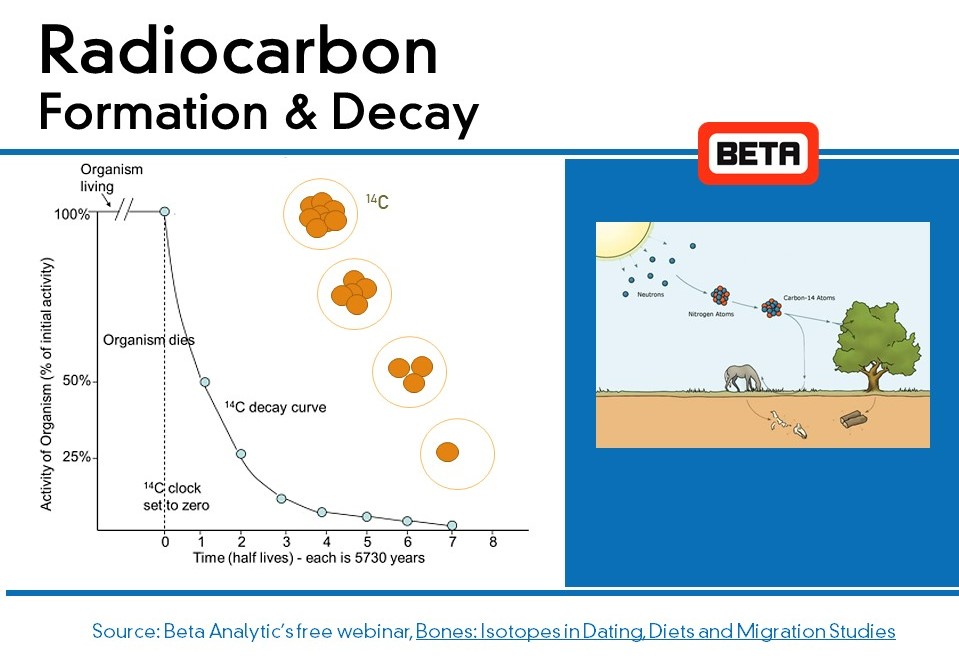
Radiocarbon (C-14) Dating
This method works on organic materials (like bone, wood, or charcoal). Living organisms constantly absorb carbon from the atmosphere, including a tiny, fixed proportion of the radioactive isotope Carbon-14. When an organism dies, it stops absorbing carbon, and the C-14 it contains begins to decay into Nitrogen-14 at a predictable rate. The half-life of C-14 is approximately 5,730 years, meaning that after this period, half of the original C-14 will have decayed. By measuring the remaining ratio of C-14 to stable carbon (C-12), scientists can calculate how long it has been since the organism died.
Thermoluminescence (TL) Dating
This technique is invaluable for dating inorganic materials that have been fired, most notably pottery. Minerals within the clay trap electrons from naturally occurring radiation in the soil over time. Think of it as a battery that slowly charges. When the clay is fired (e.g., in a kiln), the intense heat releases all the trapped electrons, essentially resetting the clock to zero. After firing, the material again begins to accumulate trapped electrons. In the lab, by reheating a sample and measuring the amount of light (luminescence) emitted as the electrons are released, scientists can determine how much time has passed since the object was last fired.

3. The Special Challenge: Dating Ancient Texts
While scientific methods are excellent for artifacts, our most important sources for philosophy are texts, which present a unique set of dating challenges. For a text like the Rigveda, which existed as an oral tradition for centuries before being written down, what does "dating" even mean? Are we dating its composition, its compilation, or the oldest surviving manuscript?
Historians use a combination of analytical techniques to tackle this problem.
Dating Ancient Literary Sources: Problems, Methods, Historical Challenges Explained
This article outlines the primary methods and significant difficulties historians face when attempting to date literary works from ancient India.
Please read the article, focusing on two main areas: Start with the table under "Techniques for Dating Ancient Literary Texts". It gives a good overview of the methods like linguistic analysis and historical references. Then, read the section on "Dating Ancient Literary Sources Major Problems", paying close attention to the challenges of oral tradition, multiple authors, and later interpolations. These are particularly relevant to the Vedic and Puranic literature we will be studying.
The key takeaways are:
- Linguistic Stratigraphy: Languages evolve. The Sanskrit of the Rigveda is measurably different from the Sanskrit of the later Upanishads or the even later Puranas. By tracing this linguistic evolution, we can establish a relative sequence for the texts.
- Internal Evidence: Texts sometimes mention datable events, rulers, or astronomical observations. A reference to a specific king known from inscriptions can help anchor a text in time.
- External Correlation: If a text describes a particular type of building or ritual practice, and archaeologists excavate a site with corresponding features that can be dated using C-14 or TL, we can establish a correlation.
- The Problem of Interpolation: Ancient Indian texts were often "living documents," with new sections added by later generations. This makes it incredibly difficult to date a text as a single entity; different parts may belong to different centuries.
4. Application and Controversy: The Case of Indian Chronology
Nowhere are these challenges more apparent than in the study of ancient India, where chronology is a field of intense debate. The methods we've discussed are not just theoretical; they are at the heart of arguments about the timeline of Indian civilization.
One of the most interesting forms of internal evidence is astronomical data. Ancient texts sometimes describe the positions of stars and constellations for ritual purposes. Due to the slow wobble of the Earth's axis, known as axial precession, these positions change over millennia. By using software to model the ancient sky, some researchers attempt to find the date that matches the textual description.
The following video discusses this approach in the context of dating the Puranas.
Puranas as History: Scientific Validation of Indian Civilization's Ancient Origins | Dr. Raj Vedam
This video from Sangam Talks, by Dr. Raj Vedam, presents a perspective on dating that challenges mainstream academic views by relying heavily on Puranic textual evidence, including astronomical data. It's a prime example of how different interpretations of sources lead to different chronologies.
Please watch the segment from this video which explains how the story of Dhruva in the Vishnu Purana is used to argue for a very ancient date for the text, based on the precession of the pole star. This is a concrete application of using astronomical data within a text for dating.
This astronomical method is powerful but also contentious, as it depends on the interpretation of poetic verses as precise astronomical observations. This leads us to the central controversy in Indian chronology: the conflict between the timeline derived from the Puranic king lists and the one constructed by modern historians, which is largely anchored by correlating Indian kings with figures mentioned in Greek sources.
The video goes on to highlight the core of this discrepancy.
Puranas as History: Scientific Validation of Indian Civilization's Ancient Origins | Dr. Raj Vedam
Continuing with the same video, we will now look at the direct conflict between different chronological models.
Please watch this segment from this clip. It contrasts the Puranic timeline, which places the Buddha around 1800 BCE, with the conventional timeline, which places Chandragupta Maurya around 300 BCE based on his identification with the "Sandrakottos" of Greek records. The speaker argues this identification created a massive distortion in the traditional timeline.
This debate over the "anchor point" of Indian history—whether it should be the Puranic start of the Kali Yuga (3102 BCE) or the Greek synchronism of Chandragupta Maurya—is fundamental. It results in two vastly different timelines for major events and figures, including the Buddha. As the video briefly mentions, recent archaeological dating at Lumbini (Buddha's birthplace) has yielded C-14 dates that some scholars argue are closer to the Puranic timeline, adding more fuel to the debate.
Conclusion
In this lesson, we have moved from identifying sources to organizing them in time. We've explored the foundational principles of chronology and seen that establishing a timeline is a complex act of synthesis and interpretation.
Here are the key takeaways:
- Relative Dating (Stratigraphy, Typology) establishes sequence (older/younger).
- Absolute Dating (Radiocarbon, Thermoluminescence) provides a calendar year range, based on predictable physical or chemical processes.
- All dating methods have limitations: C-14 only works for organic material up to ~50,000 years; TL requires fired material; dendrochronology is region-specific.
- Dating ancient texts is especially challenging due to oral transmission, lack of original manuscripts, and later interpolations. It relies on linguistic analysis and correlating internal evidence with external data.
- Ancient Indian chronology is a field of active debate, with significant discrepancies between traditional Puranic timelines and conventional academic models. The choice of chronological "anchor points" dramatically alters the historical narrative.
Understanding these methods and their inherent uncertainties is not a weakness; it is the hallmark of a critical and analytical approach to history. It allows us to see historical timelines not as immutable facts, but as the current best-fit models based on the available data—models that are constantly being tested and refined.
In our next lesson, we will apply this critical lens to one of the most significant and debated topics in early Indian history: the Aryan migration theory, where the dating of texts, artifacts, and linguistic changes is paramount.