Hello. In the previous lesson, the MPC chose Bank Rate by weighing evidence and forecasts, then voting. The next step is to identify what receives that rate directly. A balance your bank holds at the Bank of England and a balance you hold at your bank are both called deposits, but they are different claims on different institutions. Allow about 30–35 minutes for this lesson and its short resources.
Two kinds of deposit
Start with a brief distinction between central bank money and the money in everyday bank accounts.
Money creation in the modern economy - Quarterly Bulletin
Watch “Money creation in the modern economy” from the Bank of England for its concise distinction between reserves and customer deposits.
Watch the opening explanation. Focus on where commercial banks hold reserves, and where individuals and businesses hold their deposits. You can stop at 00:00:58; the later discussion of how loans create deposits is not needed for this lesson.
Suppose you have £100 in an account at a commercial bank. That balance is your deposit: the bank owes you £100 under the terms of your account. You do not have an account containing £100 of reserves at the Bank of England.
A commercial bank, meanwhile, may hold a balance in its own account at the Bank of England. That balance is called reserves. It is an asset of the commercial bank and a liability of the Bank of England. Eligible financial firms use reserves to settle payments between themselves.
| Balance | Account holder | Institution that owes the balance |
|---|---|---|
| Customer deposit | You | Your commercial bank |
| Reserves | An eligible financial firm | The Bank of England |
The Bank of England’s Market Operations Guide places these two balances in the wider monetary system.
Bank of England Market Operations Guide: Our objectives
Read the Bank of England’s explanation of reserves and their relationship to customer deposits. The key distinction is who holds each balance and at which institution.
Find “Using our balance sheet to support our mission”. Read the two paragraphs, beginning with “Our main liabilities” and ending with the sentence about “supporting financial stability”. Pay particular attention to the definition of reserves and the statement that they underpin deposits held by individuals and businesses at commercial banks.
“Underpin” does not mean that each pound in a customer’s account sits untouched as a matching pound of reserves. The two balances appear on different institutions’ books. Reserves matter, among other reasons, because banks can use them to settle obligations to other banks.
Which balance receives Bank Rate?
The MPC sets Bank Rate, but it does not pay that rate into every bank account. The Bank of England implements the decision primarily by paying interest at Bank Rate on reserve balances held with it by eligible financial firms.
Return to the guide for its direct statement of that rule.
Bank of England Market Operations Guide: Our objectives
Read how the MPC’s Bank Rate decision is applied to reserves, then note the guide’s brief distinction between that direct payment and its influence on other rates.
Under “Maintaining monetary stability”, find “We keep prices steady using Bank Rate”. In the paragraph beginning “The MPC’s monetary policy stance”, read the explanation through the following paragraph, ending at “households and businesses”. Focus first on the balances that receive Bank Rate directly; treat the discussion of wider interest rates as a preview.
If the Bank of England pays interest on a commercial bank’s eligible reserves, the commercial bank receives that interest. If your savings account pays interest, your commercial bank pays you according to its account terms. Those are separate payments, made by separate institutions. Your savings rate might change after an MPC decision, but it is not itself Bank Rate.
For a purely illustrative comparison, imagine Bank Rate were 4% and your savings account advertised 3%. The first figure would describe the rate applied to eligible reserves at the Bank of England; the second would describe the rate your bank offers on that customer account. Neither figure is a statement of today’s rates, and there is no rule requiring the two to be equal.
A bank’s reserve interest is also not automatically profit of the same amount. The bank has other assets, liabilities and costs, including whatever it owes its depositors. We will examine its reasons for changing—or not changing—customer rates later in the course.
A payment makes the distinction visible
Consider a simplified transfer of £100 from your account at Bank A to someone’s account at Bank B. Bank A reduces the deposit it owes you; Bank B increases the deposit it owes the recipient. If this payment is settled between the banks in reserves, Bank A’s reserve balance at the Bank of England falls and Bank B’s rises.
Two changes have occurred, but they are not the same account moving from one holder to another. The customer deposit entries are on the commercial banks’ books. The reserve entries are on the Bank of England’s books. In practice, payment arrangements can offset multiple transfers, so a single payment need not produce an exactly matching, separately visible reserve movement. The example shows the roles of the balances rather than every detail of payment processing.
This distinction also explains why calling reserves “money set aside for customers” is misleading. Customers hold claims on their commercial banks, not personal reserve accounts. Reserves help banks settle with one another; they are not customer deposits relabelled.
Locating the first link in the rate chain
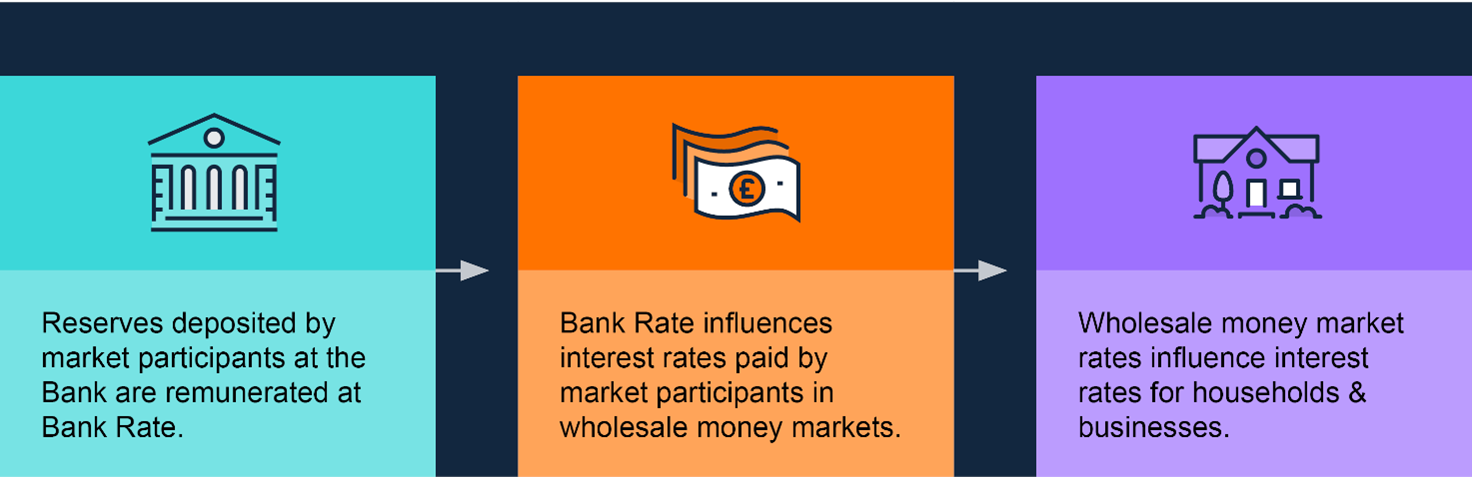
The first box is the direct application of Bank Rate studied here. The later boxes describe influence, not a promise that every rate will match Bank Rate or change by the same amount. Keeping that distinction in view will make the rest of the chain easier to follow.
Key takeaways
Your deposit is a claim on a commercial bank. Reserves are balances eligible financial firms hold at the Bank of England. The Bank of England pays Bank Rate on eligible reserve balances; a commercial bank decides what interest, if any, it pays on a customer deposit under that account’s terms. The two rates are connected indirectly, not identical by definition.
In the next lesson, you will follow the first indirect link: how interest on reserves helps anchor overnight sterling money-market rates without making those rates exactly equal to Bank Rate.